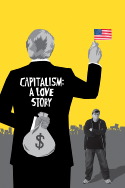
Review of Capitalism: A Love Story (2009) by Sergio Z — 26 Jun 2011
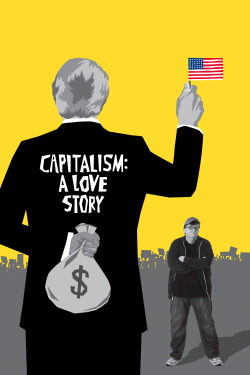
Capitalism: A Love Story is a perfect example of Michael Moore's provocative film making gone down the drain due to the simple error of early production. The documentary tries its best to pull out information about the financial crisis, and points the finger at the United States government and businesses just as much as in any other Moore film. The issue is simply the fact that Moore went into this much too quickly. The film lacks content, and thus all the finger-pointing becomes incredibly redundant.
The film was released shortly after the worst of the crisis had passed and the economy was in recovery, but that was not nearly enough time for Moore to measure the true impact that this crisis had on its people and what governmental and/or business representatives were corrupt in this conflict. The information is thin to say the least. Sure, it packs a punch like most Michael Moore films, but there isn't the human touch or the emotional apathy that is felt in Bowling For Columbine. Moore tries to add an emotional touch to the film with interviews and stories of loss, but the larger scale impact is missing, and moreover, Moore never really manages to point the finger at anyone. Overall, the film feels dumbed down, because nothing ever happens in essence. You never get the feeling that Moore is actually achieving anything with his film.
Moore throws us facts and economic techno-babble, but it doesn't enlighten the audience considerably. On the contrary, the film no longer comes across as a documentary aimed at criticizing the government, but as a propaganda film intended to brainwash its viewer into hating the government. Its disappointing because the potential of Moore's film comes across clearly, but his skill is filtered out due to the early production. Moore did not conduct enough thorough research, nor did he give it enough time to consider future implications. I watched the film thinking that Moore must have thought "oh something went wrong, I better make a film before anyone else does", which from a commercial standpoint isn't a bad idea (after all, the film was nominated for an Oscar that year).
Too little is thoroughly explained, and Moore makes a clear point about corruption and lack of fair-play with businesses that cost thousands of Americans their homes and jobs, but he never manages to truly pin-point who's fault it is. Moore takes the audience by the hand and dictates whats bad, whats good and whats confusing, but he never clearly outlines as to why. Over time, Moore achieves to shine that negative light that's trademark in his documentaries with his bitter sarcasm, but an audience member would be hard-pressed to explain why Moore convinced him or herself about the "unfair" and "corrupt" in the business world. The film never shows any big events, in fact, the few things that we see are small scale factory shut downs and stories that we have all heard hundreds of times during the crisis. Moore fails to bring any juicy new material to the table, and thus suffers from lack of relevant data for a feature length documentary.
Moore's film required more preparation. The film came out in the right time, but its information was far too narrow to be a convincing effort. Moore undoubtedly gained some more attention with an Oscar nomination - something he didn't deserve and only received due to the few documentaries that are released in a year's time - and thus succeeded in some aspects. It's a disappointment that the film didn't do a better job at convincing its audience, and this is something that comes across the most when its the editing that seems to be what influences the audiences opinion, and not the data that is presented.
In the end, it's understandable why Inside Job won the Oscar a few years later, because Charles Ferguson managed to deliver and interesting, and far more revealing documentary about the financial crisis. Moore still packs his human punch, but for such a large scale disaster, with so many stakeholders, Moore requires more information than just emotional stories and human hardships in the United States of America. An unfortunately overrated and poorly prepared film, that should have deserved much more attention to data, and less focus on small scale events.
This review of Capitalism: A Love Story (2009) was written by Sergio Z on 26 Jun 2011.
Capitalism: A Love Story has generally received positive reviews.
Was this review helpful?