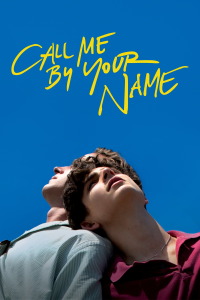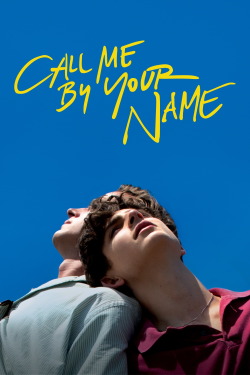
Review of Call Me by Your Name (2017) by Kevin F — 26 Apr 2018
Beyond the waters of the first love.
Who would dare to refute that this universal feeling doesn't dwell in the soul and mind of every thinking being? In any of its variables or possible presentations, it's used as a verb and predicate from the genesis of life, therefore, it has been adapted and represented by a subject in infinite ways which take the name: art. Here is a question: what type of art doesn't contain love for reality, for fiction, for the utopian? Painting to reflect the beauty of nature, sculpture to symbolize the tidiness of bodies, music to interpret the power of sounds, dance to praise the synchronicity of moves, writing to digest the fantasies of humanity. Likewise, the seventh art, the one that appeals to each and every one of these above, has also had the opportunity to join the party. Films, an imitation of reality, have opened doors to stories of any kind, working with the three-key-components requirement (setup, confrontation, and resolution) which are motivated vehemently by love for audiovisual production and life. Fables invented by humans, about humans and for humans. What we do bind us as a society, creates a spirit of community, we all survive at the expense of others, and those others of others, it's a cyclical chain that unifies us and we don't realize, we will, when relentless materialism and selfishness edge love out. Some ambitious films have wanted to reflect this. However, other films, even more ambitious, decided to have a quick dip in habitual paths, but posing poignant, real own visions about relationships, unimaginable in the hopeless' eyes. Such is the case of intimist filmmaker Luca Guadagnino and his latest film premiered at the Sundance Film Festival last year, a story that breathes desire, but also discomfort.
Adapting one of the most emblematic books written by Andre Aciman, the story invites us to the hottest days of the summer of 1983 in northern Italy, stifling daytimes on which Elio, an American boy marveled by music and its history, moves lazily transcribing scores and flirting with some girls. However, his monotonous holiday will take a twist by an unexpected visit, that, without wondering, would fill with color, pleasure and pain the life of the young boy. It's Oliver, a highbrow student who in pursuit of his doctorate, is staying in Perlman's summer mansion in order to be an intern tasked with helping Elio's father, a professor specializing in Greco-Roman culture. And as days pass by, the friendship of the two young people will be strengthened without control, living not only a good time of leisure, but also the awakening of sexual maturation, destiny acceptance and identity formation, events that affect the cyclical but special lives of each character, especially, the protagonists of this transformative journey.
There are awful, bad, regular, admissible, good and excellent adapted screenplays. This belongs to that last lucky category. Adapting Aciman's words is not easy, I would say that it would be an unfilmable material, and not precisely in visual terms, it's actually the narrative and emotional weight that requires a reliable adaptation. "Eight White Nights" American writer has shown a particular delicacy describing the situations on paper, uses language and technique in a compact and naturally functional way, his narrations seem to breathe life in images, in real images. That's why James Ivory's screenplay deserves gold recognition, because, with the duty to be up to the vision of the author, the level of demand was considerably further, however, there was no risk whatsoever here. Based on a customary but effective mold, the plot has a traditional structure until the third act, because the resolution seems to get us back, emerging more problems, knowing such difficulties are mere vehicles used by the author to represent an irrefutable truth: real life isn't a fairy tale and will never be; at least, it was for half an hour. There are several tools implanted in the script that demonstrate a radical change to the romance genre, because, just like "The Big Sick" did, exposes the flourishing of a relationship in a tangible truth, I.E., around a panorama in which any of the viewers would live, unfriendly neighbors, relentless destinies, disappointments transformed into hope. It often ends in a "realistic" way, but we don't get ahead of it, and let's return to the beginning. Elio's tale is simple, not flat, he's a boy like any other, resigned to the emotions and warmth of the heat wave in his parents' holiday home; reading, playing, taking baths in the icy river and pedaling through the emblematic Mediterranean alleys. The touching and formally important thing about this character arrives when Oliver pops up in the place because he's the one who sets off the deep journey that the protagonist and the spectator will undertake. From the first scenes, this young man connects with the audience by means of his simplicity, candor and austerity, he's a teenager who simply lives music throughout summer, and then possibly the other, and the other, and so the same way until he typecast in the group of people who lives the moment and dies as a response to fate. Oliver is the key to a necessary abyss, because not only mean the awakening of a new sexual dimension, but also the awakening of maturation, acceptance, pain; love isn't always pure happiness. And we see that Eliot's life is rebuilt every time he is in Oliver's company in an ordinary, but beautiful way, he portrays what many young people may be experiencing now. Ivory didn't be seduced by sexual superficiality or bland approach on sodomy, he cuts out from the book the necessary stuff to conceive each line with patience, slowly but with a dynamic pace that achieves that the spectator, independently its gender or sexual identity, is reflected in the mortal desires of this pair of characters, makes us complicit in a thorny spiral that ends in a concerted fantastic point. There is no complete catharsis for Eliot because the movie doesn't represent a purgative experience for anyone, what the film aims to show is the vulnerability of feelings, regardless of race, color or flavor; we are indelible in the face of danger, we can always be hunters but also preys. As far as Oliver is concerned, from a distant and quite objective perspective, many would identify him as a supporting character, and although in part he is, the writer knows very well how to endow argumentative importance the limited cast, so he doesn't feel like a mere addition, as a tool, is someone vital to the story, someone who equally experiences not only sexual but emotional discoveries, is a three-dimensional invention that wants to have a "summer love", even so, if his life breaks apart. In the end, many people may think that Oliver got a happy ending, however, before a more acute and committed perspective, it was fully concluded that he is not, they will understand if they analyze in depth the telephone talk scene, it's not joy or simplicity what we notice in their voices, which have changed fully.
Separate mention must be made of certain scenes that borders on the memorable. The pictures get a solid position in the story, thus, the conception and the approach of those moments play a vital role in different but powerful ways. From vitality-radiating lines to power-expelling dialogues, each moment builds one more pillar in the plot, no matter how insignificant may seem - there's a lot for the ordinary spectator surely, - they keep an intrinsic meaning correlated with the characters. I have selected just one and not randomly, this is starring Eliot and one peach. But, what does a peach turn into something so disruptive and disturbing, as Oliver would have said: (its scientific name, Prunus persica, literally means "Persian plum", as it is closely related to the plum)? Enough. Those who have seen the film will immediately understand what I'm talking about and although it seems that this scene simply finds its raison d'être in the mania to disturb the audience, it's not, rather, its meaning expresses the doubts and experiments passing through his mind due to the moment in which he is, this scene insinuates Elio's final elections. It's a scene that, free from morbidness or stupefaction that it causes, has become lodged in my head, and not only my head, it 's curious to write in my browser "peach" and run into content related to the film. Interestingly, not all the best situations have to do with intrepid sexual stuff, because although in this field slides quite well, are those in which the reality spits us in the face, in which we see ourselves reflected our past or our present. Without a doubt, an intimate and very important achievement for adapted-screenplay stories.
The performances are, beforehand, a foretold delight. Timothée Chalamet is off the charts as Eliot, the sincerity and fidelity that this young actor- who participates in two of the films nominated in the Academy Awards this year -imbues into the extracted-from-the-book character are overwhelming, establishing himself as the promising young of the moment, since with that final scene he ratifies a commendable tour de force. There is no doubt that the film wouldn't be the same without his simplicity and natural charisma, what is more, it'd be nothing because Chalamet is the whole film, his interpretation steals all the attention, even the praises that were directed towards enormous - figurative and literally - Armie Hammer. Over the years, we have seen that Hammer, a great Californian actor, has been able to balance the roles he signs up for, that is to say, has not been categorically opted for indie leads, therefore, taking part from Guy Ritchie's hyperactive stories to Boots Riley's narrative ferocity. It seems that the actor has taken on a big challenge with Oliver, one that means transmute himself internally with sensitivity and moral complexity. Hammer could catch much more attention if his character wasn't tied to the actions of the protagonist, however, with the great work done, in the same way you can notice an intoxicating and even captivating determination. Without hesitation, the chemistry between these two actors is mind-boggling and really unexpected, absolutely neither one of the scenes in which they shares screen feels synthetic, ridiculous or unnatural, nor those in which eroticism takes precedence, each part is propelled by the commitment and talent of these passionate actors, who, without necessarily being homosexual, builds a beautiful and intimate portrait about what love means, getting above barriers or stigmas. It's worth mentioning the fascinating work of the protagonist's parents, Amira Casar and Michael Stuhlbarg, especially the father's due to his tearful monologue, brimming with understanding and power, he expresses and encloses unusual skills.
Another fundamental cornerstone, truly fundamental is called Luca Guadagnino. We know that the Sicilian filmmaker is prone to tales of love, words like 'frivolous' or 'plastic' will never be used as adjectives to describe his stories. Not for nothing, the filmmaker was seduced by the potential that Aciman's work had, it was a great opportunity and more than a commitment to his work, was gladness and a debt to his homeland, a promise residing in it. The man who always worked with fabulous Tilda Swinton as his muse on movies as "A Bigger Splash" or "I Am Love" - oddly she doesn't collaborate in any way this time, - is the one who refocused and erected what film-adaptation "Call Me by Your Name " is today, he gets to align drama and comedy so organic that we almost forget the two-hour-and-twelve-minute runtime, The perception of time is absent thanks to the human and effective immersion that the filmmaker offers us to experience from the initial credits, those where the names of the surprisingly few involved are drawn on photographs of Greek and Roman sculptures to the sound of vibrating pieces. The filmmaker's sensibility and inscrutability make the film an irreplaceable, pessimistic and wonderful, deep and amusing, reflective and peculiar time; the best film of the director and genre in recent years, no doubt about it.
The naturalism and spectacularity of the pictures are predominant in the movie, the pride of the director is evident when filming in his mother country, because he goes into raptures leaving the camera in a static position even after the characters are no longer in front of it. The screen teems with Italian culture colors, the yellows from summer or clover greens from the natural landscapes are perceived and enjoyed thanks to the fine and communicative talent of Thai cinematographer Sayombhu Mukdeeprom and the entire art and production department led by Roberta Federico. Adopting as a rule the use of a single pair of specific lenses, mostly for the most beautiful dreamscapes in the country, the creative team weaves a visually intrepid and artistically unique look, because apart from making known an already-classical culture unintentionally, it delivers images that express more than words, namely, inserting tacit messages, forcing the viewer to codify and appreciate them. Visually, it's not an easy film, far less exhaustive, the true beauty is in the lack of artificiality, everything is emphatically vivacious, coherent with the beauty of the writing, proposing angles and constant soft focuses to set in the focal spot it needs, a skillfully functional strategy; likewise, it represents that intimate and relaxed aura of the book, altering minimally the contents from this one, portraying the story and its purposes with incomparable knack, a slap for "Fifty Shades of Grey", although, there is no comparison.
The soundtrack is also very well developed, with the anomaly of having two completely rewardable original songs. Every year, I've coincided with the winner of the BOS in the Academy Awards, because without thinking, I end up listening to the memorable song from the winner film on and on again. Last year, 'City of Stars' or 'Audition' from "La La Land" become my addiction, now, something strange happens because although "Mystery of Love" by Sufjan Stevens is nominated alongside great contenders from Disney, Netflix, and other indie studios, I feel and I think that either "Remember Me" from "Coco" or this fabulous song should take home a little golden man. Both transmit vulnerability and power on par, sadness and happiness on par, these two melodies have such a clear meaning in the scene they are placed, everything shines in a majestic way. One of the most beautiful, intimate and special compositions of the year.
Personally, "Call Me by Your Name" could be the "Brokeback Mountain" for a new generation and not for its realistic approach to the portrait of virility or the importance of any person's feelings, but by the vastness of messages (truths) that a simply deep story can say, a change, that's what it wants.
"Call Me by Your Name" by Luca Guadagnino invigorates again homosexual-love stories in cinema by means of a staggering coming-of-age, led by a terrifying interpretation of Timothée Chalamet and a shrewd and very personal eye of a director who fortifies his filmography, while it's one of the most faithful and emotionally charged film adaptations of the last century, proving that even if you have a pre-established foundation, originality, passion and creativity in the artistic field are vital for a motion picture which reaches a whole new level of emotional power, here, an example. Getting rid of taboos, this film is one of the most human, magnetic and heartfelt movies about teenagers and love I have seen in my short life, one that leaves opportunities for more bold and talented writers, actors, directors or any kind of artists to raise their hands and say: Here I am and this is my story.
This review of Call Me by Your Name (2017) was written by Kevin F on 26 Apr 2018.
Call Me by Your Name has generally received very positive reviews.
Was this review helpful?