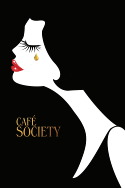
Review of Café Society (2016) by Jack G — 22 Jul 2016
It's a given by this point but after how many dozens of Woody Allen films there is a relative tier system, the 'major' and 'minor' works by a man who has written/directed so many that some almost argue are too many in number. In this sliding scale, Cafe Society is... a very good minor work. It's not necessarily very 'major', or is it particularly underrated in the scope of the critics - it carries a 75% rating on RT which is significantly higher than last year's actually underrated Irrational Man - but within the sandbox that he works in, he does what he does and it's funny and light and even just a touch affecting. Not to 'Manhattan' levels surely, but close.
It's a story of Hollywood and (in some smaller part) gangsters, glamour and romance, and the romance part is given the most attention as this is basically a light romantic comedy with some more thoughtful elements. Nothing is especially dark here in the story of Bobby Dorfman (Eisenberg, who seems like he was specially created from Woody Allen Chia-Pet seeds in a lab to be the Woody-esque lead in a Woody Allen movie), who comes to Hollywood in the 'Golden' age of the 30's to get work from his uncle Phil (Carrell), and meets his secretary Vonnie (Kristen Stewart, making it the third time this screen couple's together so their chemistry is perfect).
It becomes kind of a love triangle of course - the perennial story of the "Friend Zone" done in Woody's approach as Vonnie is really with Phil and Bobby being in love with Vonnie and her being love with him AND Phil and when will uncle and nephew know what the other has (maybe with a touch of The Apartment too, for good measure, though I may just be reading into it that way) - and set in the backdrop of 30's period Hollywood and 30's period New York; in the sub-plot, as much as it is (which is kind of, well, light) Corey Stoll is Eisenberg's brother, a gangster who rises to power as a tough guy and gets one of those nightclubs that we always think of from the movies, especially in the 1930's and in other period settings. But this isn't so much a Midnight in Paris scenario where the famous figures appearing is part of the running gag (there are plenty of names dropped, more to set us in here and give raging movie geeks something to go 'yeah, ooh, ahh'), nor is it quite Bullets Over Broadway, where the gangster setting really added to the story.
There are some things about Stoll's character that do come into play in the film, especially in the third act, but he's relegated to the "B" plotline which is a shame since Stoll is so wonderful in the role and does as much as he can with it (noticeable wig and all). The movie really belongs to Eisenberg and Stewart and Carrell (and later Blake Lively has a small role that works enough as it can), and it is what it is: a story of love being confused around all the sides, and then when a decision is made and third act kicks into gear the 'what if' of it all between Bobby and Vonnie becomes more of the focus. I liked that part of it, what is not said being shown with these two young people who do love each other and like each other's energy but, of course, the world as it is and what Hollywood and New York and respective other lovers have to offer gets in the way. Or the old "the heart wants what it wants" logic of other Allen movies coming back around.
So it it terribly original? No. But I found myself laughing through chunks of it - not through all, but enough - and some of it through jokes about Judaism which I thought by now I would have had enough of through nearly 50 years of Woody flicks. He still has great lines and sharp wit, and by now, in his 80th year, there is a slightly more mature look at what relationships have to offer for people or what people settle for, and it's regardless of period or not. Adding to all of this is the technical side of Vittorio Storaro, the master Italian cinematographer behind many of Bertolucci's and Beatty's directed films and Apocalypse Now, who a) gets Woody to shoot digitally and... it works, especially for scenes meant for very low light by candle or other means, and b) gets the camera to move, often, and this is a nice change from some (not all) films by this director which can be static and with long takes. The movement's refreshing and aside from that all of the locations and the whole nightclub and different places in Hollywood are gorgeous... which is all part of the point, isn't it?
It's a movie that could be comfortable back in the 30s, maybe with Lubitsch writing/directing (again, Wilder connection comes through), and Woody's got a top shelf cast to work with. If only there was more time for Stoll and his story, thrown in more-so as a slight, running gag and to have excuses for 'gangster' moments like throwing people into holes to cover up with cement and things like that, maybe it would be even more complete. So it's not any huge "Return to Form", though by this point what form would this filmmaker have to return to? He makes what he makes and we can either take em or leave em. I take this one mostly happily, with a few reservations.
This review of Café Society (2016) was written by Jack G on 22 Jul 2016.
Café Society has generally received positive reviews.
Was this review helpful?