Review of Caché (2005) by Everett J — 03 Apr 2008
[i]Cache.
[/i]dir. Michael Haneke.
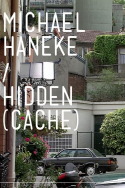
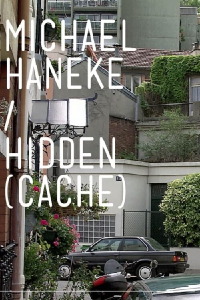
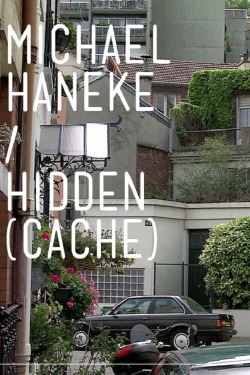
Deception, cruelty and guilt are explored in this taut, exquisitely filmed psychological drama. Georges Laurent (Daniel Auteuil) is a successful host of a book-related television program. His wife Anne (Juliette Binoche) works as publishing firm. They have a son named Pierre (Daniel Duval). They are the typical upper middle-class family, working exceedingly hard, and not having a tremendous amount of free time to be particuarly intimate with one another. Indeed, there is a coldness that exists primarily between the husband and the wife and this is accentuated when a series of videotapes are left on their doorstep. The tapes at first merely show the Laurent's house; they go to work, arrive home, and other banalities. However, these tapes begin to be accompanied by drawings that appear to come from the hand of a child. Also, one tape shows Georges's childhood home and this prompts him to track down a man named Majid (Maurice Bénichou) whose parent's used to work for Georges's parents. After tragic circumstances in which Majid's parent's were killed, Georges's parents decided to adopt him. This new arrangement angered the six year old Georges and he concocted an elaborate lie that resulted in Majid being removed from the home and sent to an orphanage. The film doesn't explicitly say that Majid sent the tapes but a tape arrives at the Laurent home showing the meeting between Georges and Majid. A secret camera had filmed the meeting as well as a section where Majid breaks down. It also isn't clear if he is aware that he is being filmed. Later, after Pierre goes missing, the Laurent's head over to Majid's apartment and meet his son (Walid Akfir) who is presented as a potential distributor of the tapes.
The camera remains static for much of the film and allows the viewer the opportunity to meditate on various scenes without being tricked through various editorial techniques that tend to articulate a specific directorial intention. Haneke eschews such techniques in these scenes and there is nothing for the viewer to do but cement these images in their minds. This film deals with raw footage of filmed reality, which it often presents as part of the narrative structure. It isn't until the film rewinds the footage or a shot of the Laurent's manipulating the filmed images is shown that the audience realizes the characters are viewing one of the tapes that has been mysteriously brought to their address. The viewer is taken aback by this jarring effect because it takes us out of the integrity of the shot. We are made aware that we are watching an external element that is deliberately altering the images we are being shown. The film suggests that Anne may be having an affair with Pierrot Laurent (Lester Makedonsky), after a scene shows him affectionately touching her hand. Later, Pierre accuses her of so much and she naturally denies any involvement with Pierrot.
The core aspect of this film is the way small lies sometimes grow into monsters over the course of time. Majid is depicted as a man whose life has been exceedingly difficult and his son puts the blame for this squarely on Georges's shoulders. After Majid invites Georges to his apartment and tells him he merely wants him to be present. He brings out a razor and slashes his throat, forcing Georges to witness the physical embodiment off all the residual guilt he has carried with him from treating Majid so unfairly. Before Majid's death, Georges has a dream in which Majid is shown cutting the neck of a rooster which flops helplessly in the dirt. Then he comes at the camera with his cleaver, ostensibly to butcher Georges. Georges is also burdened by the lies he repeatedly tells Anne in order to retain the integrity of his secrecy. Gradually, this causes friction between the couple and their marriage begins to fracture.
Overall, this film poses many more questions than it answers. The ending can be read in several ways depending on the observational skills of the viewer. Haneke deliberately leaves the story open and steadfastly refuses to offer much insight into any aspect of the story as it is. The performances are all quite good in that the actors are able to embody fleshed out characters replete with complicated emotions and various techniques for disguising various aspects of their personalities from one another. Auteuil remains a mystery throughout the film and decidedly refuses to give anything away that might allow for an insight into the nature of his character. It's a struggle to come to terms with Georges because he is mostly closed off although there is a scene where he breaks down after Pierre has seemingly disappeared. Binoche is a bit easier to decipher because the character is more varied emotionally and she is subject to fits of anger, frustration, and fear. Ultimately, the breakdown in the marriage is seen as a product of mistrust and outright treachery however slight it might appear on the surface. Nuances and intricately woven pathways of deceit are displayed here and deliberately left vague and barely perceptible at first glance. A little game erupts into a psychological tug-of-war between two characters who might not have known each other very well at all before these calamitous events start to befall them.
This review of Caché (2005) was written by Everett J on 03 Apr 2008.
Caché has generally received positive reviews.
Was this review helpful?