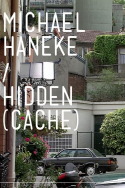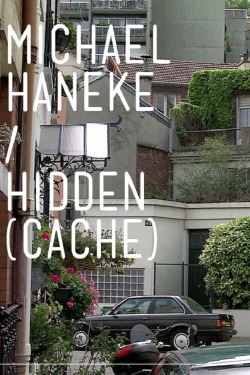
Review of Caché (2005) by Tim M — 23 Aug 2010
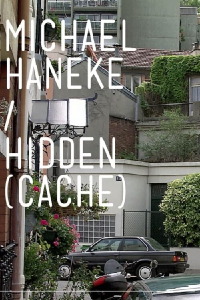
"Caché" has no ending, because the story it tells has been neither officially recognized nor resolved. France has still not formally acknowledged the casualties of October 17th 1961. Georges Laurent, a TV literary journalist, receives videotapes of the exterior of his home along with pictures of a bloodied boy and a bloodied rooster.
Georges imagines the tapes are sent to him by an Algerian man, Majid, who grew up with him. Majid's parents worked on his family estate but were killed in the repression of the Paris October riots in 1961.
Georges' parents planned to adopt Majid, but Georges convinced them to send him to an orphanage instead. Georges' adult rationalisation of his act and thus avoidance of responsibility are initially understandable: his was the immature reaction of a 6 year old, who ruined the life of an immigrant boy rather than share the affections of his parents.
He was a child, the act was committed at an age when moral accountability does not apply (now, had he been 7...) and the memory of the lies he told at the time has been repressed. France's involvement with Algeria is not unlike the Laurent family with Majid, a boy intended for adoption but subsequently abandoned.
Time has passed, those responsible have... well... not passed (Maurice Papon at the time of the film's making was still very much alive--he died in February 2007), but France considers herself matured, and that bygones must be bygones.
Yet the guilt haunts Georges somehow, and, as the typical self-involved Frenchman that he is, he feels only the plight of his personal condition and subsequently hunts his own victim down (a victim he's decidedly turned into his tormentor) and blindly lets a non-confrontational situation with Majid escalate rather than offer something of an acknowledgment, a genuine compensation or an apology.
Now, after any sinister chapter of History, in the convalescing period it may be decided that in order to recover and rebuild, one must forget, temporarily. This is reasonable. In 1962, the Evian Accords granted Algeria its independence from France.
In the 8 years leading up to 1962, the two countries were at war with one another. Stories such as October 17th had to be ignored for the acting parties to effectively move on with the peace negotiations.
But what happens when 40 years later, history repeats itself as a result of permanently denying the facts and thus perverting the lessons of our history? The following generations barely know what happened that day, and are certainly not willing to take the blame or shoulder any of the guilt for crimes committed by the Vth republic, while it was still "in its infancy".
But the guilt nevertheless haunts our collective memory.
This review of Caché (2005) was written by Tim M on 23 Aug 2010.
Caché has generally received positive reviews.
Was this review helpful?