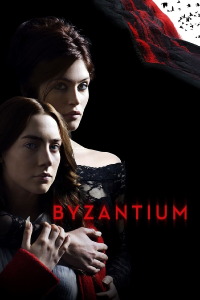
Review of Byzantium (2013) by Cynthia S — 16 Feb 2014
Neil Jordan's latest overlooked gem is a distinct take on gothic vampire lore and is yet the latest in a series of films that could be considered the first Golden Age of vampire cinema.
The film is a non-traditional take on the vampire legend, not unlike Guillermo del Toro's "Cronos." The female vampires in this story are "soucriants" vs. traditional vampires. As vampires, they are super simplified. There is not a bulky set of rules that force abrupt differences between human and vampire behavior in the course of the day. I am usually bothered by slackness of the sunlight rule, but these creatures are arguably a different kind than the standard. They need blood to live and are immortal, that's mostly it.
In my opinion, the best horror films are the ones that comment on issues of our everyday reality. Tomas Alfredson's "Let the Right One In" criticizes a whole raft of issues, including pedophilia and the welfare state. This story may be first to take on institutional misogyny and just sexism in general, framing it in an unconventional urban mother-daughter drama.
Playwright and screenwriter Moira Buffini uses the intemperance of vampirism to underscore the persistence of gender inequality in modern society. The two main characters, Saoirse Ronan's Ella and her mum, Gemma Arterton's Clara not only have to deal with the logistical challenges of feeding and not getting caught, but also fight off the deep misogyny of the vampire brotherhood, who want Ella and by extension, Clara, dead. The film's name recalls an ancient locale and state of mind, should sexism go the way of Constantinople's predecessor? I would say so.
In an interesting angle, vampirism saved these two females from being snuffed out by their time. The theme of prostitution and a lack of sexual agency are presented as unholy catalysts for vampirism, coming back to vampirism as a metaphor for intemperance. Intemperate treatment of people leads to perpetual intemperance both from the violators and the victims. Although I have trouble with the fact that Bella Swan felt like she needed to be turned to be worth a damn, I do find it interesting that acquiring vampirism freed these females from the sexual shackles and morbidity of their era. We know that the predators of the world aren't exclusively male, but many of them are and were in the time period they hail from. Though the reason she wanted to become a vampire was spurred by mistreatment by men, the fact that Clara actually sought it voluntarily instead of being raped/turned against her will, resembles relative agency.
The primary drawback of this story is that it is not very subtle in its commentary on gender-based prejudices from establishment societal structures. The use of prostitution is yes, a blunt decision, but is believable as a forcing factor. The vileness of the experience for the women is believable as a something that would drive someone to do the unthinkable, whatever that may be.
The vampires of this story display a sort of moral aspiration that exceeds the standard. The triumph of love over unreasonable ostracism and the targeted extermination of predators are interesting moral codes for vampires, a crowd who are typically amoral, or in other words, soulless. Is it because these vampires are female? It might be a stretch to imply gender causation, but let's just say their station allowed them to experience the short end of the stick. The world knows how hard it is to walk a mile in the shoes of your victim. Vampires with aspirations in the 90th percentile of nobility in their kind are rare in a story. Perhaps letting females into the vampire (or any) brethren might introduce some cool new perspectives on how to conduct business.
Another theme touched upon is executive parental action in assessing the lesser of two evils. Performing a sin on your child to prevent involuntary physical suffering and an early demise at the price of a potential eternity of emotional malaise is a hard call for anyone to make. The parent has to make the call as to which is more mutable, i.e., you can change the way you think, but once your health is stolen, you're gone. Clara turned Ella both because Arterton didn't want to live an eternity alone and because Ella was on a track to get sucked up into the sex work business and an early death. Clara's maternal love for Ella is one of the driving forces in this story and boy, is it a powerful one.
Did I mention that it's also a fun, sexy vampire film with solid acting and craft? Saoirse Ronan conveys the circumspect ethereality of her character Ella with certainty. Ella's fatigue and emotional dissonance stemming from immortality would make her a good conversational friend for Eli of "Let the Right One In." Some moments of this film felt like backstory for "Let the Right One In." Gemma Arterton was saucy as the mom and managed the sexual/violent, protective mother balance very well. Strawberry Fields? Perhaps there's a little more to her than that.
Director Neil Jordan is extraordinarily efficient, squeezing a trans-era epic into a two hour film. He has done this once before, with "Interview with the Vampire." As a spiritual and thematic successor to "Interview with the Vampire," it is nearly as sweeping and contains a vampire duo that fit the voracious/sexual and angsty/circumspect archetypes that were present in Lestat and Louis. It also contains fitting cinematographyby Sean Bobbitt ("12 Years a Slave") and score by Javier Navarrette ("Pan's Labyrinth"). You can't take an artist with his level of craft for granted.
It joins Alfredson's "Let the Right One In," Reeves' readaptation "Let Me In, " and Park's "Thirst" as both one of the best recent vampire films released and as one of my favorite vampire films of all time. Like the most satisfying treasures, this work was hiding in plain sight. Even if it is a bit direct, this ignored film is a sweeping and passionately made vampire drama that presents a topical anti-sexism and pro-love narrative with key ingredients of blood and passion. (12 February 2014).
This review of Byzantium (2013) was written by Cynthia S on 16 Feb 2014.
Byzantium has generally received positive reviews.
Was this review helpful?