Review of By the Grace of God (2019) by Bertaut1 — 14 Nov 2019
A well-made film about dignity in the face of hypocrisy.
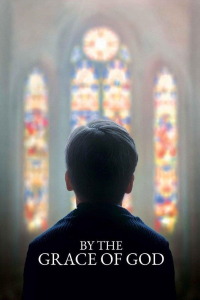
Written and directed by François Ozon and originally planned as a documentary, Grâce à Dieu (By the Grace of God) is a partly-fictionalised account of the case of Fr. Bernard Preynat. Probably Ozon's most formally conventional work, with none of his usual visual panache, the film was modelled after Tom McCarthy's exceptional Spotlight (2015), an important comparison insofar as it speaks to Ozon's lack of formal gymnastics; in short, the conventional style is matched to the thematic seriousness, which depicts the Church as an institution that talks a lot about forgiveness and redemption, but seems to have very little understanding of justice or punishment.
The film begins in 2014 as Alexandre Guérin (Melvil Poupaud) discovers that Fr. Bernard Preynat (Bernard Verley), the priest who he believed to have been defrocked for sexually abusing him, is not only still a priest, but is still working with children. He contacts the Archbishop of Lyon, Cardinal Philippe Barbarin (François Marthouret), but the Church won't take the matter much further, citing the 20-year statute of limitations. Alexandre, who has raised his five children in the faith, feels compelled to act, and reluctantly takes his story to the press. He's soon contacted by François Debord (Denis Ménochet), another victim of Preynat. Now an atheist, the more militant François advises marshalling the power of social media. Soon, they're joined by a third man, Emmanuel Thomassin (a heart-breaking turn by Swann Arlaud), whose entire adult life has been negatively affected by his childhood.
Although the film's central trio are fictional composites, the sequence of events is based on real-life, whilst both Preynat and Barbarin are very real, with Preynat (who has now been defrocked, with a criminal trial pending) believed to have molested up to 85 boys over a thirty 30-year period, most between the ages of 9 and 12. Rather than telling the stories of Alexandre, François, and Emmanuel concurrently, Ozon structures the film in the style of a relay, giving the narrative over to each in turn. Of course, there is overlap, and towards the end, Alexandre re-emerges as the protagonist, but this style allows for a slightly different story-telling technique for each man. Alexandre's act is largely epistolary, the stylistic formality of which captures his formal relationship with the Church. Once the more bullish and theatrical François takes over, the style becomes more confrontational. Then, in the third section, which focuses on the emotionally fragile Emmanuel, the film is at its most empathetic, with a stronger sense of humanism. In a film noticeable for its director's formal restraint, it's a well-handled and subtle way of matching form to content without necessarily foregrounding it. This structure also lends itself to exploring the psychological specificity of each man in a way that wouldn't have been possible via concurrent editing.
This is important because Ozon is interested in the mechanics of healing, with each man dealing with their experiences in different ways. Although Alexandre found strength in his faith, he's constantly on the defensive about how his actions are not intended as an attack against the Church, arguing "it's about justice, not revenge" and "I'm doing this for the church, not against it", as he points out that "families need to know the Church will always protect children". However, whereas Alexandre reaffirms his faith, François rejects his, arguing, "my faith is human, not Catholic hypocrisy". For Emmanuel, the process of healing seems barely to have begun, if it ever will. However, the film is unequivocal in asserting that for all three men, the trauma will never leave them, it's a part of who they are, not necessarily the main part, but a part nonetheless, a part with which they will always wrestle.
From a more critical standpoint, Ozon overuses the epistolary format in the first act, which often feels less like a coherent narrative held together by letters and more like a series of letters occasionally interrupted by "on-screen" events. The film also occasionally finds it difficult to escape its origins as a documentary, with some scenes, notwithstanding the superb acting, feeling more like respectful reconstructions rather than scenes in a narrative drama. The fact that the case is still ongoing also robs it of a natural structure, and one wonders if perhaps Ozon wouldn't have been better waiting until the conclusion of the criminal trial.
Less procedural than the investigative journalism-basis of Spotlight, Grâce à Dieu is no less honest or unsettling. It may be too controlled for some, whilst the measured pacing and hefty subject matter will undoubtedly put off others. Nevertheless, uncharacteristically solemn for Ozon, it is another important document on a subject that, sadly, seems unlikely to go away any time soon.
This review of By the Grace of God (2019) was written by Bertaut1 on 14 Nov 2019.
By the Grace of God has generally received positive reviews.
Was this review helpful?