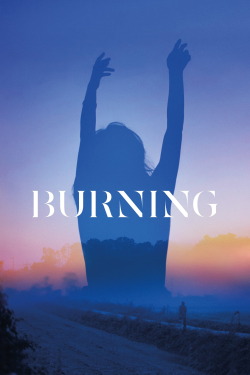
Review of Burning (2018) by Bertaut1 — 16 Feb 2019
A slow-burning mystery about economics, class, and sexual jealousy. And cats.
A thriller about a missing person. An allegory of class division. A fable about modern consumerism. A dramatisation of psychological breakdown. An analysis of socio-economic disenfranchisement. A critique of toxic masculinity and its concomitant misogyny. An extended rib on Schrodinger's cat. Beoning is all of these. And none of them. Essentially a psychological drama about three people, although it's possible that only one of those people is real. There are also two cats. Or maybe only one cat. For some, those more used to concrete black-and-white, yes-and-no narratives, the film's ambiguity will be off-putting. However, irrespective of that, director Lee Chang-dong's mastery of tone is extraordinary to witness, bestowing portentous significance upon the most inanimate of objects.
Adapted by Lee and Jungmi Oh from Haruki Murakami's 1983 short story "Barn Burning", which itself is loosely inspired by William Faulkner's 1939 short story, Beoning is set in contemporary South Korea, and tells the story of aspiring novelist Lee Jong-su (Ah-in Yoo), who by chance encounters Shin Hae-mi (Jong-seo Jun), who claims to have gone to school with him, although he doesn't remember. Beginning a tentative relationship, Jong-su is confused when Hae-mi returns from a trip to Africa with a new friend, the wealthy and confidant Ben (Steven Yeun). As the trio form a strange relationship, Ben tells Jong-su that he likes to burn down a greenhouse every few months. Shortly thereafter, Hae-mi disappears, and, suspecting Ben, Jong-su determines to find her. Thematically, the film covers a plethora of issues; toxic masculinity, alpha and beta males, economics and consumerism, class, the place of women in Korean society, sexual jealousy, working-class privations, faceless capitalism, writer's block, and gender politics. In relation to this last theme, one of the things that so captivates Jong-su about Hae-mi is her provocative behaviour. Yet later, when she dances topless outside his house, he is disgusted, telling Ben, "only a whore acts like that." It's a succinct summary of a societal double-standard. Whilst it could be argued that Hae-mi functions only to further Jong-su and Ben's arcs, devoid of any real agency herself, an alternative reading is that she is poorly sketched so as to represent a patriarchal society in which women are seen as less complex than men. However, there is also the possibility that she doesn't actually exist, and in this sense, the fact that she is so sexualised is because she is literally a male's fantasy, a sexual obsession born in the disturbed mind of an unreliable narrator. The film is told exclusively from Jong-su's perspective, everything we see is filtered through his ideological outlook. So, for example, when he sees Ben yawning as Hae-mi is dancing, the yawn becomes sinister, because that's how Jong-su interprets it. In this sense, if one theorises that Hae-mi is a figment of Jong-su's imagination, then so too must Ben, serving as the inverse to Hae-mi; a personification of everything to which Jong-su aspires, but is unable to attain.
One of the most salient motifs, if not necessarily a theme unto itself, is that of disappearance, with references scattered throughout the film - Hae-mi notes that her childhood home is gone, as is the well she fell into; Jong-su recollects how after his mother abandoned the family, his father burnt her clothes; when Ben tells Jong-su about his greenhouse hobby, he states, "you can make it disappear as if it never even existed"; Hae-mi says she wants to disappear; when Jong-su asks Ben if it's possible Hae-mi has gone on another trip, Ben says, "maybe she disappeared like a puff of smoke". The most important scene in this sense is one in which Hae-mi tells Jon-su that she's learning pantomime, and proceeds to mime peeling and eating a tangerine, telling Jong-su the trick isn't to pretend the tangerine is really there, but to "forget it doesn't exist". This challenge to perception is crucial not just in how Jong-su becomes convinced Hae-mi has met foul play despite the lack of evidence, it also provides a clue for the audience as to how best to parse the film itself.
All in all, I found Beoning to be a haunting film, one which I couldn't get out of head for days, and I'm keen to see it again. Some will dislike the ambiguity, but Lee's masterful control of tone is extraordinary, balancing a plethora of themes within a half-social-realist/half-magic-realist milieu. As good an exercise in cinematic suggestiveness as you're likely to see, the film is such that everything on screen, every word spoken, every background detail could be important. Or not. Fiercely intelligent, deeply nuanced, complexly layered, this is the finely crafted work of a distinct and relevant auteur.
This review of Burning (2018) was written by Bertaut1 on 16 Feb 2019.
Burning has generally received very positive reviews.
Was this review helpful?