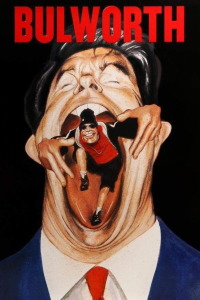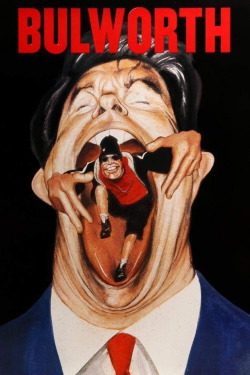
Review of Bulworth (1998) by Paul Z — 28 Jul 2010
What this satire on modern civic affairs boils down to is a politician who can no longer bring himself to repeat the phrase, "America is standing on the doorstep of a new millennium." More times than he could possibly count, he has repeated the same empty Pavlovian signals, the same hollow BS, the same crap. Now he sits in his office, playing one of his dumb TV commercials nonstop. He has not eaten or slept in three days. He is sick to the black heart of the American political process. Bulworth isn't just comprised of the candidate making caustic jabs like an anarchist Jackie Mason. There's enormous significance in much of the dialogue, written by Beatty with a credit to the commentaries of American culture by such as Noam Chomsky. Beatty takes aim at the fable about how government is spendthrift and industry is effective by holding that government runs Medicare for a quarter of the expense scooped away by insurance companies for same quality health care. However, why don't we have national health care like every other First World country? Insurance payoffs, Bulworth is just too elated to announce.
Warren Beatty's Bulworth makes me laugh, and cringe, and it does admirable work. It hits you that if all politicians were as forthright as Bulworth, the flimsy scaffolding of our system would crumble, and we would have to start all over again. Like its contemporaries Wag the Dog and Primary Colors, but much much more straightforwardly, the movie conveys that essentially everything expressed in public by a politician is spin. Spin control is only the term for spin they're called on. Bulworth is a former Kennedy liberal (like Beatty himself), an incumbent senator from California who is charged by an opponent as being "old liberal wine trying to pour himself into a new conservative bottle." The humor to Bulworth is that liberal and conservative, Democrat and Republican, are no longer monikers that signify much, an illusion that has become an ever-deepening divide in the two parties since this film's release: Nevertheless, when it comes to national health care, for instance, the insurance companies have had both parties at their beck and call.
Bulworth is done for. He loathes his job and his life, and has recently misspent millions in the market. So he submits a contract on his own life and flies back to California believing he has three days to live. His approaching demise invigorates him with a sensation of abandon: Finally he is liberated to say precisely what he thinks, and that's what he does. In a black church, he notes, "Half your kids are out of work and the other half are in jail. Do you see any Democrat doing anything about it? Certainly not me! So what're you gonna do, vote Republican? Come on! You're not gonna vote Republican! Let's call a spade a spade!" Bulworth's chief of staff, played in bleakly comic fashion by the great character actor Oliver Platt (oh where has he gone?), goes crazy and hits a fire alarm to end the church service. Though an hour later, in Beverly Hills, Beatty is offending a predominantly Jewish crowd of movie execs: "How much money do you guys really need?" he asks, saying that they produce "mostly crap." And so on. "That was good. Really good," he says. He likes political speechmaking for the first time. Tagging along with Bulworth through his transformation is a clique of sexy young black women, who cram into his limousine and guide him to an after-hours club, where he tries hip-hop and drugs. Constantly drifting closeby is a captivating woman named Nina, Halle Berry, who later takes him home to her neighborhood, where he watches grade-school kids selling crack and is given a dose of the reality of families where everybody has lost someone to violence.
The movie blasts in all directions. When Bulworth asks Nina where all the black leaders have gone, her response is as astute and persuasive as a year's plethora of editorials. Though when the movie depicts black culture as inevitably more genuine and honest than white, that's an excess impulse. The utility of blacks as hidden supplies of authenticity and honor is a tired cliché in white liberal soap-boxing. There is even an enigmatic old black man who trails Bulworth around, chanting abracadabra that, I think, is supposed to be cryptic worldly-wise maxims. It's better when Bulworth disregards political correctness and says what he believes, inconsiderate all the same, as when he suggests that the answer to racial hardships is for everybody to eff everybody else until we're all the same color.
Bulworth is not a perfect movie, nor could it be. It's a little uneven and takes too many chances. I don't believe the love plot between Bulworth and Nina. It's a reprocessing of the long burnt-out movie cliché that a man in a struggle for his life can invariably find time, in three days, to fall in love with a woman half his age. However that particular charge is miniscule in comparison to the effectiveness of the rest of the film. Beatty tarries very close to home, and in the tone of the film as well as its Clinton-era contemporaries like Wag the Dog and Primary Colors, it epitomizes political problems in the US that since their time have grown into much different, much uglier problems. Bulworth works like a scream of agitated comedic mania. It's about a sort of prototypical figure who appears more and more to signify the cyclical American condition: the guy who's mad as hell and isn't going to take it anymore. Interesting, how in the decades since we heard those words in Network, we've completely ignored why they were said.
This review of Bulworth (1998) was written by Paul Z on 28 Jul 2010.
Bulworth has generally received positive reviews.
Was this review helpful?