Review of Bully (2001) by Ian D — 15 Aug 2008
Love him or hate him, since exploding onto the American independent scene with the Harmony Korine scripted 'Kids' in 1995, Larry Clark has cemented himself as one of the most talked about directors of the last 20 years. 'Kids' was a film drenched in controversy; Clark offered a portrayal of American youth as never seen before, in all its violent and sexual graphic glory. This, in part, was the problem; whereas many filmmakers baulk at the prospect of showing what many deem the un-showable, Clark seizes the opportunity with both hands and delivers simple yet effective stories that shy away from nothing.
Of course, such an attitude comes with some fairly serious consequences. Due to his reoccurring interest in underage sex, rumours started circulating that Clark himself was a paedophile. Although quite obviously unjust and harmful, such stigma rarely detaches itself from an individual, especially one in the public eye. Some have even cited this as one of the reasons for Clark's relatively low filmic output over the years. Indeed, having ridden a wave of controversy for the majority of his career and accumulated a great deal of press because of it, Clark could have been one of the most prolific directors in America - as things stand, a Larry Clark film is about as rare as a Terrence Malick one. I am, as yet, undecided over whether I think this is a good thing or not.
Larry Clark started his artistic career as a photographer, during which period his work reflected many of the same themes that have become staple inclusions in his films. The youth of today, specifically skater-culture, sex and drug use are all prominent topics of observation whilst autobiographical elements permeate his book 'Teenage Lust' as well as his 2002 film, 'Ken Park'. Dealing with such issues at arm's length is one thing, but to implicate yourself directly in them is another thing entirely, suggesting that those people who think that Clark has balls don't even know the half of it. Stanley Kubrick, as most will know, also started his career as a photographer, an aspect of his past that has been made significant by those who praise his eye for framing in his later work as a film director. It is fair to say that Kubrick made infinitely more use of his photographic knowledge in applying it to his new medium; Clark has an eye for framing but he doesn't possess nearly the same amount of cinematographical prowess that Kubrick does. However, few do or have done in the past, so maybe I am making an unfair comparison.
Perhaps, though, the problem is ambition - Kubrick's camera often points at the breathtaking, the magnificent, making the unimaginable imaginable. Clark's on the other hand too often points at a teenage girl's breasts, stomach, thighs or ass - the difference being that Clark has only the desire to hold a mirror up to society, or at least show us society as he sees it whereas Kubrick consistently set his sights on bigger things. I suppose the question is: do you find what you are looking for in Clark's portrayal of teenage hedonism or do you need Kubrickian sized cinema to satisfy you?
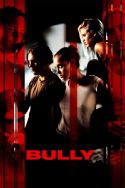
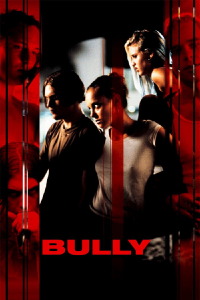
'Bully', Clark's third film, more or less carries on where 'Kids' left off in terms of theme. The plot is remarkably simple, like all good plots are. And as is the case with many good plots, it is based on a true story - the 1993 murder of Bobby Kent by his 'best friend' Marty Puccio (played by the late Brad Renfro) and a group of accomplices, most of whom have been affected by Bobby's indiscriminate harassment at some point. Bobby's character is not only the most interesting, but also the driving force of the film. He continually taunts and abuses those around him, his tortuous behaviour extending to rape and physical violence, but maintains a veneer of innocence whilst at home. Bobby seemingly lives duel lives, one before the watchful eye of his father who is strict and authoritarian and another whilst off the family radar in which he treats people how he sees fit.
Played with real loathsomeness by Nick Stahl (better known as the Yellow Bastard from 'Sin City'), Bobby really gets under your skin. He is a character that is driven by the unknown, perhaps a sense of adventurous youth gone wrong - I get the feeling that he often doesn't know that he is causing so much pain and anguish, he seems to be oblivious to it. There are suggestions that he is gay, or at least bi-curious, the obvious one being that he rapes a girl whilst forcing her to watch gay porn. Which ever way you look at him, there is always a great deal that is concealed and because of this he becomes intriguing.
The film unfolds with a slightly surrealistic feel. As with 2006's 'Brick' it transposes the lives and actions of children into an adult world, the result of which is often quite startling. As I watched and listened to the conversations of teenagers quite seriously discussing how to murder another person my mind kept wandering back to one fact; these people are just children. As with 'Brick', the characters of 'Bully' are not treated like adolescents as such, but the inescapable reality is that they are. This truth is revealed at the end of the film when the group responsible for Bobby's death come undone, realising that they are incapable of dealing with their actions. Up to this point however, the premeditated nature of their crime and the cavalier attitude with which they go about it really strikes a chord. Adding to this surrealistic feel is the character of Donny, played by a rather unhinged Michael Pitt, who seems unable to take anything seriously and perpetually high on some kind of drug. His character fits in well with the portrayal of youth that Clark has made his focus since 'Kids' and indeed could have slotted in effortlessly amongst the characters in Clark's debut feature.
Clark's photographical background is evident in the film; he seems content with showing things simply as they are whilst other directors may opt for more camera movement or a series of more complicated shots. In all honesty this is neither to the detriment nor to the benefit of the film itself as the narrative provides most, if not all, of the interest. As I previously noted however, Clark doesn't really do himself any favours by lingering on the adolescent form for as long as he does. We are introduced to the character of Donny much in the same way that we are to Telly in 'Kids', by watching him have sex. One shot of a character named Ali follows her as she walks up the path to a house whilst quite unnecessarily focusing on her barely covered ass. Although I don't think that such scenes and shots entirely spoil the film, I struggle to find a reason why they are required to present Clark's view of American youth. I would imagine that there are more effective ways to portray a generation going off the rails than to have all of the girls dress in revealing clothes - the very way in which the group go about planning their revenge is evidence enough of a lack of moral consciousness.
As with many American independent films that explore the darker side of life, 'Bully' isn't really what I'd call an enjoyable experience, but that isn't to say that it isn't a good watch. Although interesting in terms of being a character study as well as a true story (Clark's adapted screenplay is reasonably faithful to its source material) I can't help but think of it as 'Kids 2'. I cannot honestly say on the evidence of this film that Clark has a penchant for diversity, such is its similarity to his previous work in terms of theme and style. Of course not everyone will see this as a bad thing, especially those who champion 'Kids' as an 'important' independent film, but I can't help but think that someone who releases so few films should explore a variety of subjects. A 'Kids' and 'Bully' double bill might just reveal that lack of ambition that I talked about earlier...
In 2002, Clark was arrested for punching Hamish McAlpine (the head of 'Ken Park's UK distributor) in the face, breaking his nose. According to Clark, the incident was the result of an argument about the ongoing conflict in Israel and the Middle East. It seems then that Clark does have opinions and convictions about world affairs beyond what he has shown in his films thus far. I believe that Larry Clark does have a thing or two to say about the world, and I think that if he used cinema as a vessel for some of these convictions he would be able to move away from the stigma that has attached itself to him.
----------------------------------------------------.
Brad Renfro died from an accidental overdose on January 15th 2008 after a long-running addiction to heroin. Best known for his roles in 'The Client', 'Sleepers' and 'Apt Pupil', Renfro will be seen on the silver screen for the final time in next year's 'The Informers', a collection of short interlinking stories based on the first book by Bret Easton Ellis, author of cult classics 'American Psycho' and 'The Rules of Attraction'.
This review of Bully (2001) was written by Ian D on 15 Aug 2008.
Bully has generally received positive reviews.
Was this review helpful?