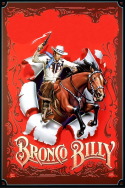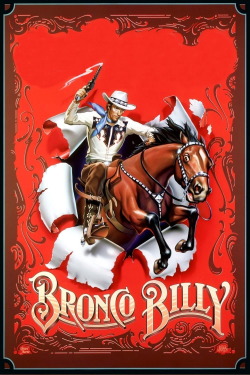
Review of Bronco Billy (1980) by Van R — 06 Mar 2010
"Bronco Billy" represents another example of Clint Eastwood's offbeat, non-traditional, cinematic endeavors. Primarily, this sentimental road show of sorts follows an anachronistic Wild West rodeo show on tour around the west and focuses on the problems that they encounter and resolve to keep the show going. This troupe of performers runs across an heiress on the lam that winds up hiding out with them until she learns that she has been reported murdered and may lose her fortune.
Shrewdly, Eastwood explores another facet of his own iconic western persona in a low-budget but endearing version of Henry Hathaway's "Circus World" (1964) with John Wayne. "Bronco Billy" and "Circus World" deal with the problems of holding together a modern-day western circus show. Both movies feature a catastrophic tent fire and the protagonists are constantly tangling with problems. Chiefly, however, the comparison between the two films ends here, because "Bronco Billy" lassos bigger themes than the contrived, self-conscious "Circus World." As it turns out, the Clint Eastwood characterâ??Bronco Billy McCoyâ??is a huge fraud in the best sense that Paul Newman's hero amounted to a fraud in Robert Altman's "Buffalo Bill and the Indians, or Sitting Bull's History Lesson" (1976). Bronco Billy and Buffalo Bill shoot the same kind of explosive pellet-laden cartridges to account for their excellent marksmanship.
The chief difference between the Eastwood character and the Newman character is that Bronco Billy knows that he's a fraud while William F. Cody does everything to perpetrate his own mythological destiny. Whereas director Altman ridicules Buffalo Bill as a cynical fraud in the bi-centennial "Buffalo Bill," the Eastwood film pokes fun at Bronco Billy's masquerade but not the dreamer of a man beneath the masquerade.
In another sense, "Bronco Billy" shares a lot of similarities with the common man in the films of Frank Capra. Or perhaps underdogs is a better choice of words. As it turns out, Bronco Billy was never a cowboy. In fact, he was a shoe salesman who shot his unfaithful wife and served time in prison. While in prison, Bronco Billy meet the future members of his traveling, one-horse, Wild West Show and taught them everything that he knew so they could go on tour.
In a reference to Cecil B. DeMille's "The Greatest Show on Earth" where James Stewart hid out in clown-face from the law, the Sam Bottoms characterâ??a lasso twirling cowboyâ??is a draft dodger from the Vietnam era. "Bronco Billy" sings the praises of the lower middle class, perhaps even lower, because this is essentially a populist modern-day oater. Were that not enough, everybody in "Bronco Billy" knows that they are a fraud, and the theme of the film is that you can be anything that you want to be in Bronco Billy's Wild West Show.
As any credible film scholar will point out, Clint Eastwood is paying homage to Federico Felliniâ??whether the former realizes he was paying tribute to the Maestro or notâ??because the circus formed a pivot part in all Felllini's work. In a sense, director Eastwood appropriates himself as a hero the same way that Fellini relied on Marcello Mastroianni as his typical protagonist. Moreover, Sondra Locke who plays the recalcitrant heiress that recalls Fellini's own wife Giulietta Masina in a reversal of sorts. Bronco Billy's circus reforms the hard-hearted Antoinette Lilly and gives her a home, the way that Fellini's circuses give Masina a home in his own films. Hardcore Eastwood fans that want to see Eastwood in "Dirty Harry" type movies are not going to still through "Bronco Billy." Or if they do, they will be disappointed. An underrated classic!
This review of Bronco Billy (1980) was written by Van R on 06 Mar 2010.
Bronco Billy has generally received mixed reviews.
Was this review helpful?