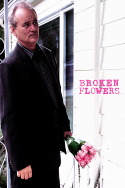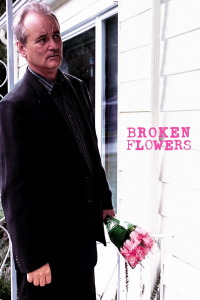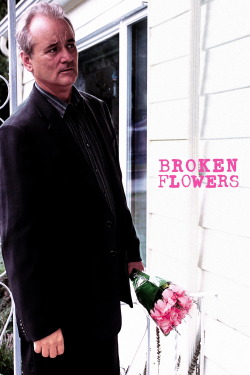
Review of Broken Flowers (2005) by Kenny M — 03 Nov 2009
The most delightfully bleak, melancholy film that I have ever seen. It's a film that has no cohesive conclusion-and it is all the more powerful for that reason.
Bill Murray is absolutely mind-blowing in his eternally indifferent despair. This is the role Bill Murray was born to play. His portrayal of Don Johnston comes across in the dried-up, almost faceless manner that only the most human of actors can begin to pursue. He pushes away deep characterization, he pushes away emotional response, but we're left with a surreal, stunning performance that you wouldn't expect out of anyone but Bill Murray. It's terribly overdone in this age, of course, but nobody has ever done it better than this aging, gray-haired version of Bill Murray. It's incredible what powerful impact each of the other actors in the cast, which is loaded fairly well but not to the point of distracting from the direction, have on the tone of each of their scenes. Each character is just a face fleeting by in Don's life-and yet each character seems to be so much more colorful than Don. By establishing themselves as almost completely unrelatable, we're reluctantly forced into Don's shoes. His experiences with the subtly whimsical characters aren't just reminiscent of the viewer's past. They are the viewer's past. Consequently, Don's inescapably bizarre universe suddenly becomes something we're oddly familiar with-the eternal deja-vu of the day to day that simultaneously troubles us and thrills us.
The script is riddled with Don Juan and Lolita reference. The Don Juan references almost felt quite intrusive among the stellar direction and impossibly sublime cast. But, thankfully, Broken Flowers doesn't tie itself down to the constraints of the archetype. At the end, we see no meaningful punishment or reward; Broken Flowers is ultimately more like "Catcher in the Rye" in terms of total impact than it is a Don Juan story. And to be honest, the Lolita material didn't last long enough for you to care. Just a quick shot of a naked Alexis Dziena, and then it's over. The juxtaposition of the shamelessly flamboyant literary reference along with subtle deadpan of the rest of the script may very well have been what made the ever-present indifference so fascinating. This, combined with Don's evident sexual tension in the company of the likes of Chloe Sevigny's character, and, to a lesser extent, his ex-girlfriends, is what truly drives the importance of Don's unflappable apathy to the plot's melancholy tone. Each line of dialogue seems to be handled delicately, as if the writers truly had *my* reaction in mind. But I feel like this impression is mainly due to the performance and direction, not due to the fairly "safe" writing used. And yet, the structure underlying it-Don's observations of the results of his failed relationships-and his ironic failure in his quest- are what truly made this masterpiece of an atmosphere possible.
Throughout it all, Jarmusch gives us some real standout cinema. Each moment is packed with a deadpan cynicism and a lingering uncomfortability. Each moment leaves you wanting a little something more, something you can't identify; for this very reason it is both unsettling and thrilling, leaving you with an emotional canvas that you don't know what to do with. It should be noted that the soundtrack works seamlessly well with the melodramatic encounters. The plain yet out-of-place driving music sets the mood for each scene perfectly.
"Broken Flowers"'s most significant achievement comes across in the ending of the film, or lack thereof. Don has ultimately achieved nothing. He has made no progress in his unmotivated quest to find his son, and he has not grown as a character or in relation to the women he encounters. We're left with a shot of a beaten Don standing on the street with the same expression he's had on his face since the beginning. What happens next is anyone's guess. Don sure doesn't *seem* like he's going to move a muscle for the rest of his meaningless life. But we know he will. We know he's going to turn around and move on with his life as if nothing had happened. We know he will and we know we would too.
This ambiguity frees Broken Flowers from a definitive message, and it leaves the viewer the task of completing Don's story. Throughout the movie, we are asked questions, but never given answers. Don challenges nothing that comes in front of him, and it is this blind acceptance, coupled with Murray's joyless inhuman stares, that make the viewer question so much about what Don accepts and what we accept. Don swallows his reality so easily that we have to double-take to make sure we haven't been doing the same thing. It's for this reason that Murray's emotionless performance is so emotionally charged: every line is injected with satire-not of the hypocrite, but of the human. The discomfort that Murray has uncovered is not something that you easily forget.
It's not to say that Broken Flowers intends to make the case for nihilism-or even critical observation, for that matter-but that Don's tale is so ambiguous and thus unavoidably true to each person that his tale is going to come across as confirmation of what defines the viewer. For some, this means a re-evaluation of values according to subjective bias-in the words of Nietzsche: "What does your conscience say? â?? 'You shall become the person you are.'".
Of course, any good existentialist art is going to come across as depressing fringe philosophy to the masses, and any good nihilist art is so ambiguous that it's interpreted according to the psychological bias of the viewer-which is why I think, when you get down to it, Broken Flowers is really more of an exercise in deconstructionism than it is in bolstering the relative truth of the the mind.
Or maybe, when it comes down to it, Murray, Jarmusch, and his cast really don't know what they're doing, they're just playing the roles they've played in their own lives, and I'm pulling a meaning (or lack thereof) out of what really is meaningless. Why did Don even begin on his quest? Why did he put himself into this position? Why am I awake at ungodly hours writing an in-depth analysis of a four year old dramedy when I could be doing homework, or sleeping? These questions don't have answers, and it doesn't make sense to start asking them.
"It's all bullshit, folks, and it's bad for ya".
This review of Broken Flowers (2005) was written by Kenny M on 03 Nov 2009.
Broken Flowers has generally received positive reviews.
Was this review helpful?