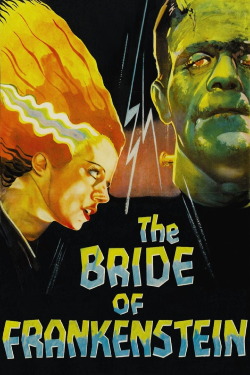
Review of Bride of Frankenstein (1935) by Roman R — 20 Jul 2013
"The Bride of Frankenstein" is a sequel that's just as good as the original, if not even better at times. While it shows that the sequel wasn't planned from the early scenes of retroactive continuity and the fact that the original novel is completely forgotten as a film it really works. The story introduces a villain that's delightfully diabolic and proves a great foil for our hero Henry Frankenstein, the special effects are spectacular, the monster gets a lot of character development and becomes more than just a mindless brute, the film has a lot of funny moments and there are some touching, intellectual points raised as well.
Here's a basic outline for the story: At the end of the last film, a mob of torch-wielding villagers chased Frankenstein's monster into a windmill after it killed several people and abducted its creator. The monster and Henry Frankenstein confronted each other at the top of the windmill and in a moment of real humanity, it saved the doctor. The windmill burned to the ground and the monster was assumed dead. When the sequel begins however, we learn that the monster fell into the flooded basement of the windmill and survived. It is spotted by a witness but no one believes Minnie (I don't blame them, she's incredibly irritating in every Universal Film). The monster wanders the wilderness, trying to make friends but is constantly shunned by everyone that it meets. That is until it befriends a blind man living by himself in the woods. The Hermit takes care of the monster and teaches him to speak, teaches him about music and even shows him how to smoke. The two become friends until two wandering hunters expose the monster and drive him away from his new home. Meanwhile, Frankenstein meets with Dr. Pretorious, a scientist who has also searching for a way to create artificial life. Through blackmail, Pretorious convinces Frankenstein to work with him. Pretorious and the Monster accidentally meet in a crypt and the two decide to force Frankenstein to create a mate for the monster, hence the title of the film. Now Frankenstein is caught between two adversaries, one a diabolic mad scientist eager to play God and the other, his own creation demanding a companion to end its loneliness.
The new addition to the franchise, Dr. Pretorious (Ernest Thesinger) is a fantastic antagonist. He is really diabolical and resorts to any means to get what he wants, be it blackmail, bribery, theft or even murder. He is completely at ease with dwelling in crypts, manipulating people and there's even some implications that he deals in black magic. When Dr. Frankenstein was playing God in the first film and creating life, it felt like the man was just so excited about his discovery that he was disregarding all safety and ethical points. When Dr. Pretorious is discussing creating life, it's like he is defying God and wants to prove that he is on a higher level than other humans by creating man (or woman) in his own image. He sees everyone as beneath him and only really has respect for Frankenstein because the man has knowledge that he wants. He also has a sense of humour so you kind of like the guy. Throughout the film he's got two notable lines that really show off his sense of humour. The first is when he and Frankenstein are getting ready to discuss Pretorious' creations. Pretorious claims that gin is his only weakness, but later when the meets the monster, he claims that cigars are his only weakness. It's a funny set of lines and it implies that the character's rationalizes his decisions regardless of what they are every time.
Director James Wale wisely decides to give the monster a lot more character in the movie. No longer is the monster wandering around just terrorizing people without any understanding of what's going on. Now, it's looking for a friend and has gained real intelligence. It understands that fire is painful, that people can drown if they fall in water and that its physical appearance, which has become significantly worse because of the burns it suffered while in the windmill, makes other people afraid of it. When the creature learns to talk, it gets some funny and touching moments as it befriends the Hermit. You see it enjoying music, cigars and food, it learns to recognize what it likes (for example later when it sees Pretorious it decides to approach him and ask for a cigar and drink) and even has a moment where it sheds a tear when it feels sad. Combined with the fact that throughout the film its burns heal and it yearns for a mate (or a friend) it becomes clear that Boris Karloff's character is very much alive and not just a re-animated corpse. You see that it has hopes and dreams, but also feels desperation and anger after being treated so horrendously by the people around it.
Doctor Frankenstein returns but in this film he is a changed man. After seeing the destruction that was caused by experiment run amuck, he's reluctant to create life again but is too scared to go to the police or attempt to fight back. He just wants to get back to his life but feels some genuine guilt because he did not take responsibility for the creature he created. It was tormented by everyone (including his assistant) and lashed out at the world. He knows however that there is good in the creature and understands that it can be reasoned with yet feels too helpless to do so.
One aspect that needs to be discussed while reviewing the film is the religious aspect and symbols. \During a scene where the monster is captured by villagers, it is tied to a pole in a fashion that reminds you of a crucifixion. This automatically makes you think of Jesus Christ, but the two figures are polar opposites. Christ was born as the son of God from a woman, was crucified and then came back to life as humanity's salvation. The monster was created from man without God's aid, is resurrected from the dead before being crucified and spreads terror wherever it goes. However, a scene where the Hermit admits that he has "prayed many times to God to bring him a friend" implies that it is divine intervention that brings these two misfits together. Because of his handicap, the old man is unable to judge people by their appearance and welcomes the monster in his home with open arms. He thanks God for taking pity on him and bringing him a friend, while the monster is grateful to find someone who will finally accept him. It's a touching scene, implying that even the lowliest, most hated creatures have a place in society and that there is someone out there that will accept them for who they are. As the scene fades, a crucifix behind the two characters is highlighted and "Ave Maria" is heard in the background. This sequence brings a whole new meaning to Dr. Pretorious' previous toast "To a new world, of gods and monsters!" While when you see it the first time around, it is clear that he is referring to himself and Frankenstein as the gods. They are able to create life at a whim and their creations are the monsters. However, after seeing the creature compared to Jesus Christ and after seeing it as a gift from the heaven, sent to the hermit as a sympathetic misfit, it appears that the monsters are Pretorious and Frankenstein. There are even some suggestions that Pretorious is a demonic character and not a man at all, with his mocking references to the Bible, ("Leave the charnel house and follow the ways of nature - or of God, if you like your Bible stories"), his obscure method of creating life and a scene where he is seen dining in a crypt. This aspect of the film alone will generate countless discussions and it's been a delight to analyze and re-watch certain excerpts of the film just to see the different comparisons.
Pretty much everything you liked in the first film is back. You get a mad scientist lab that is just as elaborate, Boris Karloff and Colin Clive are back as the monster and his creator, you get the angry torch-wielding mob but the movie pushes these even further. The laboratory is more elaborate and we get to see more of the monster creation process when it comes to the bride, the mob sequences are longer and you get to see them really confront the creature and both Karloff and Clive get to expand on their characters. There is no hunchback helper but instead we get another scientist, so it's a fair trade. The film also contains many humorous moments and while some of the jokes have been lost in the generations since the film has been released, there are no sequences that will leave you scratching your head wondering what the characters are talking about. Because modern horror films were built on the Universal Monster movies, most audiences will not be frightened by this entry but the jokes still ring true today. Yes there are some sequences that are dated (the rubber bat in the cave might have been the best they could have done in 1935 but in 2013 it just looks silly) but the film still fires on all cylinders and you'll quickly forget the flubs because of the strength of the story and the multiple layers contained in the film.
Not only is "Bride of Frankenstein" a landmark in filmmaking, but it's genuinely impressive today. The sequences in the mad scientist laboratories don't get much better than they do here and the parts where Dr. Pretorious shows off his creations are spectacular. The film is still funny, still touching and on the implications about science running amuck are still relevant and disturbing. You'll be surprised how well it has aged and it has the added bonus of being a film that you can show to children, discussing with them the importance of not judging people on their appearance while you discuss the religious implications with your grown-up friends. Forget the fact that this is a black-and-white film that's nearly 70 years old, it stands the test of time and you'll be delighted to have seen it. It easily overcomes its flaws and earns its 5 star rating. It's a must-see movie if you're a fan of horror or just a fan of movies.(Dvd, June 9, 2013).
This review of Bride of Frankenstein (1935) was written by Roman R on 20 Jul 2013.
Bride of Frankenstein has generally received very positive reviews.
Was this review helpful?