Review of Brave (2012) by Shiira — 15 Nov 2012
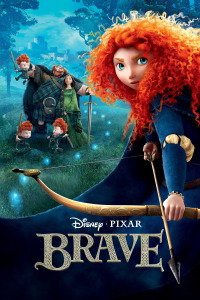
This time, it's Kelly Macdonald's turn to be the princess, the future queen of Scotland. As Merida, she gets to be brave, but brave how? In Elizabeth, Macdonald plays Isabel Knollys, one of the then-princess' girlfriends, first glimpsed in a meadow, where she climbs off a horse and joins the idling others, who stop their dancing in order to greet the future queen's rival.
Elizabeth, meanwhile, undulates alone, pretending not to notice the male presence. Whereas Merida grabs the reigns of her own horse, Isabel needs a man to do the riding, Elizabeth's man, the Earl of Leicester, who would later marry the lesser wench, while "The Virgin Queen", a Protestant, was busy antagonizing the Catholics.
Unlike Elizabeth, the reluctant princess' formative years is distinguished by the obfuscation of a love interest and friends, both male, and more pointedly, female. It's a filmic calibration, calculatedly so.
Instead of a true love, a man without the pedigree to marry a princess, Merida has a bow; no beau at all, no analog to Elizabeth's earl. Brave, despite its comic tempering, can't quite obscure the fact that Merida hatches a murder plot against the queen.
Elinor, due to her interpellation into a patriarchal structure, turns a deaf ear to Merida's plea that she "just listen". The mother is too preoccupied with her daughter's betrothal, thereby circumventing an open dialogue about the redhead's lesbianism.
At the outset of Brave, a transfiguration is suggested, when Merida, as a wee lass, encounters a will-o'-the-wisp while retrieving an errant arrow. According to lore, this floating body of blue light is reputed to drive people off safe paths.
Metaphorically speaking, as life journeys go, heterosexuality, for a princess and future queen, would seem to be a less complicated road. Marry, and live happily ever after. Merida, however, is no storybook princess.
At the archery contest, she declares, "I'll be shooting for my own hand," and afterwards, in the castle, the proto-feminist ranting persists, as the victorious princess, proud of her performative emancipation, tells Elinor, "I'm not going to be like you," before charging off into the woods on her horse.
By perchance, the will-o'-the-wisp returns, finding the lost girl at her most vulnerable. Intuiting what Merida wants, the spirit leads the princess to a witch, who then concocts an elixir, a cake, with the power to "change" the queen(into a corpse?).
As Elinor writhes and spasms, her daughter sits bedside, oblivious to the potentiality of her mother's death. The girl's overriding concern is that the queen should remand her impending nuptials. She tries to coax some last words out of the queen before the poison takes effect.
But unexpectedly, Elinor turns into a bear, causing Merida to remark, "The witch must have given me a gamy spell." These seemingly benevolent words are double-edged, treacherous words that the audience, who presumes the heroine to be good, will vault past, never once entertaining the notion that the tainted cake was meant to kill.
After all, it's a children's film. Scan the castle interiors; scan the crowd at the playing field for a girl, a peasant, perhaps, a secret lover who has to escape detection from the parental royals.The cake, and the violence which proceeds its consumption by a matriarchal figure, recalls Heavenly Creatures, when Pauline tells her mother to take the last pastry, to "treat yourself", just before the girls murder Honora Parker.
With mom out of the way, Paulie thinks her fate is changed; she and Juliet(first seen dressed as a princess) can now be together. "She doesn't seem to "bear" us any grudge," Juliet says, as the torrid lovers make their last-minute preparations.
Neither does Elinor, who adjusts to her new form in record time. That's because she's one, too: a lesbian. While searching for the sprite, Merida lets loose a Freudian slip of sorts, shouting, "Fine, don't come out while my mom is watching.
" She knows, though; the father, too, about them both. Later, back at the castle, the king tells Merida, "Just like your mom, you devil." He knows that the bear is his wife; he believes Merida.
Only as a beast, a monster, can he justifiably kill his gay queen. "Don't let her out!" the king barks out at the housekeeper, or else he'll have to kill Merida, too, bear or not. Brave, in essence, is Mulan with kilts.
Even more sexually confused than her Scottish counterpart, only in drag, as Ping, can Mulan love Li Shang. She too is leery about marriage. "When will my reflection show, who I am inside," the cross-dresser sings.
Subconsciously, she purposefully sets the matchmaker on fire. But alas, to be a dutiful daughter, Mulan will marry the handsome captain, and please her tradition-bound parents. Merida, however, has other ideas.
Like Joan, who passes on sailing to Kiloran in "I Know Where I'm Going", Merida, too, stays on dry land for love.
This review of Brave (2012) was written by Shiira on 15 Nov 2012.
Brave has generally received positive reviews.
Was this review helpful?