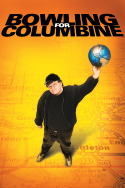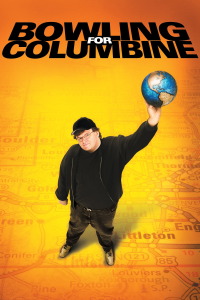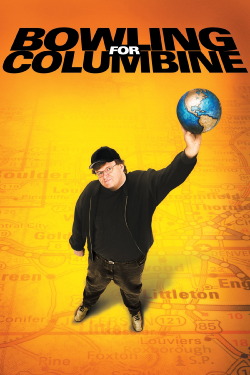
Review of Bowling for Columbine (2002) by Florence . — 11 Jan 2011
When Michael Moore's incendiary documentary Bowling For Columbine was released, the nation's capital was in the grip of fear over a mystery sniper who was killing D.C. citizens. A movie that told us that America was filled with jingoistic simpletons who care more about the right to a gun than, say, health care, wasn't exactly necessary at that time. But the proof Moore gives is plenty reason to have a belly full of laughs. And this from an average looking schlub who wear caps like Hollywood stars wear sunglasses. But in a decade in which it seemed the whole world was falling apart, Moore's provocations were sorely needed, and he delivered, with cocky energy and genuine populism.
Many may say that Moore's 2004 hot-potato feature Fahrenheit 9/11 was his boldest move in a decade that included Sicko and his most recent Capitalism: A Love Story, but as terrific as that film was, the president is an easy target. It takes real cojones to prod and mock America's gun obsession, and Moore, like a one man gang, aims and fires on all cylinders. In Bowling For Columbine Moore makes the point that guns are a neutral entity, and deadly in the hands over over-zealous Americans, and, worst of all, they're too damn easy to obtain (Moore makes this point hilariously when he opens a bank account solely for the purpose of getting the free gift: a rifle. Lax gun laws and easily accessible firearms are a dangerous combination in a right-to-bear-arms, gotta-defend-the-homeland culture like America's he argues. His proof? The Columbine massacre at Columbine High School in Littleton, Colorado where teens Dylan Klebold and Eric Harris gunned down 12 students and one teacher, injured 21 others and then killed themselves. The footage of the security cameras capturing the boys in the act with audio of victims' testimony is absolutely chilling. Moore even enlists a survivor of the tragedy, now paralyzed to accompany him at a Kmart, the company from which the two gunmen bought their bullets.
Of course Moore can't resist having some fun at the expense of gun nuts. Footage is shown of Chris Rock riffing on how bullets should be incredibly expensive in order to deter crime; a compacted, borderline superficial history of American foreign policy hypocrisies is shown; Michigan's welfare to work policies, which Moore cites as complicit in the shooting death of a 6-year-old child by another child in his hometown of Flint is powerfully indicted, there's even a South Park-style reference to Canada, who apparently have tons of guns, but seldom use them on one another.
The humor can get confusing concerning Moore's intentions, but the relentless bits of sardonic humor are the film's most appealing aspects, and a true sign of the times, when comedians like Jon Stewart and Stephen Colbert are more trusted for information and truth than is the actual news media. Moore understands that humor is what grabs people's attention the most. And Moore's a master at keeping us entertained long enough to entertain some really heavy questions. Moore became a lifelong member of the National Rifle Association after the Columbine tragedy to instigate change from within. Moore even gets an interview with then-NRA president and actor Charleston Heston, who makes the mistake of allowing Moore and his crew into his home. It's a tense scene, but of course Moore has a point when he takes the NRA to task for their gross insensitivity by staging rallies in Littleton, Colo. and Flint right after tragic gun incidents.
But Bowling For Columbine's real lasting impact is the fact that it's the movie that propelled the documentary to new heights. By the time of Moore's Fahrenheit 9/11, a documentary could actually crack the top five box office. From there, there was no end to the wave of documentaries that used similar storytelling devices and aimed for similar success (Super Size Me, The Five Obstructions, March of The Penguins, Murderball) until the line between documentary and fiction began to blue (Catfish, I'm Still Here). The last decade was the decade of the documentary, where treatises on the Iraq War and even a competition between Donkey Kong experts could be just as thrilling as a summer blockbuster.
This review of Bowling for Columbine (2002) was written by Florence . on 11 Jan 2011.
Bowling for Columbine has generally received very positive reviews.
Was this review helpful?