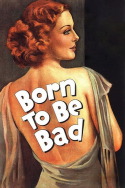
Review of Born to Be Bad (1934) by Zoran S — 08 Sep 2011
The Last Gasp of Pre-Code.
According to both IMDB and Wikipedia, this movie went back to the Hays Office twice. And yet I cannot see how it passed at all, given that the main character was an unwed teenage mother. Who actively works to break up a marriage and never really suffers a comeuppance for it. Oh, it's true that her, shall we say, current occupation is never mentioned; at one point, she angrily declares that she's a "model." And apparently, a lot of shots where she shows skin were trimmed. On the other hand, this strikes me as the very definition of "a movie whose plot goes against the Code." Not just one or two elements but the underlying plot structure itself. The sanctity of marriage had to be honoured, but it seems as though all the characters see marriage as something which can and should be dissolved if it no longer works out. Which is what I think, too, but Joe Breen and I never would have agreed about a whole lot of things.
Years ago, at the age of fifteen, Letty Strong (Loretta Young) stumbled into the bookstore of "Fuzzy" (Henry Travers) and gave birth. The child has grown into a wild boy whom she named Mickey (Jackie Kelk). She tells Fuzzy that she has trained him to be strong and not to be fooled by anyone or anything. Certainly not some meaningless concept of "honour." And one day, Mickey is hanging onto the back of a truck while on his roller skates, and he is injured in a car accident. Letty colludes with her lawyer, Adolph (Harry Green), a broad Jewish stereotype, and claims in court that Mickey is much more seriously injured than he really is. This is because she figures this will let her get a lot of money out of Malcolm Trevor (Cary Grant), who was driving the truck which injured her boy. He owns a dairy, and she figures between his personal money and the company's, she and Mickey will make out like bandits. Only her lies are revealed, she is declared an unfit mother, and Malcolm and his wife, Alyce (Marion Burns), adopt Mickey.
As you might guess, this movie is from before Cary Grant became Cary Grant. He'd been a plaything of Mae West (speaking of dodging the Code); he'd been the Mock Turtle. (We've that coming up soon!) But the earliest of the movies of his which I've seen where he's really That Cary Grant is [i]The Amazing Adventure[/i]. And there's [i]Topper[/i], the year after that. Here, he's wealthy, at least, but there's an earnest nobility which he wouldn't shake until 1941, at earliest, and the dreary and dreadful [i]Penny Serenade[/i]. But what this movie, the Mae West, and [i]Penny Serenade[/i] have in common is a decided lack of charm. Most people, I think, would be surprised to know of the man's lower-class roots. In later years, it would be hard to believe that Letty's attempted seduction of Malcolm was an act. Here, it's a bit hard to believe it isn't. He's nice enough, and he's certainly rich enough, but he really doesn't seem to be Letty's type at all.
Interestingly, Jackie Kelk seems to have spent most of his career on the radio, though that does leave an awful lot of career uncovered. He would, in time, play Jimmy Olsen on the radio. Here, he is one of those characters where the boy must help drive the picture without ever actually needing to be a talented actor, though I will say that he doesn't do a bad job. I'll admit that I tend to focus a lot more on the acting of children than is necessarily fair, but I do also tend to give credit where credit is due. Loretta Young would spend a lot of her career as a goodie-goodie--though it's worth noting that, in my favourite of her movies, it's seriously suggested that she might leave her husband for Cary Grant's character. Grant, of course, would play suave, debonair men, even if they often ended up in rather peculiar circumstances, chasing after dinosaur bones or being chased by spies. But this isn't their later careers, and the kid doesn't need to stand up to that. But he does well with what he does face.
The only professional review of this movie on the site refers to this as a "woman's picture," and I suppose it is at that. On the other hand, because it does also miss quite a lot of the movie's plot, the review misses some of the actual drama to the story, drama which is enough for me to give the movie a marginally positive review. Letty is in Holly Golightly's sorority of the powder room, if you will, that legion of movie women of no discernible means of support who nonetheless make quite a nice living. Unlike Holly, though, this living has made Letty hard. Not the hard shell that Holly has, actually hard. Her only soft spot is for her son, and that's where the movie hits her. She thought that making him hard as well would shelter him from the world, but it seems at the end that developing a sense of honour is opening a whole array of opportunities that she would never be able to give him. Which is, I suppose, "women's picture" enough.
This review of Born to Be Bad (1934) was written by Zoran S on 08 Sep 2011.
Born to Be Bad has generally received mixed reviews.
Was this review helpful?