Review of Border (2018) by Bertaut1 — 20 Mar 2019
Supremely weird, but thought-provoking, even if a little morally ambiguous.
Based on the short story by John Ajvide Lindqvist, written for the screen by Lindqvist, Ali Abbasi, and Isabella Eklöf, and directed by Abbasi, Gräns is a psychological drama, a study of loneliness, a romance, a body-horror, an investigation into what gives us our humanity, and a thriller. Set in a half-realist/half-fantastical milieu, no matter how fanciful the plot becomes, it remains always grounded in emotional realism. Problems include a subplot that feels disconnected from the main narrative, a ridiculous coincidence, a twist you can see a mile away, and a pronounced moral ambiguity that's difficult to parse. Nevertheless, this is unique filmmaking, raising all manner of questions about how we act towards the Other.
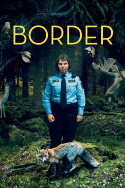
Tina (Eva Melander) is a customs officer with the ability to smell guilt. Suffering from deformities that give her a somewhat Neanderthal-like appearance, she is shocked to encounter Vore (Eero Milonoff), who has the same deformities. Although she smells something on him, she isn't sure what it is, and she lets him through customs. A few days later, he passes through again, this time volunteering to be searched. This leads to a shocking discovery, and the beginning of a strange relationship.
Given the fantastical components of the plot, one of the most interesting things about Gräns is how grounded in realism the aesthetic is. Indeed, o of the strongest elements of the film is how emotionally relatable Tina's arc is; the events may be fantastical, but the emotions are quotidian - loneliness, shyness, fear, love, disgust etc.
An important example of this is that Abbasi sets up a contrast between the forest which surrounds Tina's home and the rest of the locations. Presented as a somewhat magical place, whilst everything else is filmed with a cold palette of greys and washed out light blues and greens, the forest is shot with richer colours; the design elements are more imaginative; the camera work more fluid; even the sound design is more varied, suggesting the whole place is vibrantly alive, in stark contrast to the cold concrete and steel world seen elsewhere.
The film's opening scene establishes Tina's attraction to the animal world; as she gently handles a bug, before carefully placing it back into the grass. Later, there's a scene with a moose, another with a fox, and a scene in which she is rushing her neighbour to hospital to give birth but stops to let a family of deer cross the road. These scenes are shot by cinematographer Nadim Carlsen with a sense of wonder, and an almost ethereal quality, as far removed from the mundanity of the customs desk as you can get. For all her closeness to animals, however, Tina is equally as distant from humans, and is desperately lonely, in a society that judges based on appearance. On the other hand, Vore is introduced as a rebel against social norms; whereas Tina is ashamed of her differences, he is proud of his - seen most clearly at a buffet, where he takes all the smoked salmon, and then hungrily eats it with little concern for etiquette.
The film also probes what gives us our humanity, suggesting that in a world populated by humans lacking in humanity, maybe Tina and Vore are the most human characters, or certainly the most humane. Tied to this is the notion of finding one's tribe, and what kind of sacrifices and subversions of one's moral code, if any, are acceptable in that search. However, the film does end in an extremely morally ambiguous manner, and I've rarely come out of a movie with such a pronounced case of "what was the director trying to say with that?".
Elsewhere, a child porn subplot does little but detract from the main plot. I get that it's there to show us Tina's abilities and her moral code, but too much time is given to it without it ever being made to seem urgent or important. And when it is finally integrated into the main narrative, it happens with a plot twist so telegraphed, if you don't see it coming, you've never seen a movie before. Also, when we learn how the two plots connect, and when we backtrack to the start of the film, we find that the entire house of cards relies on a monumental movie coincidence.
These missteps aside, Gräns exposes the layers upon which our society is built, and is unafraid to suggest that exclusion has become a major facet of Western civilisation, an important topic at a time when there are increased calls for closed borders and increasingly irrational fears of the Other. The morality of the dénouement is a little questionable, but this is still a fine piece of work with a lot on its mind.
This review of Border (2018) was written by Bertaut1 on 20 Mar 2019.
Border has generally received positive reviews.
Was this review helpful?