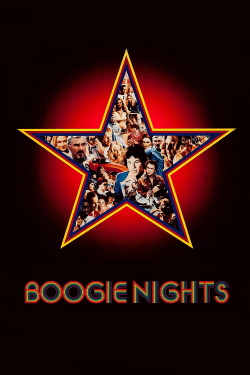
Review of Boogie Nights (1997) by Katherine B — 31 May 2011
This great ensemble film about the porn industry by Paul Thomas Anderson and set during the late 70s and early 80s is a surprisingly unusual extravaganza, mostly because it is an intelligent director addressing a controversial subject matter. It is heavy on great music and complicated yet beautiful scenes, boasts an unbelievable cast and is one of the most competently written films you're likely to find.
Spoilers ahead.
What's most interesting about the film is how it spoofs the classical-era films, or in other words, the notion of nuclear American family. This is a very obvious characteristic that the film flaunts. Amber Waves and Jack Horner are surrogate parents for Dirk Diggler. Dirk rejects his family name and takes the name of his new parents; a porn name. He is in good company when he arrives in Jack's house alongside Roller Girl, Reed Rothchild and Buck Swope, all children in the new unconventional nuclear family. The classic Hollywood trajectory is followed surprisingly closely here (as seen in films from 1933's "Only Yesterday" all the way up to 1990's "Home Alone"), as the family is together then torn apart by an unseeable force (in this case, the video-tape) and is ultimately reconciled at the end.
Of course this conventionality is satirical and wildly off-set because of the actual setting of the film and its characters. Where the conventional American family is obviously represented in platonic relationships, the fact that Jack's family is based on sex upsets the feeling of familiarity usually a staple in such stories. What we have then is not a film celebrating the new unconventional family, such as something like Don DeLillo's "White Noise" but instead offers a new perspective on an old idea. Basically, the film purports the idea that a family is something that is built on a vested interest, something that was absent from Dirk's "biological" family; an antagonistic mother, a cowardly father and a sexual son. The film ultimately rewards all its characters, Buck gets his business, Maurice starting a new club with his brothers etc.
The family aspect focuses heavily on Dirk, but Jack also has an interesting struggle of his own involving the art of his trade. Early on when Jack, Amber, Roller Girl and Dirk all meet in a diner, Jack divulges his desire to create the ultimate film in which people will stay in the theatre after they've jerked off to see how the story ends. Jack's artistic hopes are given a fighting chance when Dirk arrives on the scene and brings his dreams to life. Despite the acclaim Jack's films finally receive he must come crashing back down to earth when he is forced to work on video.
Jack clearly has impressions of what porn and sex are that he eventually and disastrously discovers his audience don't hold the same view of what he does that he holds. This becomes clear in two scenes, first, the scene in which Jack comes to realise his financier is a paedophile, a thing that shakes his faith in the industry and second the scene in which Jack, Roller Girl and the cameraman are cruising through LA looking for an amateur to film with. Jack's artistic vision clashes with the amateur boy's desire to fuck, and so a tension arises. When Jack beats the boy he is beating his audience for its indifference to his vision; it's desire to "jerk off and leave". It is really a tongue-in-cheek interpretation of the divide between film-makers and film-goers played out in a fantastically over-the-top manner.
Criticism of this film would have to include the fact that Anderson lifted the style of this film wholesale from Scorsese's "Goodfellas" and "Casino" with the use of kinetic camera movements, swift-editing and upbeat music feeling very familiar. Thankfully Anderson seems to have perfected his own individual style as is seen in "There Will Be Blood", but here his youth and inexperience are glaring, but not overpowering.
What is very impressive here is both the script, which sets up some fantastic moments, such as the scene with Alfred Molina's drug-dealer and his Chinese fire-cracker friend, and the amazing long-shots that appear throughout the film, most notably the opening scene and Lil' Bill's murder-suicide.
Overall, the film is messy at times, but delightfully provocative in its treatment of familiar themes in unfamiliar places. A great success.
This review of Boogie Nights (1997) was written by Katherine B on 31 May 2011.
Boogie Nights has generally received positive reviews.
Was this review helpful?