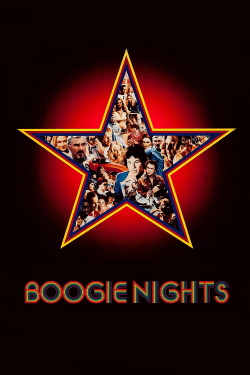
Review of Boogie Nights (1997) by Movie P — 03 Aug 2013
"Not since the mysteriously reclusive Terrence Malick has there been such an explosion of sheer talent on the American movie scene.".
Paul Thomas Anderson's sophomore feature can be summed up by Andrew Sarris' quote above: Quite simply, Boogie Nights is a masterpiece. A stylishly sleazy, rollicking tale of the Porn Industry "when sex was safe, and pleasure was a business". In crafting an epic that is grand in scope (almost subversively so), yet deeply focused on it's all too-human cast, Anderson assures the world that he is a cinematic talent to be reckoned with. It's brilliance as a film lies in the fact that, while the events depicted onscreen are often brutal, depressing, or simply disturbing, you simply can't turn it off. Anderson's filmmaking is utterly compelling, a glossy ode to the hedonistic 70's Porn Industry, while never losing sight of the characters that push his film into the realm of brilliance.
Following the naive Eddie Adams (Mark Wahlberg, in a star-making role), a young man with a grand aspiration, and large penis, as he struggles to break away from his small-town roots, and become (in his own words) a big, bright, shining star, we get a first-hand view of the highs, the lows, the crushing depths, and the soaring peaks of life in the industry. Eddie is brought under the wing of legendary exotic film director Jack Horner (the perfectly-cast Burt Reynolds), and his family: A bunch of disparate, often meaningless individuals, who find this community as a refuge from the harsh light of reality. Following his feature film debut, Eddie (newly rechristened with the iconic nickname Dirk Diggler) takes the Industry by storm: He becomes the most bankable star in Porno history, ensuring Horner's dream of mainstream credibility. All is not well, however, as video begins to make it's presence known, and Jack's dreams start to appear as just that: Dreams. As the 70's, a time of optimism, hedonism, and a love of life, reach their end, and the 80's characterised by the "Greed is Good" mentality take hold, the mask of success begins to slip, portrayed in the most subversively humourous scene by Anderson.
Just about every facet of this film is praiseworthy, be it the human performances, the natural dialogue, or mesmerising direction. Anderson's style is one that could be misinterpreted as cold: His use of long, uninterrupted shots, flashy colours, and loud, well-known soundtrack picks could very easily be held up as examples of flashy directorial posturing, in place of a good story. Such is not the case, however, as Anderson's self-written screenplay is astonishingly human, with an eye for character traits. These wonderful specimens are then brought to life by an all-star cast you would never have thought of: Wahlberg, Reynolds, William H. Macy, Anderson mainstay Phillip Seymour Hoffman, John C. Reilly, and Don Cheadle all have small, but developed roles to play, and give the ensemble some serious legs, acting-wise.
The acting, writing, and direction are the most noticeably brilliant details in Anderson's breakthrough, but there are many more subtle features that continue to pop into my head, as I think the film over. First and foremost: the soundtrack is simply magnificent, creating the feel of the 70's in such an authentic way, that I often have to remind myself that the film is only as old as I am. With a number of singalong tunes as well as wide range of lesser known tracks, to back up the rest of the film, the soundtrack, I daresay, puts Tarantino to shame.
Next up, is the cinematography. Anderson's camerawork has a strangely contradictory feel: On one hand, it has a perfectly precise, almost calculated feel to it, yet it retains a sense of wobbliness (it's the best I could do), that backs up the "groovy" atmosphere of the film. The subtly epic scale of the film, punctuated by slow, lazily shot scenes is almost a contradiction in itself, yet it works to perfection, making Boogie Nights an astonishingly original watch.
There's nothing of Boogie Nights that I would truly call negative, but there are a few things that I look back on a little less enamoured with. Roughly the first hour of Boogie Nights is masterpiece material, it is so tightly scripted, acted, directed, and presented, that I could barely feel the time fly by. Afterwards, however, the film becomes somewhat sloppier, as the 80's cocaine madness takes hold, friendships break, and nihilism and paranoia replace optimism and happiness. In retrospect, one could view this as a clever way of setting up the tone of the later portions of the film: Wild, emotional, and unapologetic. Unfortunately, to this viewer, it came across as a much harder adjustment than settling into the previous hour. Luckily, the last half-hour (Titled "Long Way Down (One Last Thing)) is absolutely fantastic, and more than makes up for my gripes with the other portions of the film. Thanks to a hilarious, and unnerving Alfred Molina, Boogie Nights recaptures the slick charm of it's earlier scenes, and bumps it's way back up to five-star rating.
Boogie Nights, now is seen as a nigh-masterpiece: Paul Thomas Anderson's roaring explosion into Mainstream notice, tackling heavy themes, such as obsession, desperation, and the lack of resolution of everyday problems. When you have such an infamous title to live up to, it can be hard to meet expectations, but with the body of work he has produced, P. T. Anderson's debut, after fifteen years, remains a modern classic.
Final Grade: A.
This review of Boogie Nights (1997) was written by Movie P on 03 Aug 2013.
Boogie Nights has generally received positive reviews.
Was this review helpful?