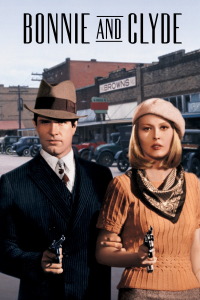
Review of Bonnie and Clyde (1967) by Paul Z — 28 Apr 2011
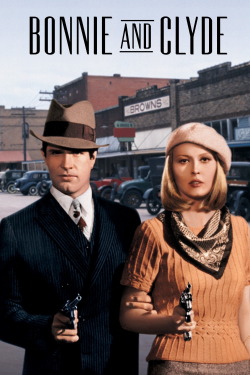
This wry, irreverent ride was hailed the first modern American film. It came down like a bucket of water. American moviegoers had seen nothing like it before. In feeling and liberty it prevailed from the French New Wave, especially Truffautâ(TM)s own film about star-crossed sweethearts, Jules and Jim. Actually, Truffaut initially accepted David Newman and Robert Bentonâ(TM)s original screenplay---which with director Arthur Pennâ(TM)s support is a stunning success at character psychology through action---and brought it to the scrutiny of Beatty, who was single-minded in producing it.
The tale of the production has become virtually as renowned as its heroes. Chronicles are recounted about how Beatty prostrated at the feet of Jack Warner, pleading for the permission to greenlight the film. How Warner saw the original cut and detested it. How the movie was lambasted and Warner Bros. was resolved to abandon it in a chain of Texas drive-ins, and how Beatty begged the studio to take a chance. How it opened and rapidly closed in fall 1967, berated by the critics, getting but one overjoyed opening-day newspaper notice. 1967â(TM)s quirky, visceral crime spree wouldnâ(TM)t disappear. The bluegrass soundtrack shot to the top of the billboards. Critics notably retracted their initial damaging reviews. The movie re-released, went on to become one of Warner Bros.â(TM) biggest hits and won 10 nominations. Ha! There are more ways than just the standard ones youâ(TM)re used to in which a story can be effectively filmed and be gratifying! Movies are not a technical high school! Ha!
But less valuable was the effect it had on the American film business. Beattyâ(TM)s readiness to play a brutal character with sexual dysfunction was rare for an established 1960s male lead. Actually, Beatty and Penn cast the movie generally with unfamiliar stage actors, so effectively that all the major players became stars due to this film. Behind the camera, the movie catapulted the careers the entire production crew. And Guffeyâ(TM)s cinematography catapulted an entire new wave of its own, of films shot and edited in the more impressionistic French style.
Penn came garden-crisp to the project after a booming letdown also made with Beatty. Robert Benton became a significant director. Itâ(TM)s like this one film sent all those careers gushing through to the present. It was a film in which all of the dubious pieces convened at the appointed hour.
But more than anything, it was a tour de force of tone, in which the actors and filmmakers were all on the same wavelength as they shifted the material from side to side between comedy and tragedy. The opening scenes are flippant, beginning with Clydeâ(TM)s audacity after Bonnie catches him attempting to pinch her motherâ(TM)s car. She intuits in him immediately the agency of her getaway from a tedious Depression-era Texas town. What he basically gives her, for the adorable, idolizing wheelman C.W. Moss and for the eager newspaper readers is the prospect of thrill in lives of monotonous hardship. Clyde announces them at the commencement of a bank heist so theyâ(TM)ll be certain to receive acknowledgment. Gene Wilder is as hilarious in his bit role here as in his whole riotous performance in The Producers. And one of the movieâ(TM)s great moments comes as Clyde offers his gun to an evicted black sharecropper so he can put a bullet through a bankâ(TM)s foreclosure sign.
If Clyde provides fascination, what with all the symbolic overcompensating by guns and rampaging cars, Bonnie provides hype. She writes The Ballad of Bonnie and Clyde and sends it to a newspaper, and she models for photos sporting a pistol and a cigar. Clydeâ(TM)s brother Buck is less clouded by compensating for sexual inadequacy and more interested in bank jobs than tabloid headings. He comes fastened to Blanche, whose shrill protests aggravate Bonnie, and us. When agents besiege one of their hideaway, she runs earsplitting across the lawn, still holding the spatula she was using to cook. Gene Hackmanâ(TM)s Buck Barrow is a jolly, simple, big-hearted man, a little flabby, prone to noisy jokes, knee-slapping and broad reactions. When we first see him, thereâ(TM)s a lull in the conversation, as if theyâ(TM)ve said everything already. Itâ(TM)s too much for Buck, who abruptly claps his hands together and spouts out spiritedly.
Penn helms the film as a succession of set pieces, which linger in the memory, concentrated and unmistakable. The Okie camp where destitute farmers, tractored off their land by the banks, huddle over campfires. Bonnieâ(TM)s gloomy, dull, bewildered family reunion. The heist that goes awry when C.W. unthinkingly parks the car. The way amusement twirls blindingly into brutality, as when a robbery concludes with a meat cleaver and a bag of flour, or a bungled escape with a bullet in a bank manâ(TM)s face. The confrontation with a state trooper whoâ(TM)s made to sit for the gangâ~s photos, and then foolishly freed. The scene where C.W., a gas station helper, impulsively flees with the couple. The scene where C.W.â(TM)s father easily badgers him for getting a tattoo. And then the slow-motion formalized dance of the ultimate massacre.
The movie ends in a volley of bullets that eternally revolutionized the way the movies portray violence. But the entire film offered a pattern that would be used frequently in subsequent films. It created a genre as well as a cinema movement. Nowadays, the innovation of Bonnie and Clyde has been immersed in innumerable other films, and itâ(TM)s difficult to see how novel and unique it mustâ(TM)ve felt in 1967, similar to how the 1941 shock of Citizen Kane might not be palpable to those reared in the dusk of its impact.
This review of Bonnie and Clyde (1967) was written by Paul Z on 28 Apr 2011.
Bonnie and Clyde has generally received very positive reviews.
Was this review helpful?