Review of Bonnie and Clyde (1967) by Travis H — 26 Feb 2012
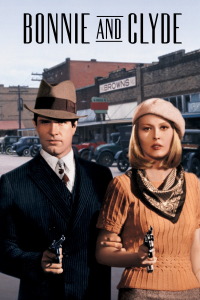
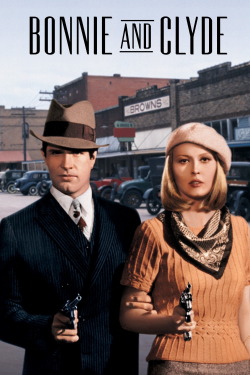
If Arthur Penn's seminal Bonnie and Clyde has a moral, it's that there are few things more dangerous than bored young people with big ambition and no prospects. Clyde Barrow (Warren Beatty) and Bonnie Parker (Faye Dunaway) were two such young people in the 1930's, who robbed banks and gunned down lawmen largely because they had nothing better to do. Joined by Clyde's brother Buck (Gene Hackman), his high-strung wife Blanche, and their bumbling getaway man CW Moss, they cut a swath across the Midwest and became the most notorious outlaws since Jesse James before meeting their end in a hail of bullets.
The oddest yet most alluring thing about the gang (at least as portrayed here) is despite the numerous felonies they commit, they don't seem like bad people. They come across less as hardened killers than awkward young lovers who wanted fame, fortune, and excitement, and decided the only way to find them was to go outside the law. At first, they succeed almost in spite of themselves, making rookie mistakes like robbing a recently failed bank. Even when they hit their stride, the satisfaction of a successful stick-up is eclipsed by the excitement of reading about their exploits in the paper and in becoming household names.
And despite the rapid body count they amass, they never seem to relish the violence. They don't mind firing a few shots into the air, just to scare folks, but they don't shoot anyone unless they have to. For them, shootouts are an unwelcome danger that gets in the way of their real business, and killing someone is only further reason for the law to track them down, and maybe something to feel guilty over. After a struggle in grocery store results in serious injury to the proprietor, Clyde complains to Bonny "Why did he have to go and do that? Ain't got nothing against him.".
Together with the rest of the gang, they're almost like a big, thieving, murdering family. They have their fights and falling outs, and they make up. They get homesick. They have their personality clashes, with Bonnie and Blanche barely tolerating each other. Between Blanche's excitability, Buck's hickish ways and corny jokes, and CW's good natured idiocy, much of the film has a cheery, even humorous feel. Nowhere is this truer than during the shootout in Joplin. Bullets are flying everywhere and cops are dropping left and right, but the sight of Blanche running across the yard waving her arms, screaming her lungs out, and generally making a complete fool of herself renders the scene absolutely hilarious.
But despite the not infrequent comic relief, Bonnie and Clyde is no lighthearted comedy. They are wanted men and women, and danger is never far from them. In reflective moments, Clyde and Bonnie readily admit that they'll someday go out in a hail of bullets- people in their line of work don't tend to have long and happy lives. And throughout the final reel, it becomes clear that the end is drawing closer. As the number of lawmen on their trail increases, the shootouts become bigger and bloodier, the escapes become ever narrower, and their luck begins to fail, until finally the young lovers meet their destiny on a quiet country back road.
These scenes, especially the latter, were larger, far bloodier, and more realistic than any put on film up to that point. Up until then, most movie violence had been largely bloodless, with actors merely grimacing or slumping over when shot, and the more horrific violence merely being implied. But Bonnie and Clyde dared to show what really happens when lead meets flesh. The now famous death scene shocked audiences upon the film's release in 1967, and is still powerful more than forty years later. It's no understatement to say that Bonnie and Clyde paved the way for nearly every modern shoot-em-up, from The Wild Bunch to Scarface.
Perhaps what really makes Bonnie and Clyde special is that although it had the subject, and the budget, of a quickie exploitation film, Penn treated the material with nuance and style, giving us real people with hopes, dreams, and emotions of their own, and making graphic violence and human sexuality worthy of high cinema. With powerful performances by Beatty and Dunaway, groundbreaking effects work, and its then unique mix of gunplay, humor, and personal drama, Bonnie and Clyde did more than any sensationalist headline to create the mystique that surrounds its protagonist to this day, and heralded the arrival of new wave cinema to the US. This was, and is, one of the great American movies.
This review of Bonnie and Clyde (1967) was written by Travis H on 26 Feb 2012.
Bonnie and Clyde has generally received very positive reviews.
Was this review helpful?