Review of Bob le Flambeur (1956) by Adam C — 29 Feb 2008
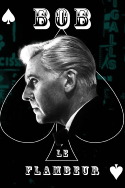
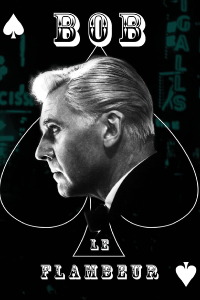
For the curious, and I was when I first heard about this film, [i]le flambeur[/i] is the French term for what we would call a high roller. And, indeed, we see "Bob" (Roger Duchesne) ride a lot of waves in his fortunes. At the beginning, he is up two hundred "clams," according to the subtitles; whether they mean francs or dollars is anybody's guess. Well, I imagine you could work it out if you spoke French, but I don't, or at least, not enough for it to count here. Given the context, I assume that it's some sort of slang term that even someone who learned their French in high school wouldn't necessarily get.
Bob seems to have lived his whole life on gambling and crime. Mostly, at this point, gambling. He is, of course, a high roller. He takes his money to a horse race, bets it all, and wins. He takes his winnings to Deauville, the casino, bets it all, and loses. However, while he's at Deauville, his friend Roger (André Garet) sees an old underworld friend, Jean (Claude Cerval), who is now a croupier, having somehow gotten his record for pimping--apparently, the crime that goes the most against Bob's personal code of honour--suppressed. Roger learns from him that the safe at Deauville had, the previous year, contained 800 million francs on the night after the Grand Prix. I don't know the exchange rate, but even 800 million lire, which had at the time a pathetic exchange rate, wouldn't exactly be chump change. So Bob and Roger recruit a handful of others to do this one last job, the job that will set Bob up for the rest of his life. The rest of the film is the story of how things could go wrong and do.
The thing is, I don't think any score would be enough to set Bob up for life. Bob will just keep gambling. Even at the most crucial moment in the film, Bob cannot resist gambling. For heaven's sake, the man has a slot machine in his closet. This is, let's be blunt, a gambling addict. Now, I don't think that you're necessarily addicted to anything you do a lot--I don't think, for example, that it's possible to be a reading addict or a movie addict. I can stop at any time. But gambling, especially [i]winning[/i], is different. Like mind-altering substances, it does things to your brain chemistry. Bob gets an endorphin rush from winning; he probably gets an adrenaline rush from losing. He is addicted; he will never stop. Again, even in the moment where he shouldn't be gambling, where he swore for the sake of the caper that he wouldn't gamble, he does.
In fact, most of what gets these people into trouble stems from basic human problems; it's part of why this movie is so effective. Jean wants to buy his wife Suzanne (Colette Fleury) a nice present. Paolo (Daniel Cauchy) wants to impress Anne (Isabelle Corey). Marc (Gérard Buhr) wants to stay out of prison. Commissaire Ledru (Guy Decomble) wants to do his job and do it well. And so forth. It is not merely possible but easy to identify with all these people. Especially because, above it all, there is the desire to have money. Everyone can understand that.
The filming is simple, even simplistic. Apparently, film historians give this movie a lot of credit for creating the French New Wave, though I'm not as familiar with those films as I probably should be, as I almost certainly [i]will[/i] be before we get through the alphabet. (I've got several movies starting with "d" in at the library and several more in transit, including the original [i]Dawn of the Dead[/i]. I don't much care for zombie movies, but I feel I should at least see that one.) Either way, however, I'm glad I saw it. At bare minimum, it is an interesting portrait of lives entangled in one bad idea.
This review of Bob le Flambeur (1956) was written by Adam C on 29 Feb 2008.
Bob le Flambeur has generally received very positive reviews.
Was this review helpful?