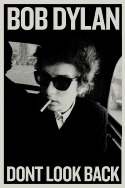
Review of Bob Dylan – Don't Look Back (1967) by Nathan M — 03 Mar 2011
"They've just got too much to lose by printing the truth." - Bob Dylan.
D.A. Pennebaker's Don't Look Back lives up to its reputation as a seminal example of Direct Cinema and the 'rockumentary' for the most part. It starts off with the music video for Subterranean Homesick Blues, already setting the edgy tone that survives to this day, although it would almost be considered stately today. The film continues with Dylan's arrival in London to thrilled fans and skeptical reporters and gets settled in a hotel room as he does, with a gracefully goofy Joan Baez as key company.
As an example of direct cinema or cinema verite, Back simultaneously stays true to the fly-on-the-wall approach to filming while using plenty of editing to remove excessive breathing room or to segue the audience directly to his performances from say an interview question. In terms of provocation as an element of verite film, Dylan's very intense and intellectual personality seems to overshadow the possibility that he was emboldened for the camera, but that situation is impossible to know for sure. In addition to showing Dylan's interactions and performances, hardball logistical negotiations undertaken by his manager are also shown, a practice very similarly reused by the memorable Rolling Stones documentary Gimme Shelter, about their controversial Altamont free concert. Overall, the 'behind the scenes' segments vary from the mundane of the aforementioned arrangements to the intense when Dylan shows his anger when one of his colleagues throws a bottle out of a tall building.
Of the various historical moments that the film captures, arguably the most weighty of them is the departure of Joan Baez. Up until this point, Baez is shown frequently in her usual state (on camera anyway), aloft and artistic. When the key moment comes though, it doesn't seem as significant as it becomes in retrospect. She simply kisses Dylan on the head and then walks out of the hotel room and apparently his life for the most part.
Dylan's challenging interview demeanor is also shown in several instances. The first instance is a press conference that is presented subsequent to his late night arrival at the London airport. He answers the inquisitive reporters while holding a large light bulb. The next notable interview scene is where he engages a 'science student' in a philosophical joust. Another significant interview portion occurs when Dylan overwhelms a Time Magazine reporter by telling him among other things that his and just magazines in general have too much to lose by printing the truth and also asks him: "Do you ask the Beatles that?".
Visually, the film is shot in a raw black and white, which pointedly accentuates the iconic low key lighting, ie. single spotlight on a solo Dylan in black (or what appears black) who blows into his harmonica headgear out of pure necessity.
In the end it is a film for a post-Beatles clientele, as defined in the film, who listen intently to what the songs say as opposed to just rocking and screaming to the groove. It presents brilliantly frozen and potent information in an entertaining arrangement and basically invented the form that subsequent rock docs followed and built upon.
This review of Bob Dylan – Don't Look Back (1967) was written by Nathan M on 03 Mar 2011.
Bob Dylan – Don't Look Back has generally received very positive reviews.
Was this review helpful?