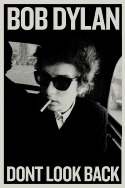
Review of Bob Dylan – Don't Look Back (1967) by Reagan W — 30 Oct 2013
Don't Look Back is an observational film directed by D.A. Pennebaker about Bob Dylan's England tour from April 30, 1965 to May 10,1965. During this time he preforms in Sheffield, Liverpool, Leicester, Birmingham, Newcastle, Manchester, and London. The main star of the film, Bob Dylan, is an American folk singer-songwriter and activist who became famous in the 1960s. His lyrics are famous for their powerful political, social, and philosophical meanings. A constant presence throughout the film is Joan Baez. She is an American fold singer-songwriter who dated Bob Dylan from 1963 to 1965. Joan Baez, like Dylan, is an activist for human rights and other social political movements. One of the more forceful characters is Albert Grossman. He represented Bob Dylan from 1962 to 1970 and is famous for his aggressive management style. Pennebaker promotes his belief that the media is biased through scene selection, mise-en-scene and sound in Don't Look Back.
Media bias is a common theme throughout the plot of Don't Look Back. In Bob Dylan's first interview in England, the reporters interrogate him about reading the Bible, and if his fans understand the meanings of his lyrics. Bob Dylan confronts the reporters several times about their own opinions during the interviews. When Dylan's treatment of these reporters and the reporter from the African Service of BBC are placed in juxtaposition, the difference is evident. In interview with African Service of BBC, Bob Dylan treats the reporter with more respect than any of the other media personnel that he interacts with in the movie. The questions posed to Dylan are less superficial regarding his humanitarian efforts rather than insulting his fans' intelligence. A science student, Terry Ellis, questions Bob Dylan while backstage before a concert. They discuss friendship, and why people form preconceived notions of others. Like with Terry, Bob Dylan challenges the Times reporter on several topics from the media to what "truth" means. This scene lacks many of the commonalities of an interview because Bob Dylan hijacks the event and rants for most of the scene about the media.
In Don't Look Back, Pennebaker uses mise-en-scene to make me dislike the media and view them as biased. While singing or hanging around with his friends Bob Dylan is always relaxed. His shoulders are down, his mouth is often turned up in a smile, or he is singing. These scenes make me sympathize with Bob Dylan and make me feel like I am there and happy with him. Compared to the interviews in which figure movement and expression such as his shoulders raising up, lips pursing and pulling straight, and his movements are tight and controlled. In the interview with the times reporter he leans forward, angling his shoulders toward the reporter. This makes me feel that the interviews are always confrontational events. The scenes of him with his friends evoke empathy in me toward Bob Dylan. The figure expression and movement of the interviews makes me dislike the media because I emphasize with Dylan, and I do not like to see him distressed. During the interview with Terry Ellis, Dylan waves his hand from the middle of his chest outward several times. I feel the motion dismisses Terry's answers as unimportant, and that Dylan's characterization of the media and the science student as biased are correct. Mise-en-scene is used to evoke an affinity in me toward Dylan and Pennebaker's worldview that the media is biased.
The cinematic style of sound is used by Pennebaker to promote the idea that the media is biased. In both the interview with the science student and the Times reporter his voice takes on a condescending tone. His pitch increases as he rants at the Times reporter. His voice becomes louder and higher pitched when he tells the reporter, "How can I answer that question if you have the nerve to ask me," when he is asked if he cares about what he writes his songs about. The volume, pitch, and timber of his voice when he is talking to the reporters make his distain for them obvious. I find myself feeling angry at the reporters and agreeing with Dylan that the media is biased due to the sound of the scenes.
Pennebaker is advocating the worldview that the media is a biased through mise-en-scene, sound, and scene selection. I am inclined to believe Bob Dylan's option on media bias presented in the film rather than feel sympathy for the media personal due the cinematic styles of mise-en-scene and sound. Pennebaker uses mise-en-scene and sound to evoke the emotions of anger and dislike in me toward the media by selecting scenes that contain disputes between Bob Dylan and the media. Regarding Bob Dylan's analysis of the media in Don't Look Back, Jeanne Hall in Documenting the Documentary says, "This level of analysis concerns itself with news organization in reason to society as a whole - the unwritten social and cultural guidelines they follow and the implicit ideological assumption they make" (Hall 231). In the middle of the film Bob Dylan even says, "All of the information presented by the media is lies and rubbish." The media are portrayed as judgmental often asking him about religion and if he has read the Bible or not. They also are portrayed as judging his fans as unintelligent. In the first and last interviews he is asked if he feels his listeners really understand his lyrics because they have meaning. The reporters show their bias in this question because it is obvious due to the langue the media view Dylan's fans as unintelligent. Bob Dylan explicitly points out the media's bias when he says, "And I don't think I'm a folk singer. You'll probably call me a folk singer, but you know, other people will know better." The media has already decided that Bob Dylan is a folk singer so nothing, not even the truth, will change their minds. Because of mise-en-scene, sound, and scene selection, Pennebaker's belief that the media is biased is both obvious and powerful.
I enjoyed watching this film, and I highly recommend it. Don't Look Back affected my options of the media, and it has given me a greater appreciation of Bob Dylan's early work. The film in is in black and white and the quality is poor compared to modern day film due to it being over forty years old; but it is an excellent documentary on the music scene, the media, and society in the 1960s.
This review of Bob Dylan – Don't Look Back (1967) was written by Reagan W on 30 Oct 2013.
Bob Dylan – Don't Look Back has generally received very positive reviews.
Was this review helpful?