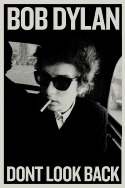
Review of Bob Dylan – Don't Look Back (1967) by Kelli R — 29 Oct 2013
Off the Stage.
A young folk singer, Bob Dylan performs not to show off his melodies or his harmonica skills but rather his poetic lyrics. Although he never explicitly describes the meaning of his lyrics, the beauty of his songs lies in that the audience creates its own interpretations. Don't Look Back, a 1967 observational documentary directed and filmed by D. A. Pennebaker, documents the stepping stone in the musical career of the man known for his nasal voice, leathery jacket, brushy hair, cigarette and sneering look. Although his overall success and countless awards reflect his revolutionary talent and ambition, I believe this documentary successfully distinguishes the sharp line dividing his musical talent from his self-important and inflated character.
Don't Look Back documents Dylan's 1965 tour around England, showing his casual conversations with friends, apathetic but sometimes engaging interviews, outstanding performances both on and off stage, and the occasional encounters with his fans. From the beginning, Dylan does not expect much as he comments to a stranger, "I figured just do the same thing I did before." What he does not realize, however, is that this tour and its events gradually changes Dylan musically and characteristically, as shown through this documentary. He begins his tour at Sheffield City Hall with one of his most famous songs, "The Times They Are a-Changing", as he does with every concert. Throughout the film, Albert Grossman, Dylan's manager, makes his unforgettable appearances; one scene he confronts one of the hotel managers who tries to silence the chatters. Soon after the manager steps in Dylan's room, Grossman starts calling him names like, "stupid nut" and "dumb". All the while Dylan is chuckling at the unnecessary seriousness of the situation. After he performs several concerts, he speaks a word with the High Sheriff's wife who tells him how much she appreciates his music and invites him they share their songs together. He also has his long-wished meeting with his musical rival, Donovan. The film reveals much of Dylan's character and successfully depicts him as an individual, which most interviewers only attempted to do.
D. A. Pennebaker intelligibly shows the difference in Dylan's musical talent and his character through his use of film techniques during the scene with the science student. This is the only part of the film where the mis-en-scene shows both of his character and of him playing his guitar. The director is clearly trying to show how his music does not necessarily define who he is and that the only real reason people respect him so much is his revolutionary and ingenious music-not his character. Throughout this part, Dylan and the science student talk about what they believe a "friend" is and what Dylan's attitude towards journalists is. After hearing what he says, I began to see the superficiality in him. His egotistical nature inhibits his ability to make friends unless they have some material or non-material benefit to him. Interviewers and journalists, those who seek to benefit from him, are treated with dislike; he remarks, "I don't like them." All the while, Dylan is casually strumming his guitar and playing along with Alan Price on the piano. This scene is significant in that it displays what lies behind Dylan's guitar and harmonica.
Another aspect of cinematography that Pennebaker uses to contrast Dylan's music and his character is the sequence of events that appear after his conversation with the interviewer from Time magazine. Right after he finishes implicitly insulting him and explaining his insignificance, the camera cuts to the preparation of his next concert. A few frames later, Dylan walks up on stage with a loud applause and begins his wonderful performance that everyone so dearly respects. I believe this film is so perfect in documenting Bob Dylan because of the way he is displayed both on and off the stage. He belittles the poor interviewer by saying that he is infinitely more important and that he will never understand the things Dylan does or why and how he does them. He selfishly avoids all of the interviewer's questions and turns them against him. Then, the following sequence of Dylan's performance is what Pennebaker intentionally organized to differentiate Dylan as a musician and as an individual.
Pennebaker does a successful job in distinguishing what most people see of Dylan and what few people see of him. The film displays Dylan's encounters with all kinds of people, from annoying interviewers whom he messes around with mercilessly, to his casual talk with his inner friends. It is even revealed by Dylan that most of what he says to interviewers is lies, so he essentially toys with people who seek his answers. What is interesting about this documentary is, however, that the audience of the film chooses his/her own interpretation of Dylan as a character. Many, even I, will come to an agreement that his on-stage performances are record-breaking. His nasal voice delivers his poetic lyrics in a way that reflects the voice of a complaining people and thus adds power to his lyrics, although Dylan himself says that, "I'm not gonna say anything about 'em, I don't write 'em for any reason. There's no message." Much like the language of poetry, Dylan's words are chosen to be interpreted more by the listener than the writer-whatever it might be, there is a beauty to each of his songs. However, on stage is where most people see Dylan. A very few people see what Dylan is like behind the curtains; this film does its job in documenting Dylan wherever he goes.
His character, on the other hand, has many different interpretations, much like his lyrics; I observe him to be self-centered, shallow and lacking in empathy, otherwise a narcissist. In one account, Dylan mercilessly attacks and questions a Time magazine interviewer by saying, "I know more about what you do-and you don't even have to ask me how or why or anything-just by looking, than you'll ever know about me. Ever." This quote describes his inflated, egotistical attitude toward the press and media. As Jeanne Hall puts it, "it culminates in the poet challenging the journalist to take his job and his very existence seriously, knowing that he will someday disappear from the face of the Earth" (Hall). During the beginning of the film, it comes to knowledge that Dylan has not read the Bible, so it can be assumed that he is not religious. Because of this, he stands strongly for his own beliefs and determines how his life runs. A reason that Dylan acts the way he does to the press could be that he perceives them to be annoying journalists who interfere with his passion for playing music. He does not answer honestly to questions because he believes that as long as he can sing and play music, he shows no interest in what the popular media labels him.
Don't Look Back was, in fact, the pioneer of rock documentary and it successfully portrayed Dylan's journey from folk to rock and roll in its finest detail. It is very informative of both Dylan's character and musical talents. The film not only features Bob Dylan as its prime star, but also shines light on his friends like, Bob Neuwirth and Joan Baez, his manager, Albert Grossman, and even Donovan Leitch who was, at the time, Dylan's rival. After watching this film, my views of Dylan has changed completely but somehow my respect for him has increased.
This review of Bob Dylan – Don't Look Back (1967) was written by Kelli R on 29 Oct 2013.
Bob Dylan – Don't Look Back has generally received very positive reviews.
Was this review helpful?