Review of Blue Valentine (2010) by Reelviews94 — 23 Mar 2016
An intensely acted, minutely observed attempt to convey the arc of a romantic involvement.
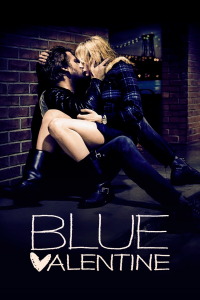
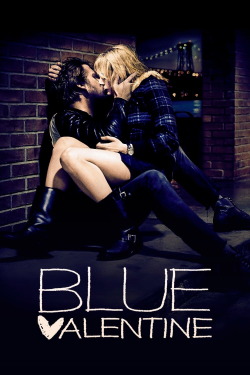
Shooting in intense closeups with long lenses and the Red digital camera system in the contemporary breakup scenes, Cianfrance immediately conveys the impression of eavesdropping on real life. Dean (Gosling), a good-looking regular Joe rarely without a cigarette and a beer, horses around at home with young daughter Frankie (Faith Wladyka) in a modest wooded Eastern neighborhood. Wife Cindy (Williams), who’s naturally attractive but letting herself go, seems sulky; life seems limited, there is a cloud concerning their missing dog and Grandpa (John Doman) is on oxygen.
On a quick grocery stop, Cindy bumps into Bobby (Mike Vogel), an ex she hasn’t seen in a long time, who impudently asks if she’s been faithful to her husband. Disgusted, she later mentions the encounter to Dean, who goes into a petulant snit. No matter what they discuss, Dean and Cindy end up arguing; their dynamic is uniformly negative and destructive.
Flashing back a few years earlier, in material shot for greater depth of field and visual detail with a shorter lens and on Super 16mm, a younger Dean (defined mostly by a fuller head of hair) happily takes a job with a moving company in Brooklyn, while Cindy is a student with an eye on the medical profession, with wrestler Bobby as her b.f. Dean and Cindy meet while helping people at an old folks’ home, and Dean is genuinely funny and charming in courting a girl he quickly comes to love and desire as his lifelong mate.
The film swings back and forth between the rising feelings of a developing relationship, one complicated by an unplanned pregnancy, and the downward spiral of its fracture. In the contemporary timeframe, the couple go to a “romantic” hotel, and while there is some upside to their night together, Cindy is ultimately called upon to cut it short for work, which leads to a giant blow-up.
Cianfrance, working with co-screenwriters Joey Curtis and Cami Delavigne and undoubted input from the actors, has succeeded in creating a precise mosaic of a relationship from innumerable small details; moment to moment, the film lives and breathes with emotional truth. The looming question, however, is whether or not it gets to the bottom of what went wrong between Dean and Cindy. It’s clear that Cindy comes to feel that Dean will always love and be there for her, and he is; he’s also a good father. However, he never matures, displays no ambition and seems oblivious to the issue of how they might improve their lot in life, which is terribly mundane.
While all this is no doubt disappointing to Cindy, she hasn’t helped matters by retreating into a cocoon, and despite a decent job, she hardly seems more capable than her husband of helping to raise the family out of the doldrums. The film is so focused on charting the couple’s emotional fluctuations that even a slightly bigger perspective is never suggested; it’s difficult to pinpoint what went wrong or if there were roads not taken that could have prevented the sorry outcome.
Scruffy-looking but handsome, Dean reaches his full potential when he marries Cindy; he apparently assumes life can just go on from there without any particular planning or strategy. Cindy is similar in this respect but, unlike her husband, is dissatisfied with the stasis. Gosling and Williams interact beautifully and without a false note, their deep immersion in their roles resulting in nothing but behavioral truths.
It’s also a muscular, highly controlled piece of filmmaking, with its photographic style carefully judged and the editing balancing both dual narrative tracks and quicksilver mood changes. Craft contributions are uniformly strong. Lensing was done in Pennsylvania, with some location work in New York.
This review of Blue Valentine (2010) was written by Reelviews94 on 23 Mar 2016.
Blue Valentine has generally received positive reviews.
Was this review helpful?