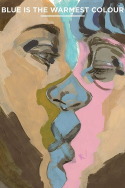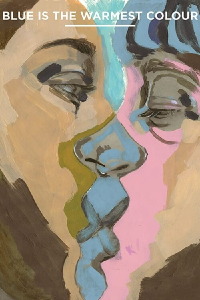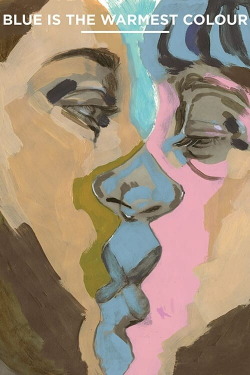
Review of Blue Is the Warmest Color (2013) by Peter C — 24 Dec 2013
I have sat through World Cup football qualifying matches half the length of this film and wanted to gouge my eyes out.
I have sat through award winning Edinburgh Festival plays a quarter the length of this film and wanted to choke on my tongue.
I have sat through wedding ceremonies of close family members an eighth the length of this film and wanted to impale myself on the church railings.
But, during the three hours (I repeat three hours) running time of Blue Is The Warmest Colour, time stopped, the outside world disappeared (as did my problems, which are many and mounting) and I was hypnotised by this utterly enchanting, seductive and heart-breaking story about young love - from feeling unloved, discovering it, exploring it, marvelling in it, falling in and out of it, and emerging out the other side of it bruised, battered and more than a little bewildered, but truly alive, albeit alone.
The main focus of the film is Adele who at the start is a cute, brown-eyed, Bambi of a girl on the cusp of womanhood trying head scratchingly hard to get her head round the unfathomable complexities of French literature at school (she is fifteen).
John-Paul Sartre, the existentialist philosopher and writer, features heavily. What is the purpose of life? What is this feeling of emptiness? And (as the rent boy said to the bishop) how can I fill it?
Adele doesn't know the answers (who does?), but she is a hopeless romantic, on the lookout for "the one" and hopes that in finding him (or her) the emptiness will disappear and she will feel complete.
At first, she falls for the Brad Pitt of the school, who in turn falls for her. "How was the sex?" her gaggle of giggly friends demand. "Did you fuck him?" they demurely enquire. She hadn't and says so, but they don't believe her. But, hey ho, that's alright, because the thought that she had satisfies them just as much as her.
Around the same time, an innocent and unexpected kiss from a female friend stirs deep emotions within her and she suddenly awakens to the realisation that she can have sexual relationships with women as well as with men. Overnight, she is besotted. But more with the idea than the person. She makes a move, but her feelings are not reciprocated. So it's back to square one, back to her lonesome ownsome, back to her feelings of emptiness.
But only temporarily.
For, like Alice In Wonderland, "curiouser and curiouser" she returns to Brad Pitt. And this time they do have sex. Was it great? No. Was it good? Yes. But was it satisfying? Hmm, the emptiness returns.
And then she meets someone who changes her life for ever.
That someone is Emma (aka The Girl With The Blue Hair, who I presume is a cousin of The Girl With The Dragon Tattoo), a sexy, intelligent, cultured twenty-something who is as passionate about life and love as she is about philosophy and fine art.
They fall in love. At first sight.
And for the first time in her life, Adele becomes the chaser and not the chased, the hunter and not the hunted, the coveter and not the coveted. Even when she agrees to sit for a painting, the subject watches the artist more than the artist watches the subject.
From that moment on, right up until the closing credits, what we see is one of the most brutally honest and up-close explorations and celebrations of physical, sexual, emotional, intellectual (and every other sort of -al) love ever shown on the big screen.
Lots of things happen in between, the listing of which would be exhausting not to mention a bit of a spoiler. But here's a few generalities. Explicit sex scenes which make for compulsive if uncomfortable viewing (graphic, voyeuristic, but important). Internalised homophobia driven by fear and shame, as well as externalised homophobia driven by fear and ignorance. Deep philosophical conversations about life and art and the meaning of both and neither. I could go on...
The film ends (as it did at the start) with the camera focussing on Adele, all by herself, exiting through a doorway, walking down a street, on her way to somewhere. But where? At the start of the film, she knew. At the end of the film, she doesn't. But is she happier? Is she more content? Has she grown as a person? Ay, there's the rub!
Once again we are back to the questions, back to the emptiness, back to the existentialism and back to the philosophy of John Paul-Sartre, who famously wrote, "We are left alone, without excuse. That is what I mean when I say that man is condemned to be free. Condemned, because he did not create himself, yet is nevertheless at liberty, and from the moment that he is thrown into this world he is responsible for everything he does.".
4/5.
This review of Blue Is the Warmest Color (2013) was written by Peter C on 24 Dec 2013.
Blue Is the Warmest Color has generally received very positive reviews.
Was this review helpful?