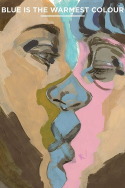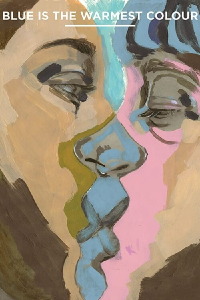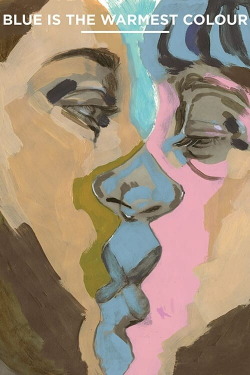
Review of Blue Is the Warmest Color (2013) by Sleepingbeauty — 08 Feb 2014
The problem with "Blue is the Warmest Color" is not pornography, it's Dogma...or at least it's legacy.
For those who don't remember, Dogma - or Dogmé '95, if you prefer - was that style of filmmaking championed by Lars von Trier and some other Danes that made the co-opting of direct cinema for the purposes of fiction filmmaking their "revolution." It's aesthetic was amateurism, poorly lit or completely unlit scenes, handheld camera work, only incidental music. It promised to restore honesty and vitality to movies, something these filmmakers felt was lacking in mainstream Hollywood cinema of the time. Twenty years ago this may have stood for something but the fact of the matter is that Dogma's aesthetic has been completely absorbed into our visual vocabulary. Whatever strength lied in the immediacy and spontaneity of its method has become a trope, a cliched code for "reality" and "honesty" and it's proliferation is increasingly just a cover for plain awful filmmaking. Director Abdellatif Kechiche's film, "Blue is the Warmest Color," is a great example of how (since this style and its variations are so ubiquitous a distinction must be made between the aesthetic of Dogma influenced dramas and the commonly employed style of the "mockumentary" used to great effect in comedies that is basically a combination of direct cinema and cinema verite but not the subject of this critique).
Where to begin with the ineptness of this film? There's almost too much to talk about. Lets just look at one of the worst scenes: Adele and Emma's first encounter.
So much has been made of the staginess of the sex scenes in this movie that no one has said anything about or even noticed the staginess of almost everything else in the movie? Nearly every beat in this film feels false and sloppily conceived. It's ironic that the very technique which is supposed to give a greater sense of reality to the picture actually exposes its fraud. Adele first sees Emma in the middle of a cross walk. Adele crosses the street one day soon after her first kiss with another girl and spots Emma, an apparently out lesbian who looks her over. Adele stops in the middle of the cross walk to blankly stare at Emma as she passes her by. Keep in mind this is a very busy crosswalk on a bustling street. Miraculously, Emma, walking with her arm around another girl gives Adele a good looking over as well in the middle of the crowded intersection. This is their first encounter. Now who stops in the middle of a busy intersection to stare at someone walking passed them? Well, possibly someone possessed by some great life forsaking impulse. And then what fortune that the person you just looked at returns your stare with her own head cocking once-over as well! Ironically, this scene is both overplayed and underplayed at the same time. Stopping dead in the middle of an intersection is the kind of big deal moment that we would expect from an brash over-the-top Hollywood movie. But this movie trades in the subtleties, the information gained by noticing the incremental changes on a person's face or in their behavior so instead of say, a set of dangerous or hilarious consequences befalling Adele as she stands there, nothing really happens at all. She just stands there staring autistically for a very, very long beat. Now I understand that she's apt to stare autistically, the movie makes a big point of it, but standing in the middle of traffic to do so is a dangerous faux pas. If we're to believe she's suddenly found herself doing such a unusually thing on account of something so remarkable as Emma's beauty this is probably the opportunity to make a point of it. But the movie just simply doesn't seem to think much of it. The scene is handled so clumsily, so awkwardly straightforward and absent of any kind of directorial insight or angle that the whole scene comes off comically unrealistic. It completely lacks any sense of Adele's emotional intuition even though we can clearly see whats going on. This is the subtle power of a director: to use a remarkable and unlikely event to show us something about a character's inner world, their desires, their realizations or their emotional progress. If it works you might accept the absurdity of the situation that brought the insight forth ; it's a kind of slight if hand, the kind this director and Dogma would surely disdain.
So what's the point of the intersection if you're not gonna do anything with it? The problem here is more than aesthetic. It's the first time the director really fails to let us into Adele's world, to help us feel what she's feeling. We merely cognate that Adele is attracted to Emma, we never feel that she is. And even then we only cognate that because we have presumed what her desires might be after being spurned by the girl she kissed earlier in the film. If it weren't for that scene we would really have no idea why Adele is staring at this girl. The Hollywood filmmaking techniques that dogma eschews can convince us all kinds of fantastic fabrications from outer space monsters to zombie time traveling monkeys. But these filmmakers struggle to make even the simplest concept ring true.
It also doesn't help that they are also some of the most egregious violators of writing's essential concepts like the rule of "show me don't tell me." These movies are so hampered by their rejection of normal story telling technique (and creativity) that they have to spend the entire time telling us what's going on. It's ironic that a filmmaking style so confident in its ability to convey the immediacy of a character's world and experience must relentlessly fall back on the dialogue to tell us what the characters are thinking, feeling, planning and doing. And in this movie, over and over again, the actors spew the same lines with the same meanings making the same points, ad naseam. Kechiche has clearly found no other way to tell us that Adele is really obsessed with Emma other than to have her repeat that sentiment endlessly. Film is a visual medium. Great films communicate visually, not with talking. But Dogma disenfranchises filmmaking of its greatest strength - the image. In its place it has attempted to revive the muscle of the writer, subtly implying that the image in its decadence has betrayed cinema's higher purpose. But writing for the screen is precisely the art of writing so that things are visually comprehensible. Every "hack" writer in Hollywood can do this but Dogma in it's mission to restore cinematic purity fails to deliver us any new useful idea. And naturally, in the absence of any good writing, the enfeebled, hackneyed image they're left with fails to deliver as well. Giant close ups of noses, eyes and mouths don't fill in the gaps of bad writing. The documentary style they employ, so often fixed on the deep close up keeps us permanently on the outside of the actor. Instead of getting closer to a character we're stuck on their face, never allowed into their interiority. There's just no lens long enough, no close up big enough to get inside a character's world. The lenses of these filmmakers desperately search the faces of their actors looking for some look, some glance, anything that could get us in there. But, alas, nothing. The shots in "Blue" run on and on pressing the limits of acting - and our patience -but there's only so much an actor can do. And these actors took it as close to the limit as we could ask but it still wasn't enough. If only the camera could burrow into the actor's faces.
Now, don't get me wrong I understand the arguments about this Dogma style defying the traditional Hollywood narrative filmmaking that compromises the truth and integrity of a character and their moment in favor of a set of suspect narrative imperatives probably meant to accomplish the normalization of traditional values and conservative ideologies. I even agree with this conceit! And I also get that with a less lavish production (or in their case, no production at all) a more disengaged (read: objective) view point should empower the audience to seek information from the actors themselves rather than getting that information shoveled to you. These are nice ideas but this solution simply does not work. The aesthetic and the meaning of this movie have no commonality. They don't work together. Here's the problem: the aesthetic is essentially a lie and the meaning of the movie remains elusive because the aesthetic actively impedes its delivery. Dogma movies and their kin have merely created a different style of **** shoveling. Only theirs is in the guise of the audience's free reflection. But we all know that these filmmakers are including and excluding as much of a story or character as any mainstream film, just as committed to the delivery of a narrative, which restricts and expands reality as much as any other style. Its just that these artists seek the imprimatur of a documented reality rather than the common fiction of popular movies (insomuch as direct cinema documentaries are guilty of the same kind of above described contrivance, the fact that they deal with actuality, not fiction deserves a forgiveness we shouldn't extend to Dogma).
"Blue is the Warmest Color's" aesthetic can basically be described as botched voyeurism. We're only allowed as much insight into the character's lives as a peeping tom could get but then once there all the things we see are at best un-informative and at worst badly blundered contrivances. At least if we're going to have the privileged view point of a spy we should see things so intimate or private they could open a character's world to us. But then again maybe that's just the fantasy of voyeurism and this movie is the reality: that spying on people probably tells us very little about other people or worse, that other people's lives are just as boring as our own. That being said I don't think any of ours lives are quite as incredible as the ones on screen in this film. Take the ridiculous break up scene where Adele simply walks out the front door after a blistering five minute fight with Emma and ends their relationship by politely closing the door behind her or the problem that we cannot tell that Adele is any more interested in Emma than anybody else she's with in the movie because nothing in her behavior or the filmmakers technique tells us either way. In fact, since we have so little idea what Adele is feeling in this movie we must simply deduce that the relationship with Emma is the important one because its the one we have to endure for three hours...
God, I sure hope it was, I'd hate to have to watch a sequel.
There are some good things in this picture...some of the acting is pretty good but the director unfortunately did nearly everything he could to get in the way of it. In that he succeeded mightily.
Finally, don't get me started on the pornography. This was not pornography. I make pornography. Pornography is beautiful, startling, dangerous, powerful, boring, arousing, open ended, liberated and enslaved all at once. These people don't know the first thing about pornography. I wouldn't disparage it that way. Only the French could make a movie about sex so unsexy. Don't believe me? Try watching French porn sometime.
This review of Blue Is the Warmest Color (2013) was written by Sleepingbeauty on 08 Feb 2014.
Blue Is the Warmest Color has generally received very positive reviews.
Was this review helpful?