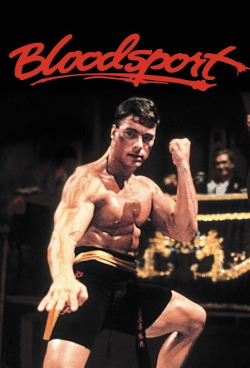
Review of Bloodsport (1988) by T W — 06 May 2015
When you go out to dinner, and you can choose anything between a Michelin star restaurant or take-out, you nonetheless realize there's value in each choice, wherever your choice happens to land. I've read a lot of the reviews on Bloodsport, and I think many people are expecting Michelin star food at a road-side food truck. Each movie has it's own niche. Not all movies are good, and not all movies are good at what they do. Bloodsport is one of those movies which must be given context before you see it, and most importantly before you critique it.
If you're expecting a Bogart, Brando, or DeNiro performance, with a Lucas, Spielberg, Cameron, or Kubrick vision, then you're already set up for disappointment. If you think Van Damme is going to deliver an Oscar, then honestly, you really have no business being a critic that's actually being paid to write. Just like everything else in life, context is often the whole enchilada.
This movie is a debut film for a martial-artist, turned actor, not the other way around. Van Damme, despite his critics, was actually a well-accomplished martial-artist, that happened to be good looking, and also possessed some charisma. Another point that I think really gets lost in the fold, is that if you have zero appreciation for martial-arts, the mental and physical training, the spirituality of the art, and the metaphysical properties of the art when practiced at the highest level, then this film will simply fall on your deaf ears and blind eyes.
There is something sincere and authentic about this film that resonates with me each time I watch it. I feel this movie knows it's not just about the fighting, but also the mental and spiritual side of martial-arts. If it feels a bit Hollywood, that's because it is. This is not a training video on martial-arts, it's a big-screen movie, so it has to be entertaining to all, and not just the martial-arts enthusiasts. To me, the acting is irrelevant. Bloodsport does it's absolute best in trying to capture the essence of world-class martial-arts in the competitive arena. Statistically, the fighting scenes comprise a fairly small section of the film, although the scenes are memorable. The film is really about a guy honoring his shidoshi (trainer and mentor) while he (the shidoshi) is on his death bed. The significance does not lie simply in someone going to fight full-contact to honor someone. The significance rather, is contained in the fact that Dux was not Japanese, yet became a master of something inherently sacred to the Japanese culture. The film really is about transcendence across cultural boundaries. Van Damme may be awkward in many things, but the seriousness never wavers when the martial-arts are concerned. There is an intense focus going on, that captivates the audience, unless of course, you're still waiting for foi gras on that street taco.
This film is all about contrasts, yet bridging that gap in the end. The foil for that whole concept, aside from Dux, is the guide Mr. Luu (the guide into Kowloon City). The guy is Chinese, through and through, yet he speaks english with correct colloquialisms, and is very in tune with Western culture; and that is what makes his character so memorable. He's a hodgepodge of cultures that identifies with many.
However, despite Dux's clear mastery of martial-arts, given his "Dim Mak" rendition and his fighting prowess, he never oversteps with hubris. That is a critical point for the films' significance (much like Luu's). Dux masters an art from the East, but still remains humble in that mastery. That is why this film carries significance, and is in fact a quality film. Bloodsport knows what it is, and never tries to pretend it's something else. Van Damme is unapologetic, because he stays within the realm he knows, which is why the training, fighting, and meditation scenes are always so serious and sincere. There is a clear reverence for martial-arts throughout the film. Ironically enough, a western film taking on an eastern art, purposefully makes fun of those whom think martial-arts is all about the flash of knowing how to beat someone up (with the Jackson character). Jackson is a "beer monster" (to reference another review), that is crude and untamed. Although Jackson is a tough opponent in the arena because of his size and the twinkle of crazy in his eyes, he ultimately loses because of his lack of humility and honor for the martial-arts. He could easily have beaten Chong Li, and probably fought Dux for the title, but-for his premature celebration when fighting Chong Li. Thus, the movie reinforces it's original stance of a reverence for all the elements of martial-arts, and not just the fighting aspect. It is this idea that makes Bloodsport such a good movie, for what it's trying to be.
The true value and merit of this film is exacerbated by juxtaposing the rest of Van Damme's career. Van Damme tries to become more of an actor, and less of a martial-artist. For obvious reasons, his career deviates from the core theme of Bloodsport. Despite his staggering commercial success, Van Damme's career is probably more on par with the overall critic's rating of Bloodsport. I applaud Van Damme for his overall success, however, the rest of his movies, outside of Kickboxer (just the first one), were mostly laughable. Bloodsport however, is an exception. It's not a coincidence Van Damme's best work was his earliest. The people who don't like this film probably think martial-arts is all about the fighting. If it was all about the fighting, Bloodsport would be an action film, and not a martial-arts film. I don't blame them for that, but why bother watching/reviewing a martial-arts film, if you have such a superficial grasp on the topic? One does not have to rationalize everything about this movie to appreciate it, they simply need to calibrate their expectations to what the movie set out to do.
Unlike many other action films, Bloodsport really emphasizes and reemphasizes the complete scope of martial-arts, and not just the glamorized fight scenes. This is what sets Bloodsport apart from most, and why this film has such a divide between the critics score and the audience score. Bloodsport is not just a guilty indulgence such as Roadhouse. There is substance here, you just need to know where it's placed, and not where the low-hanging fruit is typically found.
This review of Bloodsport (1988) was written by T W on 06 May 2015.
Bloodsport has generally received positive reviews.
Was this review helpful?