Review of Blade: Trinity (2004) by Darik H — 01 Apr 2011
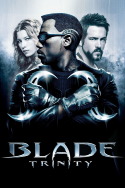
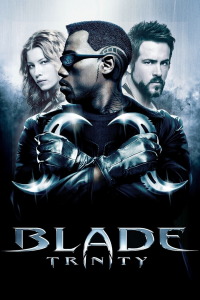
Sometimes being a good writer and being a good director are two mutually exclusive ideas. Such is the case, sadly, with David S. Goyer. The guy can write a hell of a screenplay- as demonstrated by his work on Batman Begins, the Dark Knight, and the first two Blade films- but as a director, Goyer has almost no sense of style or visual craft, and nowhere is this disparity more obvious than it is in Blade: Trinity. The third and final film in the Blade trilogy, Trinity is also only the second film to ever be directed by Goyer, and it shows; the compositions are bland and unappealing, the editing alternates between anemic and incomprehensible, and even the action, well-choreographed though it may be, feels dull and uninspired. Sure, the script has some great ideas going for it, and yeah, Goyer does manage to get some pretty decent performances out of his actors (in particular the new additions like Ryan Reynolds and Parker Posey), but the man is totally unversed in the language of cinema; he throws in camera moves at inappropriate moments, frames his heroes almost entirely in static medium shots, and has no idea how to emphasize the drama of a scene. Because of this, the movie just feels like dead weight- there's no energy to it this time, no fun or excitement, and when the pace slows to a virtual stop halfway through the film, you can't help but wonder what you ever saw in the Blade movies in the first place. What really bites about the sheer magnitude of his failure on this film, though, is that the story had the makings of a truly enjoyable send-off to the Blade series, with a satisfying culmination to the character's journey (in script stage, anyway) and probably the perfect villain (again, conceptually) to face off against the half-breed anti-hero in the finale; it's ironic that the only thing keeping the screenplay from reaching its full potential is the man who wrote it himself.
The original pitch for this movie was pretty sweet, if you ask me: Goyer initially wanted to set the last Blade a good twenty years or so in the future, in a post-apocalyptic world ruled by the vampires in which only small cells of resistance fighters remained, Blade being the leader of one of them (since he ages slower than humans, he would look virtually the same, and still be in fighting shape). While this was, clearly, an awesome idea, Goyer ultimately scrapped it when he heard that an adaptation of I Am Legend was being put into production (which ended up not even featuring vampires, go figure), and instead concocted a new, less innovative (but potentially just as interesting) story. In the near future, the vampires are stronger in numbers and influence than ever before, and they begin to set in motion their plans to conquer the human race (for only like the third time in a row). As the war between Blade and the undead starts spilling into the streets, the Daywalker becomes a target of the F.B.I., and before long they locate his base of operations and trash the place, killing Whistler in the process and bringing Blade in. Before he can be killed by the vampires who control the cops, however, Blade is rescued by two new heroes, Hannibal King and Abigail Whistler (yes, that'd be Whistler's heretofore never mentioned daughter-who-just-happens-to-also-kill-vampires), who are part of a vamp-hunting team called the Nightstalkers. Their timing couldn't be better, either, as Blade needs all the help he can get- the vampires, in their desperation, have finally resorted to awakening the progenitor of their entire undead race, Drake (or as he is more popularly known, DRACULA), to destroy the vampire hunter once and for all. Now, aided by a new biological weapon that could mean the end of every bloodsucker on the planet, Blade and the Nightstalkers have to pull off a last-ditch assault on the undead forces threatening to consume the world... before they, you know, consume the world.
Wesley Snipes is back once more in the role of Blade, a roll he made iconic in the first place, but something just isn't quite gelling this time. Maybe it's because of the disputes he reportedly had with Goyer over the reduced screen time his character gets to make room for the new supporting cast, but I can't help but get the feeling that Snipes is just phoning his performance in. Even so, he does get in a couple of cool moments as he's forced to be a team player again, this time with a bunch of snot-nosed punks who aren't even in the same league as him yet somehow don't get ripped to pieces when they start going toe-to-toe with vicious, super-strong vampires. Said punks, the Nightstalkers, are headlined by the aforementioned King and Whistler, who are played by Ryan Reynolds and Jessica Biel, respectively. Reynolds is probably the only reason one should even consider watching this movie, as his character Hannibal King is a fountain of sarcastic one-liners that are worth the price of admission alone. He's also a surprisingly capable action hero, as King actually gets into a fist-fight with an enormous man-mountain of a professional wrestler and holds his own, albeit painfully. Jessica Biel, on the other hand, is insufferably bland- her whole big character-defining trait is that she listens to MP3s while she hunts. MP3s are cool, right? That means she's cool, doesn't it? ... No. No it doesn't. Other than that, she only has two modes: "emotionally fragile waif" and "laughable Blade impersonator". The rest of the Nightstalkers are pretty unremarkable, except for Patton Oswald, who has no business being in this movie, and Natasha Lyonne as Sommerfield, the blind bio-tech expert, who actually wrings out the only pathos this movie has to offer in her relatively short role. Speaking of short roles, Kris Kristofferson is back as old fogy Whistler, appearing in a grand total of three scenes before they kill his ass off for the second time; nothing says creative desperation like killing, resurrecting, and killing a central character in the span of just three movies. On top of all that, the baddies in this movie don't hold a candle to the villains from the last two films. I like Parker Posey, and I actually think she does a great job as the blase yet quirky vampire superbitch Danica Talos, but she just isn't intimidating in the least- particularly since the hair stylists on the movie insist on giving her the Ace Ventura look. Her lackeys aren't much better; Triple H is probably the standout as Jarko Grimwood, but while the guy has size, he also has all the acting talent we've come to expect from the pro-wrestler set. Finally, there's the biggest disappointment of all: Dracula, alias Drake- the lord of the undead, king of the vampires, etc. etc.- as played by Dominic Purcell. I don't know about you, but when I think "Dracula", I do NOT think "block-headed, melodramatic lump". Purcell is woefully miscast, unable to conjure even a single iota of menace as he shifts between lumbering silence and awkwardly-shrieking his way into action; while he occasionally delivers a moment of sincerity (his final monologue to Blade is actually pretty decent), the overall performance is robotic, as if Purcell has completely forgotten how to make even a single human gesture or inflection (and before you question whether or not that was an intentional choice, trust me- it really doesn't matter). The only redeeming aspect of the character is his climactic transformation into the awesome Drake Beast, a seven-foot tall crimson monstrosity who receives far too little screen time and is actually played by creature performer Brian Steele.
The script by David Goyer is an interesting one, playing with both the popular concept of the vampire and the literal possibilities of the creature. Goyer's always been an idea man, full of interesting takes on old stories and, in the Blade series, fun twists on vampire lore (hell, the whole concept of urban vampirism came pretty much from the first movie!), but apparently without a collaborating director to keep an eye on the dramatic heart of the piece, the guy's totally unable to convey the pathos in his own work- and there's plenty to work with in the script to Blade: Trinity, believe me, but Goyer just can't bring it to life. Maybe it's because the cinematography by Gabriel Beristain, which seemed to work in Blade II, is so god awful here, alternating between dull, flat colors and a pallid vomit-yellow that permeates the frame and robs it of all livelihood. The music, too, seems to be lacking the energy and drive of the first two films, which is pretty shocking considering that it's done by the RZA- but then again, rappers don't always make the best composers (I miss the Confusion Pump Panel remix...). It's just... I don't know. In every production category, I can't think of a single word to describe this film more aptly than just... "boring." This is a Blade film. BORING SHOULD NOT BE PART OF THE EQUATION.
Following this travesty of a film, Goyer would go on to write The Dark Knight and direct The Unborn, among other things, thus proving that he has no talent for filmmaking beyond the written word. It's a shame, too, because Blade: Trinity could have kicked some serious ass if it'd been helmed by even a halfway-competent director. Stephen Norrington, Guillermo Del Toro, and Christopher Nolan have all been able to craft fun, engaging movies from Goyer's screenplays; what could David Slade have done with this third installment, I wonder? Or Matthew Vaughn? Danny Boyle, even? So many filmmakers could have lent this script the style, pacing, and personality it was missing. With Goyer at the helm, though, the film just comes across as bland, a litany of cool ideas unfettered by drama or any sort of emotional attachment to the characters. Goyer is all concept, no execution- he's an idea man, pure and simple. I feel bad for the guy, really... but not so bad that I'd want to watch Trinity again. It's a stale send-off to an awesome franchise, marred by blandness, haphazard pacing, wholly inappropriate cast choices, and a really pathetic resolution to the character arc of Blade: after beating Dracula and releasing a virus that we are TOLD will kill every vampire on the planet, Blade, rather than finding the peace he was striving for and relinquishing his role as Daywalker, instead just rides off into the night as the voice over tells us that "the war never ends". Except, you know, when all the enemies are dead, right? Then wouldn't the war, by definition, be over? It's a lame cop-out that leaves the door open for sequels (or a crappy T.V. adaptation that only lasts for one season, as it were), but consequently finishes out the franchise on something of an anti-climax. Considering how the rest of the movie turned out, though, I guess that's appropriate.
This review of Blade: Trinity (2004) was written by Darik H on 01 Apr 2011.
Blade: Trinity has generally received mixed reviews.
Was this review helpful?