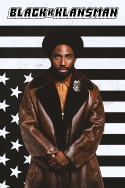
Review of BlacKkKlansman (2018) by Viaje — 13 Sep 2018
Can you really be "entertained" or "educated" when you're immediately aware the film you're watching is intentionally biased to manipulate you to a political paradigm not based on the truth? Think about it.
Instead of providing serious treatment of the subject matter, at best, the "Blackkklansman" functions as a parody of "true events," or even worse, a lousy derivative of "Undercover Brother (2002)." That's right, "Undercover Brother," starring Eddie Griffin, Jr. and directed by Spike Lee's cousin Malcolm D. Lee is superior to "Blackkklansman" with a better script, direction, editing, and acting, plus it's also "Blacker.".
The script failed to detail fact-based images of Stallworth conducting surveillance to document actual criminal activity being performed by the KKK, and instead the film took "artistic license" to present: (1) chronologically incorrect social and political rhetoric; and (2) stereotypcial degrading images of Black and White people. Remember, this film is based on a "true story," but instead of dealing with the truth, Spike Lee ignored the veracity of historical facts and intentionally made-up a bunch of crap.
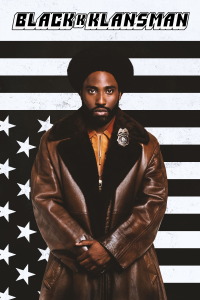
As the first Black police officer for Colorado Springs, Stallworth (John David Washington) was directed to go "undercover" to inflitate an upcoming speaking engagement by former leader of the Student Nonviolent Coordinating Committee (SNCC) and "Honorary Prime Minister" of the Black Panther Party (BPP), Kwame Ture, who was formerly known as Stokely Carmichael. The film completely ignored the fact that Kwame Ture was NOT a threat to "White rule," and in particular, that every so-called major "Black militant" from the 1960s had already been assassinated, or incarcerated, or in college completing a Ph.D, or in Russia receiving an honorary Ph.D., or an escaped felon living in Cuba, or as with Kwame Ture, on a book tour. By 1979 the threat of "Black militancy" had already been eliminated.
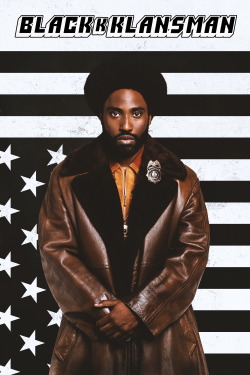
Art direction by Marci Mudd, set decoration by Cathy T. Marshall, and costume design by Marci Rodgers were all poorly executed. The early 1960s to the early 1970s were volatile times for Black people, but 1979 was no where nearly as volatile, because White people and disingenuous Black people had already successfully killed the threat of "Black militancy." So, why did Spike Lee have his cast of characters wearing large militant-looking afro-wigs, leather jackets et al especially when in the late 1970s and throughout the 1980s chemically processed "jheri curls" had largely replaced the afro? Spike Lee could have easily "fact checked" the aforementioned by watching that classic scene in Eddie Murphy's 1988 film, "Coming to America," where oily glyserol from three jheri curled Black people dripped and stained the couch.
The "real" Ron Stallworth clearly looked more like former boxing heavyweight champion Larry Holmes than the "supersized and militarized" version Spike Lee trust upon an unsuspecting film audience. Is "Blackkklansman" a "Blaxploitation" film simply because it's directed by and features a predominately Black cast? If so, what about "Black Panther (2018)?" Sadly, it's typical for the White controlled media is to completely ignore the fact that until the early 1960s and throughout the United States, in both Southern and Northern states, many if not most Black people were prohibited from entering White owned and controlled theatres, or required to sit only in the balcony or at the very back (of the bus - get it). So, to provide films for Black people, in 1916 Noble and George Johnson of Omaha, Nebraska formed the first all-black movie production unit in the country, the Lincoln Motion Picture Company, which included a network of places (local social halls, churches, schools, Black-owned theatres, etc.) located in Black communities to showcase their product. As with the Negro Baseball League, the Black film production industry was very successful throughout the 1930s and 1940s as hundreds of movies including musicals, westerns, crime dramas, romantic comedies, etc., with all-Black casts were produced and released. As with the Negro Baseball League, integration eventually killed the Black film industry.
The purpose of seeing a movie is to be "entertained" or "educated," right? Perhaps, in an attempt to "entertain" and "educate" (Black people?) Spike Lee sought to give "Blackkklansman" a 1970s "look and feel," but if true, that was a mistake because by 1979 the production of films targeted to Black audiences was nearly over, but the need for truthful, fact-based films about the Black experience in America never disappeared. "Blackkklansman" only used the "truth" for source material, but not as a linear, fact-based docu-drama. Can you really be "entertained" or "educated" when you're immediately aware the film you're watching is intentionally biased to manipulate you to a political paradigm not based on the truth? Think about it.
This review of BlacKkKlansman (2018) was written by Viaje on 13 Sep 2018.
BlacKkKlansman has generally received very positive reviews.
Was this review helpful?