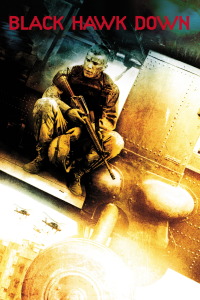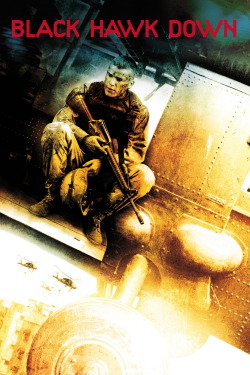
Review of Black Hawk Down (2001) by Jeff T — 13 Apr 2012
C'est la guerre.
Right from the start, on a black screen, we see the words "Based on an actual event", printed to remind us that what we are about to see is all too real and an unfortunate part of our history. We then see upsetting images of children starving -- victims of famine, victims of a madman's corrupt power. This conveys a sense of morbid despair. The country is Somalia located in East Africa. Civil unrest and constant internal turmoil have pushed this country to the brink of its own self-destruction. A warlord named Mohamed Farrah Aidid has usurped much of the power in Somalia and now rules the lands with the iron fist of a dictator. 300,000 innocent people died of starvation because of his greed...
The U.N. tries to help by sending out food supplies, but Aidid has seized most of the shipments and would rather use them to feed his own militia. The U.S. -- out of altruism -- decides to get involved in a predicament which really wasn't their business in the first place. On August 1993, the U.S. sends troops to put an end to Aidid's reign of terror. Six weeks later . . . on October 2, 1993, Army Rangers and members of the Delta Force await at the U.S. Army Headquarters at Mogadishu Airport.
The Army Rangers and Delta Force members are a diverse bunch. One of them is Staff Sergent Matt Eversmann (Josh Hartnett). This is Eversmann's first time commanding a unit -- otherwise known as a "chalk." Although he doesn't try to show it, one can tell he is extremely apprehensive. His peers also describe Eversmann as an idealist. His idealism and true intentions are revealed in his statement about the situation and people in Somalia: "Look, these people, they have no jobs, no food, no education . . . no future. I just figure that, you know, I mean, we have two things we can do: We can either help, or we can watch a country destroy itself on CNN." On the Delta Force side, there is Delta Sergeant 1st Class Norm "Hoot" Hooten (Eric Bana), a veteran who has pretty much seen it all and understands what war is really about. Delta Lt. Colonel Danny McKnight (Tom Sizemore) is responsible for loading and transporting the prisoners. Specialist John Grimes (Ewan McGregor) is a desk jockey and clerk who has never been in combat before. The closest thing he's had to combat experience is making coffee through Desert Storm. But his window of opportunity opens when another soldier is injured. Grimes himself is equally nervous and anxious.
Others include Major General William Garrison (Sam Shepard), the guy who runs the show; Captain Mike Steele (Jason Isaacs), who frowns upon the Delta Force; Delta Sergeant 1st Class Jeff Sanderson (William Fichtner); specialists Shawn Nelson (Ewen Bremner), and Lance Twombly (Tom Hardy); and Private 1st Class Todd Blackburn (Orlando Bloom). Blackburn's eager to see some action, excited about war . . . and foolishly naive. In his own words: "Well, I'm here to kick some ass.".
The next day, the Army Rangers and Delta Force must travel to Mogadishu, the capital of Somalia, and capture two key lieutenants of Aidid who are believed to be located at the Bakara Market. This is to be performed with speed and efficiency, an in-and-out operation. However, during the mission, one of the Black Hawk helicopters is hit and brought down by an RPG (rocket-propelled grenade). This is when everything begins to fall apart. Soon enough, the soldiers find themselves trapped in hostile territory, surrounded by enemy gunfire and the relentless Somali militia under the command of Aidid. What was supposed to be a simple search and capture mission lasting under an hour has turned into a search and rescue tribulation lasting considerably longer. Outnumbered and overwhelmed by the Somali militia, the soldiers forget their initiative and worry about just getting out alive. But in order to do so, they must depend on each other...
Based on the book Black Hawk Down: A Story of Modern War by journalist Mark Bowden, this film adaptation is simply fantastic. Like the book, Black Hawk Down gives a harrowing and graphic account of the debacle that occurred in Somalia. Like most good war films, Black Hawk Down is an unremittingly grim and gruesome war epic. But unlike most war films, Black Hawk Down is not so much about script and characters; instead, its focus is on the cruel nature of war itself and what it is like to be out there on the battlefield, where every split second is the difference between life and death. Black Hawk Down is an uncompromising and uncensored look at the hopelessness of war. Like the people in this movie, we learn that war is truly nothing but hell in another guise.
Visually, Black Hawk Down is superlative. Ridley Scott is one of my favorite directors because of his ability to create powerful visuals which pack a wallop. Here, Scott utilizes this talent to effectively recreate the war torn atmosphere and elaborate urban setting of Mogadishu. Scott carefully frames each shot for maximum verisimilitude, making sure that we not only see the visuals at their full glory, but we also feel their impact. Black Hawk Down has truly affirmed Ridley Scott's greatness as a filmmaker. Credit must also be given to Slavomir Idziak for his gritty cinematography in capturing the chaos of the civilians either running from the violence or the Somali militia shooting indiscriminately at the U.S. troops.
Ridley Scott deserves approbation for the well-made battle scenes, which powerfully captures the stark, ghastly reality of war. Imagine being a war journalist with a fellow cameraperson following the soldiers and capturing the action live. Imagine finding yourself in the heart of the treacherous battlefield where survival is not an option, but a must. In the heat of battle, the loud rattling sounds of incessant machine gun fire intensify. You are constantly under enemy fire as bullets whiz by you. You can also feel the impact of a nearby explosion from an RPG. You can even smell the smoke blowing in the face. What Ridley Scott has done to attain realism -- and pandemonium -- in the battle sequences is remarkable. While the shooting and fighting taking place at daylight were excellent, Scott's talents shined even brighter during the mightily impressive nighttime firefight. The one-two punch of Scott's direction and Idziak's cinematography make the fighting unbelievably horrific and staunching real.
As well, Ridley Scott never allows the camera to flinch during some of the most grisly moments. Instead, he actually focuses on the horrors of death, as if he were looking at it straight in the eye. When Sgt. Dominick Pilla (Danny Hoch) is shot in the neck, the film slows down -- accentuating the visceral potency of an agonizing death. The violence spares you no details. In all honesty, I didn't find the battle scenes to be "exciting" at all. Rather, the action was distressing -- like war itself.
In order to add further credence to the visual effects, Scott decided to use actual Black Hawk choppers and Little Birds from the 160th SOAR (Special Operations Aviation Regiment). Many of the pilots who were involved in the actual Oct. 3 Mogadishu fighting also participated in this movie. The fact that Scott chose to actually use the helicopter pilots who fought in the real Mogadishu battle adds authenticity to this film.
"No one gets left behind..." There is more to Black Hawk Down then just the concept that war is hell. This film underscores the themes of loyalty and unselfishness, of learning to work together for a common goal: to save one another. At first, some of the Army Rangers and Delta Force members were at odds with each other. The night before the Mogadishu raid, Captain Mike Steele disapproved of the Delta Force's more laid-back approach. He even told off Delta Sgt. Sanderson by calling the Delta Force, "a bunch of undisciplined cowboys." But in order to survive in the war zone, they will have to leave behind their chemistry problems at the army base because out there, they need to rely on each other. The sum must be greater than the individual parts. They must operate as one who unit, under one heartbeat. Out there, the enemy doesn't give a damn about human life so the soldiers must give a damn about each other for the sake of survival.
Throughout the film, the soldiers keep telling each other that no one gets left behind. This is to prove that each soldier involved is of equal importance. Everyone must be accounted for, regardless of status. For example, when Blackburn fell from the Black Hawk chopper and died upon falling to the ground, the soldiers refused to leave him behind. The actions of the Army Rangers and Delta Force members were truly admirable. The fact that they cared about each other and were willing to put their own lives on the line to help others shows nobility.
"You know what I think? It don't really matter what I think. Once that first bullet goes past your head, politics and all that shit, just goes right out the window." -Hoot.
Black Hawk Down is a different type of war movie. Many war films I have seen (Platoon, Apocalypse Now, et. al.) try to contemplate how war can affect a person emotionally, how war changes a person, or even the moral issues of war. The emphasis is not so much on war itself, but its effect on the human psyche. While many of those films were excellent, I found a good number of them to be more surreal rather than realistic. Other war films (such as Pearl Harbor) try to sanitize things by adding a sappy love story or other forms of melodrama. These elements seem to romanticize war quite a bit.
Black Hawk Down on the other hand, is a brutally honest and unnerving depiction of the true nature of war. Which is survival. When these soldiers are fighting, they cannot waste time pondering about the psychological philosophy or the morality of war. They're fighting just to survive. Out on the battlefield, these soldiers also cannot let their emotions affect their judgment. You can't hesitate when fighting in a war because hesitation can lead to a bullet in your head. Either shoot who is shooting you . . . or get shot yourself.
One interesting observation I have made is that many reviewers out there criticized this film for it's alleged jingoistic attitudes. Well, as a counterpoint, I must remind those critics what jingoism really means: loud and feverish chauvinism in the name of patriotism and glory. If I may say so myself, glory and patriotism are most likely the last two things on the back of the soldiers' minds in this movie. All they care about is survival.
A lot of war films give audiences a chance to catch their breaths because they consist of several shorter, individual battle scenes with noticeable outcomes. In Black Hawk Down, it is basically one continuous war. The only "break" during the madness is when some of the soldiers seek refuge in a derelict building. However, one of the soldiers is shot in the leg and is severely wounded. The rest of the soldiers have no choice but to perform emergency impromptu surgery. This again, reemphasizes the true nature of war; they must help each other and stay constantly alert in order to survive.
Admittedly, I wish Ridley Scott had allowed us to get to know these soldiers a little better. On the other hand, I realize this was his intention and I must respect that. His focus is more on war itself. And keep in mind that there were around 35 important speaking parts so character development is a bit difficult to do. In any case, I thought that the performers did a fine job making the people on-screen believable. Eversmann gets the most screen time, and hence is most likely deemed as the main character. But other characters play just as significant roles but for different reasons. Hoot himself is just as integral to the film as Eversmann and much of the film is devoted to him. Those two also serve as interesting contrasts. Hoot himself understands the nature of war and does not allow emotions to affect him. Eversmann on the other hand still shows emotional vulnerability -- particularly guilt when a soldier died in his command. Another example of an important character is Blackburn, who epitomizes the alacritous young soldier who is eager to fight in the war for the glory and thrill of kicking some arse. Some may consider the eager young guy a cliche, but I personally know real-life friends who always wanted to join the army for the "glory.".
There are a lot of solid performances in this movie, and I hate to leave some out, but I will highlight some of the stronger ones. As Eversmann, Josh Hartnett is one of the very few teen heartthrobs whom I consider to have true promise as a legitimate actor. He has shown flashes of potential before in such films as The Virgin Suicides, but in Black Hawk Down, he displays a certain amount of maturity seldom seen in most young actors. It is hard to believe though that this guy has also appeared in such films as Pearl Harbor and Halloween: H20. Eric Bana is excellent as Hoot for his ability to portray a Delta Force soldier who stays cool, calm, and collected in the line of fire. Sam Shepard, Jason Isaacs, and Ewan McGregor all give commendable performances as well. Ewen Bremner and Tom Hardy provide some needed comic relief, and Jeremy Piven (as Chief Warrant Officer Cliff Wolcott) provides more comic relief with some of his wisecracks. The fine acting from the ensemble cast allows the audience to care about the fate of the soldiers they portray.
The powerful soundtrack is definitely worth highlighting. The music in this movie is an eclectic mix of bluegrass and Middle Eastern and African tunes. These tunes help the audience to emotionally connect to the events that transpire on-screen.
If the film does have a major shortcoming, it is its tendency to oversimplify the situation a bit. But in my opinion, there are a good number of war movies which do that. In this case, the oversimplification is not to mislead the audience, but rather to give them a more general understanding of what is happening. Basically at first glance, the U.S. appeared to be involved in the Somalia turmoil for humanitarian reasons. But according to the film, the real reason for these soldiers' involvement can never be fully comprehended...
"Only the dead have seen the end of war." -Plato.
When all the fighting was done, the casualties were staggering. Eighteen Americans (nineteen, if one counts Delta Force Sgt. First Class Matt Rierson, who died in a mortar attack two days later) lost their lives, but the Somalis lost well over 1,000.
Black Hawk Down is a damn powerful war movie. Despite the lurid nature of this film and the end results, this film very much showcases what true valor and fortitude are all about. After watching this movie, you will gain a profound sense of respect for all the servicemen and women who served in all the military branches. While not quite the best war film ever made Black Hawk Down certainly belongs among the highest echelon of this genre.
I cannot say for sure if the events portrayed in this movie were completely accurate (I have only started reading the book as of this writing), but the filmmakers still did a damn good job. Both Ridley Scott and screenwriter Ken Nolan did their best to make the film faithful to what really happened on October 3, 1993 in Mogadishu. The movie itself is certainly real enough; it throws you into the inferno and forces you to experience first-hand what war is really like. Black Hawk Down wears you out and leaves you feeling exhausted. Even to this day, I still feel worn out by the film's intensity. Unforgettable and intense, Black Hawk Down never lets up. See it, but be prepared for an excruciating ordeal.
C'est la guerre -- that's war.
This review of Black Hawk Down (2001) was written by Jeff T on 13 Apr 2012.
Black Hawk Down has generally received very positive reviews.
Was this review helpful?