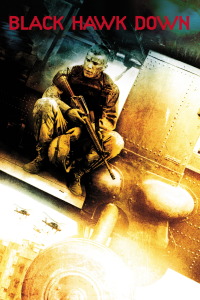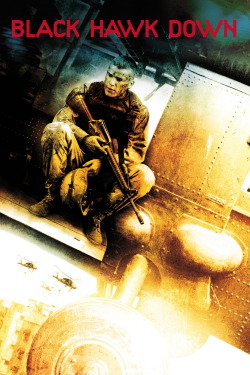
Review of Black Hawk Down (2001) by Filmclub — 26 Mar 2016
War is hell for 100 continuous minutes of screen time in “Black Hawk Down,” a relentless immersion in combat strikingly realized but none too pleasurable to sit through. Based on journalist Mark Bowden’s bestselling account of the 1993 fiasco on the streets of Mogadishu, Somalia, which left 18 American soldiers dead and more than 70 badly injured, this grim piece of work forcefully puts the viewer in the middle of the action in a harrowing way. But it crucially lacks almost everything but fighting, most particularly characterization, making Ridley Scott’s second picture this year, after “Hannibal,” almost entirely about logistics. Very well judged in its philosophical stance toward the material, this collaboration between Revolution Studios and Jerry Bruckheimer at Sony goes down like stiff medicine, leaving one feeling exhausted relief when it’s finally over. War film buffs and Scott fans will turn out, but general audiences, and women in particular, will approach with extreme caution.
Of the war films that have come out since “Saving Private Ryan,” “Black Hawk Down” most closely resembles “Enemy at the Gates,” about the siege of Stalingrad, in that both are cold accounts of remorseless urban warfare marked by constant sniping in abjectly squalid settings. The new film’s protracted detailing of door-by-door, block-by-block fighting may also remind viewers of portions of “Band of Brothers,” but that comparison only serves to underscore the present feature’s shortcomings, in that the epic HBO series was able to develop interesting characters in the service of dramatic involvement and tension, elements conspicuously missing here.
Unfortunately, it also refrains from giving you anything to feel other than general revulsion for war. Token attempts are made to differentiate the Delta Force, the aristocrats of U.S. military, from the only somewhat less exalted Task Force Rangers, but with their buzz cuts, buff bods and similar ways of talking, it’s not easy to tell the soldiers apart, nor is one encouraged to think that it’s going to be worth the effort, given how little attention Scott and the script give to the matter.
Perhaps receiving marginally more screen time than most of the others is Staff Sgt. Matt Eversmann (Josh Hartnett), who is unexpectedly put in command of one of the “chalks” that will secure the area around the Mogadishu building being raided by the Deltas. Also standing out from the pack from time to time are Ranger Lt. Col. Danny McKnight (Tom Sizemore), a fearless older soldier who comes across as a more human version of Robert Duvall’s Kilgore in “Apocalypse Now;” Delta Sgt. First Class Jeff Sanderson (William Fichtner), a resourceful pro; and Ranger Spec. Grimes (Ewan McGregor), a desk man who finally gets his shot at combat.
After a half-hour of preliminaries, Operation “Irene” begins, and the sight of 19 helicopters buzzing over the desert beaches toward the bleached-white city in the afternoon sun is stunning to behold. The 160 men, some of whom arrive on 12 Humvees and trucks, expect to be in and out within an hour and, indeed, it takes only 20 minutes for the Deltas to land, assault the building and take the two “Tier One” targets and numerous other prisoners.
A solid hour consists of little but constant shooting and shouted dialogue, making it tough to engage with characters you barely know. It may well have been Scott’s aim to keep the men basically anonymous and interchangeable — to further the point that this is what war is, that it has always been thus and always will be. And while the specific historical setting of Mogadishu is stunningly evoked via an amazing blend of location shooting, mostly in the city of Sale, Morocco, near Rabat, and on production designer Arthur Max’s utterly realistic sets, there is a simultaneous generalized feeling to the action that makes the film an expression of resignation over humankind’s need to play out these fatal scenarios over and over.
Perhaps at somewhat shorter length these points could have been made more effectively, but the pummeling viewers get — which can be rationalized intellectually as “putting them through” the firefight as vividly as possible — makes the film more rewarding to think about afterward than to actually experience. Pic will have a decidedly limited pool of repeat viewers.
However, Hans Zimmer’s score effectively juggles numerous different modes, from World Music sounds and choral work to source material.
This review of Black Hawk Down (2001) was written by Filmclub on 26 Mar 2016.
Black Hawk Down has generally received very positive reviews.
Was this review helpful?