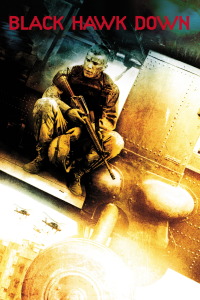
Review of Black Hawk Down (2001) by Edith N — 15 Mar 2012
And Now, a Guy Thoughtful War Movie.
You should know that I have bounced my criticisms of what actually happened during the movie off Graham, who is a veteran. And, yes, he spent most of his time overseas serving as company clerk in a motor pool, but he also spent time doing slightly more dangerous jobs. He's never told me details, but the words "convoy duty" have come up. I realize that I am frankly not capable of doing much of anything seen in this movie. I am in bad health and bad shape, and I do know that. I do not intend to disparage the bravery of the people who actually participated in the real events on which the film is based, and I do not mean to say that the goals being pursued in Somalia were not good ones. What I mean to say is that some of what happened, at least as shown in this movie, was predictable to a greater or lesser extent and could have been avoided. At very least there could have been less loss of life if a few basic precautions were taken. Probably.
October. 1993. Mogadishu, Somalia. President George H. W. Bush had ordered US troops into Somalia to aid in famine relief, and Bill Clinton kept them there when he took office. Warlords run essentially everything in the country, and needed supplies were not reaching anyone without the consent of the men in power. One of the worst of these was Mohamed Farrah Adid, who essentially controlled the city of Mogadishu. US Army Rangers were sent in to arrest two leaders of Adid's clan, but things rapidly spiraled out of control. Private Todd Blackburn (Orlando Bloom) missed a rope while attempting a descent from a helicopter, fell, and broke his back. Events only got worse, and a helicopter was shot down. Attempts to rescue the stranded soldiers only resulted in more wounded, more deaths, more trapped soldiers. Fighting lasted overnight, with twenty dead among the UN forces and an unknown number of Somali dead.
I think, frankly, that the major problem was that these men were treating the whole thing as routine. One of the soldiers was filling his canteen before heading out, and another one told him not to bother, because they'd only be gone an hour. (I had a hard time telling them apart even with their names written on their helmets.) One said he wasn't going to bother putting the ceramic plates in his body armour, because he didn't plan on getting shot in the back. (As it turns out, this means he wasn't planning [i]for[/i] getting shot in the back.) Now, those ceramic plates are heavy, and Graham says people still go out into dangerous situations without wearing them. But he literally wasn't allowed to go out without filling his canteen. And it strikes me that, no matter how routine you think a possible battle situation is going to be, you should prepare in case it isn't. I can't help wondering how much of the lack of planning was an assumption that primitive people such as the warlords they were fighting couldn't possibly be a threat to real Americans.
As for the movie itself, I just didn't get into it as much as other people seem to. Now, if ever there were a reason for a film to be essentially nothing but action sequences, being based on these particular events is it. But I still feel it's boring, and I also think the film is a lot less thoughtful than it thinks it is. There's a fairly lengthy scroll at the beginning telling us exactly who these people are and why they're there, and that was practically all the back story and character development we got. Most of the movie is only concerned with what's happening, not why. Not if it could have been prevented. Not what the consequences will be. Much of what happens is based on a "no man gets left behind mentality" without considering if that mentality is reasonable or practical. At least two men die over that policy, if I'm understanding events correctly. While the families doubtless appreciate having someone to bury, they'd appreciate even more having someone come home.
Obviously, I am not the target audience for this movie. Not least because I just had a conversation yesterday about the failings of US foreign policy in solving problems such as the ones happening in Somalia then--and now. One of the things I said is that military intervention frequently serves to unite a populace against the intervening nations even if their own best interests are being served by that same intervention. There's something of an implication that this is what happened in Somalia, though the film is not much bothered with an explanation of why things are as they are in that country. Its narrative is solely concerned with the bravery of the US soldiers in a dangerous situation. As I said, I do not dispute that they were brave. And apparently, just the ones brought to Morocco for the filming were probably enough to take over the country. (Werner Herzog would've done it, too!) But it strikes me that the movie is more interested in getting us to cheer than think about who or what we're cheering.
This review of Black Hawk Down (2001) was written by Edith N on 15 Mar 2012.
Black Hawk Down has generally received very positive reviews.
Was this review helpful?