Review of Black '47 (2018) by Bertaut1 — 15 Oct 2018
Not really the Famine film we were promised, but still a decent thriller.
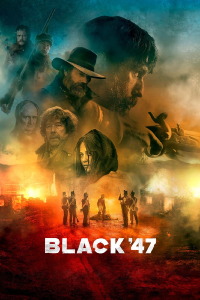
Easily the most hyped and anticipated Irish film of the last decade or so, Black '47 is proudly advertised as the "first film about the Great Famine". And were this true, it would undoubtedly occupy a canonical place in Irish artistic output. However, it isn't the first film about the Famine. It's the first film set during the Famine, but it isn't about the Famine. Written by Lance Daly, P.J. Dillon, and Pierce Ryan, and directed by Daly, this is a genre film, a revenge western set against the backdrop of the Famine. If you accept that, and don't expect to see Cecil Woodham-Smith transposed to the screen, there's quite a lot here to admire.
It is winter 1847, two years since blight caused the failure of the potato crop on which large portions of the country's poor depend. Having deserted from the British Army, Martin Feeney (James Frecheville) returns home to Connemara, learning that his immediate family is dead and his sister-in-law Ellie (Sarah Greene), and her three children are living in an abandoned cottage, When an eviction party arrives with orders to eject the family and burn the property, things turn violent, and Feeney is arrested, although he quickly escapes, and sets about exacting revenge on those he feels wronged him. Meanwhile, learning of the escape, the British Army send a team after him, led by Feeney's former commander, the world-weary Hannah (Hugo Weaving).
The Famine is the single most significant event in Irish history; a cataclysmic tragedy on a biblical scale. Between 1845 and 1852, around one-and-a-half million people died and nearly two million emigrated, reducing the populace by roughly 25%. The Irish language was laid to waste; the myths and sagas of Irish folklore were forgotten for decades; Irish literature slowed to a trickle; and hatred of the English occupiers became more galvanised than at any point in the previous 700 years of their presence. Black '47 has no intentions of dealing with the Famine on a national scale, using it instead as a backdrop for a genre exercise. No Famine narrative could ever depict a story in which a protagonist right the wrongs of Ireland, because no such person existed. Feeney is not the spirit of Ireland made flesh, and this is not a piece of Catholic wish-fulfilment.
Aesthetically, Daly depicts a number of "quintessential Famine images". These include a shot of a skull sinking into the wet mud, representing the dead and their connection to the land; when Ellie first appears, she looks like Caitlín Ní Uallacháin, the implication being that Ireland itself is literally dying; when she and her children are evicted, the scene is very much an archetype of such evictions - women and children crying, men being restrained, the thatched roof of a cottage burning, callous bailiffs; grain being stockpiled for export( bedraggled peasants huddled at the gates of an affluent estate.
The most long-lasting effect of the Famine is that it decimated Gaeilge. In seven years, the Famine did what the English couldn't manage in 700 - it destroyed that which defined us as a people. Large sections of Black '47 are in Irish, and the film actually uses the Irish language and the attempts to suppress it as an important motif. For example, when a priest asks a peasant his name, the man replies "Séamus Ó Súilleabháin". The priest turns to a translator, who responds, "James Sullivan". This speaks to the Anglicisation of Irish place names (Béal an Átha became Ballina, Trá Lí became Tralee, etc). Daly never allows the devastating effect the Famine had on the language to fade too far into the background, and the narrative is all the better for it.
Of course, all of this is not to say the film is perfect. The character of Lord Kilmichael (Jim Broadbent) is something of a clichéd, token villain. Daly also has a tendency to unsuccessfully mix naturalism with stylisation, most obviously in the use of intentionally artificial looking matte paintings as backgrounds in some of the panoramic scenes. Whilst the intention was most likely to try to evoke the look of old sepia photographs, contemporary audiences used to photorealistic CGI will probably interpret it as cheap effects work. Finally, if there's one thing I was surprised by, especially given all the references to emigration, it was the lack of reference to the coffin ship, the image of which is an indelible component of the Famine's legacy.
Black '47 is essentially a revenge western, and in that sense, it's nothing overly special. However, Daly allows the Famine background to come to the fore sufficiently so that we never forget when and where we are. Mixing the historical with the generic just enough so that each informs the other, it's not the first "Famine film", but it is a very decent, honest, and respectful attempt to put something of that great tragedy on screen.
This review of Black '47 (2018) was written by Bertaut1 on 15 Oct 2018.
Black '47 has generally received positive reviews.
Was this review helpful?