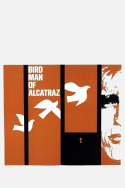
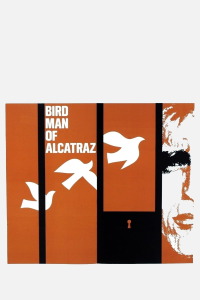
Review of Birdman of Alcatraz (1962) by Dave R — 09 Aug 2011
One questions why a 73-year-old man who has spent more than 43 years in solitary confinement hasn't been paroled by Federal authorities like the Attorney General. Could they have based their rejections on facts and incidents not observed in the almost uniformly good behavior of the eponymous Birdman? Regardless, these uncertainties don't discredit the generally forceful special pleading and stark drama involved in the history of a basically unlettered man whose rehabilitation was affected in a remarkable and, perhaps, unprecedented manner. If what we see in the film is just as true as what may be omitted, he's still an enormously sympathetic character. Were he to have committed a cold-blooded crime, for example, that wouldn't overturn the tender humanity genuinely evinced with such integrity in what Frankenheimer shows us. Birdman of Alcatraz is shaped with subtlety and almost unilateral attention to characterization, the result being that the characters, from start to finish, and thus the whole film in all its pros and cons, are remarkable and invigorating.
The lifer's stubbornness is his artistic methodology, voiced early on by his loyal guard who says, "You ain't got much, but you keep subtractin'!" Lancaster's Robert Stroud is the "real and living man" of the film's caption, a massive mama's boy shown to us while traveling to Leavenworth where he meets Malden's single-mindedly despotic warden, his arch-rival. In solitary confinement the homicidal "dingbat" finds himself keen on a fallen sparrow and steadily transforms his cell into a makeshift aviary.
In this in-depth, far-reaching construct of the Frankenheimer social exile, the solemnity of this biopic gives persuasiveness to the cutting silliness of men who resort to canaries simply so they don't shank one another and then become old together anyhow. It's about the arduous physical effort of science, about learning consideration from that guard, played by Neville Brand, about pushing to discover means to break their confined environs. Notice the way Frankenheimer has the brass band in the dinner hall fall quiet so we can hear the shiv going into a stomach. And notice the twist of its supporting cast, an outstanding rota of transformations: Telly Savalas's monologue about ugly parrots and ugly girlfriends, the spasm on Thelma Ritter's mouth that betrays her as the connection to Angela Lansbury's motherly monster in The Manchurian Candidate. In spite of it all, the movie's postscript reflects the present world from Stroud's unflappable outlook.
Frankenheimer's control focuses on the growth of his hero, a gloomy, outwardly unfixable lifer, rescued from capital punishment by the appeals of his mother to Mrs. Woodrow Wilson, into an autodidactic scientific examiner and a man whose survival thus adopted significance and import. The collaboration between director and star stand out with realism of fine distinction and regulation. We're inclined to accept as true that the hatchling sparrow he discovers when he takes his forlorn exercise time will budge this callous convict out of his desolation.
The more his noble concern with keeping it alive grows, the more we're awestruck by his longing to understand more about the virus that kills some of the numerous feathered companions he finagles to be allowed to raise. What's fascinating about it? His interest is not intellectual. It's primal. His rapport with that neighboring inmate through the bricks, played in inarticulate but entirely telling fashion by Savalas, is less about Lancaster's re-emergence from anti-social patterns than it is about the infectiousness of the human instinct to have companionship and understand more. In such a dark, dank milieu, with such somberly hushed tones throughout, we applaud the notion that, in the end, his overpoweringly acute passion for these animals, a devotion that fuels his will to live in his captivity, gives rise to his maturity as a man of knowledge and the author of a classic volume on diseases and cures in ornithology.
The devotion of Tom Gaddis, who wrote Stroud's biography, as well as the attachment of screenwriter Guy Trosper, together with Frankenheimer and Lancaster, are palpable and real. The drama they extracted from the up-to-then ongoing true story is both touching and credible albeit the entirety of the particulars don't emerge on the screen. As the dramatization of the profile of an inmate uncommon, if not exceptional, to the history of American penology, it keeps part of the portrait in shadow, but it is, all the same, a meditative and compelling story that cuts into the soul notwithstanding its oversights. An acknowledgment of the nerve required to blaze a trail, this is unquestionably one of Frankenheimer's most contemplative films.
This review of Birdman of Alcatraz (1962) was written by Dave R on 09 Aug 2011.
Birdman of Alcatraz has generally received very positive reviews.
Was this review helpful?