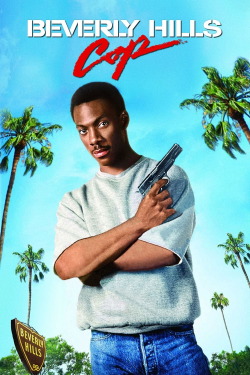
Review of Beverly Hills Cop (1984) by Paul Z — 08 Jun 2010
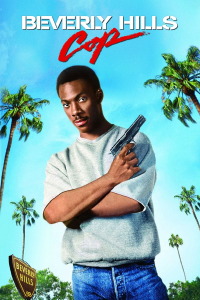
Beverly Hills Cop is among the top of my "populist" list of favorites, meaning movies made to please Friday night moviegoers and renters more than the refined tastes of critics. A big part of why I love this movie is because I grew up on it. I loved Eddie Murphy as a kid. Whether he's a brilliant actor or not, or whether or not the majority of his movies are very good, he has an energy completely apart from a movie itself. He's simply Eddie, in the face of whatever his "characters"' adversities are. But this isn't the reason I still love this movie as an adult. Watching now, I'm seeing a sharply written fish-out-of-water story---a clever insight into how a character behaves out of his element---masquerading as a Hollywood blockbuster star vehicle.
It opens with a way-over-the-top chase between a huge semi-truck and various Keystone-like squadcars, which would be exciting if it didn't function primarily as a Pointer Sisters music video. Neutron Dance is the foreground of this set-piece, not the imagery it's scoring. We're dancing in our seats instead of gripping them. Still, the film's beginning is also drenching us in the utter grittiness of urban Detroit. While also essentially a music video for The Heat is On, the opening credits sequence is comprised of naturalistic, documentary street scenes of real people, housing developments, smokestacks, etc. At the same time the film-making is glitzy and commercial with its soundtrack and obligatory set-pieces, it's truly impressive how it absorbs us in one environment and then, by the end, has completely entrenched us in another one worlds apart.
We meet Axel in action, in character undercover, wearing a smart-ass shell when he shows his face at the station after such a disaster, following in the tradition of reckless cops winning scorn from their superiors, in this case a scene-stealing performance by Gil Hill as his no-nonsense boss Inspector Todd. We then see Axel take in a surprise visit from his childhood friend Mikey, who's broken into his apartment, raided his fridge, proceeding to show him some suspicious bearer bonds. Axel doesn't care, doesn't want to know, just happy to see his old pal. We learn that Axel wasn't always into serving and protecting, and although Mikey now has a job as a security guard out in Beverly Hills, Mikey still isn't. This is the reason the night doesn't end so well for Mikey, as well as why Axel finds himself conning his way through Beverly Hills, ostensibly on vacation but really working as an effective cop with the instincts of a street-smart criminal.
This is very funny, because essentially the movie's premise is composed of a foul-mouthed inner-city cop showing clean-cut, by-the-book veterans how to catch a killer. We know who had Mikey snuffed as soon as we're introduced to him, which is correct, because what the movie's all about is how the strict bureaucracy and elite judicial system protect the biggest criminals. The culprit here is Victor Maitland, a sophisticated millionaire, one of the most respected art dealers in the country. He's also involved in a complex smuggling operation and ordering hits on little people who take more than they earn just as he does, like Mikey, and gets away with it because Beverly Hills' finest, the customs house, his manufacturers, all do just what they're told, nothing more. The more time we spend with Axel in Beverly Hills, the more we realize the cultural inducements that allow Maitland the luxury of being above even ballpark suspicion. Whenever/however Axel follows his detective instincts to Maitland, he's breaking rules, charged with felonies, in positions where he must fool everybody, until finally the Beverly Hills police are so jarred from their robotic procedure, and of course inclined to think like detectives, that reason takes over: Why would this exotic cop, this "foul-mouthed jerk from outta town" be so persistent at all this if he didn't have reason to believe something's really up?
Indeed, the movie doesn't paint Axel's unlikely cohorts as mean, ignorant, snobbish. We love these guys. In their own contrasting way, John Ashton and Judge Reinhold as Taggart and Rosewood are equally funny, perhaps even more so in some scenes, as Murphy is as Foley. And they're better than he is at adopting the gravity of less comical scenes, which makes their Laurel and Hardy relationship more complex and inspired. At any rate, these three are responsible for improvising much of their dialogue, even creating whole scenes, like the "supercop" bit, the red-meat-in-the-bowels, bringing an inimitable chemistry to their trio. While Ronny Cox is awesome in sinister roles like in RoboCop, he plays Lieutenant Bogomil not as an uptight jerk of a superior, just firm about enforcing regulations; he's got a boss too, and hangs his head and sucks up in his presence like Taggart and Rosewood do in his.
And as I said, it's great on a pure entertainment level. There are actually lots of great bit performances. There's Bronson Pinchot's memorable Serge, an effeminate European art salesman, basically the first person Axel meets in Beverly Hills. Murphy's subdued reaction to Pinchot is correct. A Martin Lawrence or Chris Tucker would've probably submerged the scene in some bombastic repulsion, but Murphy's persona in its heyday was much more graceful and well-timed than that. There's also the great veteran character actor Jonathan Banks as Maitland's thug, so matter-of-fact and stone-cold, especially when he pulls the trigger on Mikey. Oh, and Paul Reiser as the fly buzzing around Axel early on at the Detroit precinct. And the soundtrack, including obviously the immortal Faltermeyer synth melody, does give the movie an upbeat energy, though I do have my complaints. It's a real movie about the underdog in the rich man's world, and a ceaselessly entertaining one.
This review of Beverly Hills Cop (1984) was written by Paul Z on 08 Jun 2010.
Beverly Hills Cop has generally received very positive reviews.
Was this review helpful?