Review of Ben-Hur: A Tale of the Christ (1925) by Edith N — 03 Mar 2011
It's a Thirty-Two Horse Pileup in the Hippodrome Today.
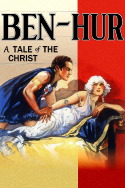
The funny thing is that this is an hour shorter than the '50s Heston version and still has more than a few scenes I think are unnecessary. I'll admit it's been a while since I read the book, but I don't think Lew Wallace, Civil War general and governor of New Mexico, put in quite as much actual stuff from the Gospels. As I recall, the whole point was that his characters sort of skirted around the edges of the story of Jesus. Yes, the subtitle is "A Story of the Christ," successfully leaving in that "Christ" is a title, but the one thing the movie gets right is in never actually showing all of Jesus. His hands proffer a gourd of water, but His face remains unshown by the camera. However, this particular version of the story feels the need to show us the Holy Family on Christmas Day in early Technicolor. No mere hanging about at the Sermon on the Mount for this version. Let's put them all right up in front so we don't forget whose story this "really" is.
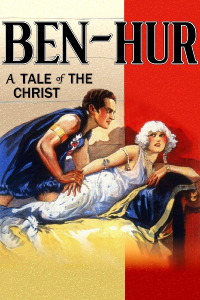
Except it's really the story of Prince Judah Ben-Hur (Ramon Novarro), scion of a minor Judean line of princes. One day, he happens to knock a tile onto the head of a Roman dignitary arriving in Jerusalem, killing him. For this "act of treason," Ben-Hur is made a galley slave, his mother and sister (Claire McDowell and Kathleen Key) are thrown into prison, and all the assets of the House of Hur are seized except what faithful slave Simonides (Nigel De Brulier) and his daughter, Esther (May McAvoy), have already taken away to Antioch. Ben-Hur serves three years as a galley slave. During a battle with pirates, he saves the life of Arrius (Frank Currier), a Roman official, who has him freed and adopts him as his son. Arrius also encourages Ben-Hur, known in Rome as Arrius the Younger, a great athlete, in his goal of seeking out Simonides--and, of course, his mother and sister.
Which, of course, leads to the dramatic chariot race. Ben-Hur's antagonist is one Messala (Francis X. Bushman, actually not a stage name), a Roman with whom he played as a child. Messala is all grown up and Roman, and it is he who declares the accident a murder and has Ben-Hur made a galley slave. It is he who throws the mother and sister into prison. And it is he upon whom Ben-Hur wants revenge. When Ben-Hur has a chance to ride against Messala in a chariot race, he takes it; those things were vicious and sometimes lethal. (It is believed that a man was killed in the original Roman filming of the chariot race, but that footage never made it to the screen. Several horses died in the Hollywood reshoot.) Ben-Hur is the only one with a team of white horses, so it's even easy to work out which one he is. Alas, it's the one usually somewhere in at most fourth place, which makes the suspense die a little. Even leaving aside that you know he has to win. After all, he's got fifty thousand gold pieces riding on the outcome!
During the filming of the remake, Gore Vidal says they realized that the hero and the villain had "a minor disagreement about politics." It's far more than that here. There is extraordinary racism in this work--among the characters. The filmmakers vilify Rome, perhaps a hint more than is deserved, but the anger between Ben-Hur and Messala comes from what Messala says about Jews as a people. Throughout the movie, characters say that Ben-Hur cannot do anything worthwhile because he is a Jew. During the betting before the chariot race, when Ben-Hur is known as the Unknown Jew, only one of the reasons the odds are so heavily stacked in Messala's favour is that people know who Messala is and know of his skill as a charioteer. There is in all of them the assumption that a Jew cannot beat a good Roman. He's got some unfortunate things to say about a Greek in the chariot race as well, though he does seem to be a fan of a certain Egyptian woman.
This isn't DeMille, but it feels as though it ought to be. There is enormous sweep to it, and it's even been suggested that well over a hundred thousand people were in it all told, though of course that's mostly extras. But what extras--half of Hollywood seems to have at least watched the chariot race, whether they were a Name yet or not. The film's producers appeared in the crowd. Such later luminaries as Carole Lombard and Myrna Loy appeared as slave girls. Indeed, one of the many, many assistant directors during the Hollywood version of the chariot race was a young man by the name of William Wyler, who would win an Oscar for the better-known version of this movie some thirty-five years later. This became one of those Big Stories which arguably went a long way toward shaping Hollywood; this one definitely influenced the treating of animals and stuntmen. There's even a one-reeler which predated this by some time, but I have a hard time imagining how you'd fit an epic of this magnitude onto one reel.
This review of Ben-Hur: A Tale of the Christ (1925) was written by Edith N on 03 Mar 2011.
Ben-Hur: A Tale of the Christ has generally received very positive reviews.
Was this review helpful?