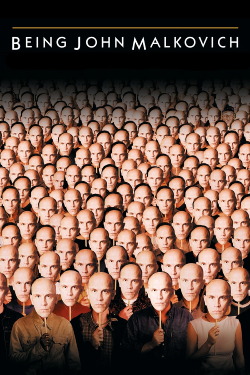
Review of Being John Malkovich (1999) by Troy R — 13 Apr 2012
The most surreal film to come out of 1999 was easily Being John Malkovich, directed by Spike Jonze and written by Charlie Kaufman. Spike Jonze made a name for himself by directing music videos for a slew of artists, most notably the Beastie Boysâ(TM) Sabotage. Being John Malkovich was Jonzeâ(TM)s feature debut and it earned him an Academy Award nomination for Best Director. It took writer Charlie Kaufman six months to finish the first draft of Being John Malkovich and his script was well received but Kaufman kept hearing â~No one will make this movie,â(TM) the average studio executive did not know what to do with the film. The movie was eventually optioned by Single Cell Pictures and after John Malkovich was on board to take part the process took off. The film is a black comedy-fantasy that brings up questions of self-identity and American celebrity culture, attacking that culture in a light-hearted yet serious way. The film is replete with unexpected twist and turns and is characterized by its many layers. Being John Malkovich presents atypical situations and asks the viewer to make something of those situations.
Explaining identity, that is, what makes us who we are over time is a tricky issue. Our personal identity is the cornerstone of self-understanding, it implies who and what we are as individuals. What someone looks like and sounds like matter in our judgments of others and our notions of their identity; it is through someoneâ(TM)s physical traits that we understand someone elseâ(TM)s identity. In one way or another all of Charlie Kaufmanâ(TM)s films explore the meaning of self, but it is Being John Malkovich that explores the idea most bluntly. Craig Schwartz, a down on his luck puppeteer, takes a job as a filing clerk on the seven-and-a-half floor of the Mertin Flemmer Building with LesterCorp. One day at work Schwartz finds a small tunnel which leads him to see the world through the eyes of actor John Malkovich, for fifteen minutes at a time. Schwartz and his business partner and unrequited love interest begin to charge customers $200 to experience a sort of fifteen minutes of fame and âbeâ? John Malkovich. In the film the customers are curious about what it is like to see the world through someone elseâ(TM)s eyes, especially a celebrityâ(TM)s eyes, even if they cannot recall a movie Malkovich has been in; many are willing to pay for this unique opportunity even if it only last for a short time. The characters that enter John Malkovich are desperate to change identities, to be known as someone else. The film implies in several places that in America the opinion of a celebrity is seen as more valid than others, or at least that the mainstream view. There is ample evidence to suggest that the opinions of celebrities are held in high esteem, for one reason or another. Magazines filled with pictures of famous people fill the check-out lines of stores, websites are dedicated to famous people, and television shows tell us the latest in âentertainment news.â? Jonze and Kaufman take the tabloid culture in America to the extreme in this film. When customers get to experience life through the eyes of John Malkovich they see him doing mundane things such as eating breakfast, riding in a cab, and ordering bath towels over the phone as he eats leftover Chinese food. These experiences are everyday occurrences and are ones in which the customers do in their everyday lives, but when a famous actor does them everything is sensationalized and overblown. This is the reason why the customers are so eager to experience âbeingâ? John Malkovich again after they come out of the portal on the side of the New Jersey Turnpike. The idea of being a celebrity reaches its height after they get a small taste of what it is like, after fifteen minutes of fame.
At the heart of Being John Malkovich is the central question of the meaning of celebrity in the modern world. Who is John Malkovich? Why would anyone want to be him? The movie is about the ownership of the self, and the idea that in America celebrity is now a commodity. The tunnel that Schwartz finds is more than just a secret portal to the inside of John Malkovichâ(TM)s head. It serves as an escape for people who are unhappy with their own lives, especially Schwartz. Maxine, his love interest, only returns that love when he is inside Malkovich which leads to Schwartz losing himself in the end. The characters in the film do not really know John Malkovich, they are responding to the fact that he is famous, and to them that is all that is important. By the end of the film John Malkovich has become a vessel, something to cast projections on and live out fantasies. This is a strong indictment of the way in which America has come to view celebrity. Nowadays experiences such as television, video games, and film provide options for an alternative life; people watch reality television instead of connecting with others. As a result, in todayâ(TM)s world there has been a blurring of the line between ordinary people and celebrities. In todayâ(TM)s world the audience is able to live through their favorite stars and in turn those same stars increasingly become the roles they play, losing a self-identity unable to turn the fact that they are famous off.
The way in which John Malkovich makes fun of and is mean to himself in this film is very un-American. The character is not a reflection of the real John Malkovich, but a reflection on how the public perceives John Malkovich. One of the strengths of the film is how Malkovich plays with the differences between who he is and how outsiders view him. Celebrities are always concerning themselves with a particular image to portray to the American public, a kind of brand. They give money to various charities and make sure the tabloids are there to document it. They adopt families of African babies to show their fans they care about African babies. There is a prevailing theme when it comes to American celebrity that if you are famous then you are owned by your fans, you owe them something. The fan controls the star and we never get to know who the star really is. In the film we only get one look into the real John Malkovich. In one of the most surreal scenes in the movie Maxine is being chased by Craigâ(TM)s wife Lotte, who also is in love with Maxine, and after being in the Malkovich vessel wants to become a man. The only time the viewer gets an understanding of the real John Malkovich is during the chase scene through Malkovichâ(TM)s subconscious as Lotte tries to kill Maxine. The two travel through repressed childhood memories and the unconscious thoughts of Malkovich. These are the reasons no one can truly âbecomeâ? John Malkovich, they are his memories, thoughts, desires, and he alone has access to them. Even after being inside Malkovich for months Craig is unable to truly âbeâ? Malkovich, he is missing the memory component. The film forces the viewer to wonder if there is an identity that anyone but ourselves can know exists. While inside Malkovich Craig has two sets of memories, one in which he is controlling John Malkovich and all his memoires of being Craig Schwartz. After entering the portal Craig still exist, and this is the reason he is never successful in becoming John Malkovich.
Being John Malkovich is a movie about self-identity and constructing personal meaning through the live of a celebrity. It is a very funny film but one with a very serious message. It is an indictment of Americaâ(TM)s obsessive fascination with celebrity culture. Jonze and Kaufman argue strongly that Americans have become disenchanted with the idea of celebrity, and that it is impossible to understand oneself through the life of a famous person. Jonze and Kaufman attack the celebrity obsessed culture that is prevalent in America today, they go after those that worship famous people showing the audience that they will never be able to truly know a celebrity. The film argues that it is a waste of time and effort to want to be a celebrity and points out that viewers are attracted to characters and not the people playing those characters. Fame is not what is important because it is an external representation of a person, and it is skill and talent that are internal and make us who we are. Fame is just a label and has no meaning and if you long for fame you are hollow. The film points out that fame is not a positive thing, it is not real.
This review of Being John Malkovich (1999) was written by Troy R on 13 Apr 2012.
Being John Malkovich has generally received very positive reviews.
Was this review helpful?