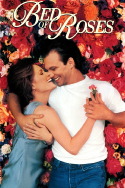
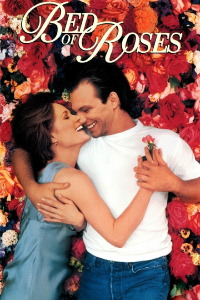
Review of Bed of Roses (1996) by Jeremy H — 06 Oct 2009
There's plenty that is "tomatoworthy" in this film, and I will start by covering the obligatory criticisms of the elements, but close by addressing the point of the film and how well it made that point.
I feel that this film has many stylistic similarities to Fried Green Tomatoes (1991) which also starred Mary Stuart Masterson. However, the producers, writers, director, composer, etc. are an entirely different set of people. By, the way, Michael Convertino's score is brilliant, and, in my opinion, the only flawless element in this film.
Other reviewers enjoyed the acting altogether, while hating all over the screenplay, or enjoyed Christian Slater, and thought Masterson was ill-cast. I too feel that Masterson was an odd choice for the role, but not disasterous. But maybe the oddness was exactly what Goldenberg was after, since, after all, this woman is supposed to have a huge "hole in her soul," and clearly was after a certain amount of on-screen awkwardness from her character. I've never been a fan of Slater one way or the other, so, despite the rave reviews of others, in my opinion, his acting was adequate but not memorable.
**begin spoiler alert**.
The screenplay clearly was in need of some additional development. The plot holds a great deal of promise, but needed some additional followthrough. Criticisms I have read and agree with point out the following: 1) that her relationship with her boss is not worked out, and the five second sequence of him finding her office empty is ambiguous, 2) that her insecurities dealing with her past are not well-developed, such as when Slater asks for her birthday, and she behaves as though she has never had to deal with such a question before, making it seem like there was no life for this character between troubled childhood and VP of a high-flying New York Investment Bank. I won't address whether or not it is realistic for a person with her flaws to achieve that position in such an aggressive and male-dominated industry. 3) Slater's character is so overkill in the "perfection" department that it strains credulity. Especially the touches about carving out time to listen to children's story hour at the local library and the veritable Garden of Eden atop the roof of his apartment. How do you get a tree to grow, not noticeably in a pot, atop the roof of a building, anyway? Is he the male version of Martha Stewart or what?
My major criticism of the film is the absurd relationship dynamic between Masterson's and Slater's characters. Obviously, this screenplay was written by a man who is very idealistic. Obviously this screenplay was NOT written by a woman. The male lead is supposed to be "perfect" but his behavior bears all the hallmarks of someone who is *amazingly* insecure. First of all he stalks her, causing a TAZER to come out of her purse at one point. Then he goes waaay overboard with everything. Cleaning New York out of every single sterling rose? "I need at least 12 dozen more! Fly them in if you have to." Doesn't that strike anyone as perhaps slightly desperate? What about the "shock and awe" set of breakfast choices he carpet-bombs her with? Plus he takes her clothes to dry cleaners without asking her. "I can get them at any time? Really? In the real world, that might not be true. And he invested in a new robe, towels, toothbrush, etc. for her, just to be amazingly safe? or amazingly needy? Is he trying to impress her, or send her screaming for the exit? Because most women in the real world would be highly suspicious of this guy, and NOT attracted to him at all. In fact they would probably be nauseated. His boundaries are just all over the place! The only reason why a person would invest so much, and on spec, no less is as an emotional bribe, trying to compensate for a perceived lack of value where it counts, with a roughly equivalent amount of value elsewhere. A woman would have written the behavioral dynamics between these characters very differently.
**end spoiler alert**.
But, as I say, all of this is little more than the obligatory criticism of the window dressing. I mean, okay, so there are a lot of glaring flaws. But why did Goldenberg want to write that screenplay anyway? And why did anyone want to invest cold, hard cash in it? What was the point of the film, and how well did it make it? Is there any reason why anyone should like a flawed cinematic effort?
Perhaps there is a reason.
I think the reason this screenplay got produced is because there is a "kernel of truth" at the center of it. Its core is about two people who are damaged. She is totally neurotic, emotionally scarred, fearful, confused, and struggling to stop sabotaging herself, hoping to find a way to let down her guard down long enough to let anything good get in. He is trying to recover from a loss that caused him to "cash out" and quit risking. And they're trying to find a way to come together. And sometimes it's not so easy.
And that part of the screenplay is actually very realistic. And that's the part that gets acted and directed the best too, because the people who made it knew that was the point of this whole exercise, so they made sure to get that part right. Because that was the original vision.
That's why, despite all it's serious flaws, all of which I acknowledge, I would still recommend this film because I can still see and appreciate that part of it.
This review of Bed of Roses (1996) was written by Jeremy H on 06 Oct 2009.
Bed of Roses has generally received positive reviews.
Was this review helpful?