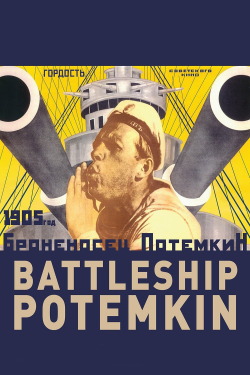
Review of Battleship Potemkin (1925) by Andrew J — 10 Feb 2008
The idea of what we know today to be a "feature film" was still in its infancy in 1925. Eighty-three years after the release of Sergei Eisenstein's "Battleship Potemkin", an amateur filmmaker today probably has access to more filmmaking tools than Eisenstein ever did.
Yet, there are scenes in "Potemkin" that are still being imitated and copied by many films today. The baby carriage sequence in "The Untouchables" is probably the most well-known example of this imitation.
With a running time of just 69 minutes, "Battleship Potemkin" remains an extraordinary and unforgettable film 83 years later. The film obviously has a political agenda, but in 1920s Russia, pretty much every artistic expression did.
Eisenstein's film transcends mere political goals because of its compelling story, and also because of its cinematic innovations especially regarding its use of montage. The sequence on the Odessa steps is justly remembered for its sheer visceral power and its depiction of brutality, but I find that most of the imitations or homages focus on the technical aspects of recreating a scene like that.
What these modern homages miss is the faces and the images of facial expressions that are so powerful in "Potemkin". For a film with no real character development (it is a silent film, after all), the story is told through facial images, and these images are the single most important thing to remember about this film.
"Battleship Potemkin" is both beautiful and terrible to watch, harrowing, brilliant, unforgettable.
This review of Battleship Potemkin (1925) was written by Andrew J on 10 Feb 2008.
Battleship Potemkin has generally received very positive reviews.
Was this review helpful?