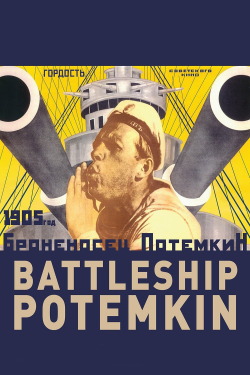
Review of Battleship Potemkin (1925) by Xac D — 13 Feb 2008
An allegory of its own subjectâ??s momentum, the techniques found â??Battleship Potempkinâ?? are a force to be reckoned with, and Eisensteinâ??s â??Odessa Stepsâ?? sequence are a perfect example of such. Incorporating almost every Eisensteinian theory of montage, this six-minute sequence has served as a reference point for cinematographers well after its filmâ??s prime. The most prominent examples of Eisensteinâ??s theories that struck me where his use of graphic, metric, and overtonal montage.
The juxtaposition of contrasting lines throughout the stair sequence was a perfect example of graphic montage, and the setting, of course, was a natural environment for such. By intentionally framing his shots of the gunmen shooting from the upper-left corner of the screen at their targets near the lower-right corner, then cutting directly to a contrasting shot of the townspeople fleeing from the upper-right to bottom-left corners of the screen, Eisenstein effectively enhanced the portrayal of the conflict between the Tsarist military regime and the prematurely celebratory townspeople.
Eisensteinâ??s use of metric montage was also prevalent throughout the scene, as the tempo of his shots became quite representative of the chaos that had suddenly ensued. By deliberately devoting a longer amount of time to the shots of the townspeople fleeing down the stairs and then quickly cutting to shorter clips of agony and death, the film created a sense of urgency that would otherwise have been somewhat melodramatic and unemotional. By shortening the length of time between each of these shots as the gunmen drew closer to the townspeople, Eisenstein was able to create a greater sense of panic in the audience.
Finally, overtonal montage was also employed in the creation of this scene in numerous examples. One of these are the stark emotional contrast between the opening of the scene as the townspeople are smiling and waving the battleship goodbye, and the immediate shock and horror that ensued upon the regimeâ??s opening of fire. Other numerous implementations of this theory are evident in the loss of innocent life - most notably the drawn out crises of the runaway infantâ??s carriage.
Through his use of multiple theories of montage, Eisenstein succeeded in a horrific depiction of the power-hungry Tsarist regime, and demonstrated their willingness to go to any length, regardless of how just or unfair, to maintain their power over the Russian people.
This review of Battleship Potemkin (1925) was written by Xac D on 13 Feb 2008.
Battleship Potemkin has generally received very positive reviews.
Was this review helpful?