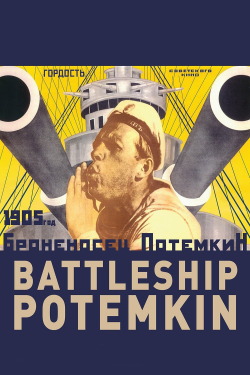
Review of Battleship Potemkin (1925) by Gabor D — 18 Apr 2009
What can I say, when a movie that was released in 1925 is still mimicked to this day, well it's gotta be in your top 3.
The effects of montage editing in Sergei Eisenstein's film "The Battleship Potemkin" directly impacts the relationship between the emotions of the viewer and the content of the film. This is expertly accomplished by filming the components of the story by juxtaposing scenes and elements in a non-linear style. Typically, Eisenstein achieves a time spatial interaction through point, counterpoint, fusion by overlaying loosely or directly related scenes to express an emotion through metaphor. In effect, the film itself becomes a larger social commentary about life, where the soldiers are the symbol of the oppressive Czarist regime and the mutinous sailors represent the oppressed population.
Perhaps the most famous scene in the film is the march of the soldiers on the Odessa steps. To capture a sense of anticipation, Eisenstein films the march in a variety of interrelated, non-linear segments. For instance, one particular scene may be reused to provide emphasis and escalation. In a literal sense, the march on the stairs could have been expressed in one or two scenes effectively, however, what Eisenstein achieves is not a literal representation but an emotional discourse that establishes impact through repetition. The mother reacting and appealing to the soldiers after her child is shot is beautifully juxtaposed against the faceless soldiers continuously and persistently marching down the stairs. Here, the montage creates a personal relationship between the viewer and the montage of emotions expressed by the woman interlaced with the continuous rhythmic impersonal, faceless montage of the soldiers. Any sense of building up an individual protagonist is discarded by Eisenstein in order to capture the essence of the whole as the part, or the part as the whole.
Creating a continuous, non-linear montage of interrelated and at some points overlapping scenes, Eisenstein is essentially manipulating how the viewer will react to what is being shown. Of course the soldiers should be able to descend the stairs in a more timely fashion, but its representation through the effects of montage reinforce a sense of fear and anticipation. Instead of being literal, Eisenstein builds the scenes according to how he wants it to be perceived emotionally; surely this is the true genius behind his work.
This review of Battleship Potemkin (1925) was written by Gabor D on 18 Apr 2009.
Battleship Potemkin has generally received very positive reviews.
Was this review helpful?