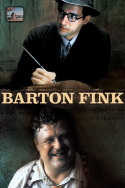
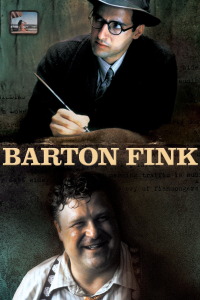
Review of Barton Fink (1991) by Mason B — 09 Apr 2010
Barton Fink, set in 1941, is about a New York playwright, played by John Turturro, who is enjoying the success of his first play, Bare Ruined Choirs. At a restaurant sometime after, he is informed by his agent that Capitol Pictures in Hollywood has offered him $1,000 per week to write a movie script. Barton is hesitant because he believes that moving to Hollywood would separate him from "the common man", his main focus as a writer. He eventually accepts the offer and moves to Hollywood where he stays at a large and unusually empty hotel where he is welcomed by the desk clerk, who along with the elevator operator seem to be the only workers in the whole place, named Chet, played by Steve Buschemi. He is taken to the sixth floor where he enters into his hotel room, a sparse room draped in subdued colors and containing one decoration, a small painting of a woman on a beach with her right arm raised to block the sun from her eyes.
Later Barton meets with the Capitol Pictures boss Jack Lipnick, played by Michael Lerner, a loud, fast talking fat man with glasses. Barton explains to him that he chose the Earle Hotel because he wants a place to stay at that, as Lipnick says, is "less Hollywood". Lipnick promises to him that the only concern he has with Fink is his writing ability and assigns him to write the script for a wrestling picture about Wallace Beery which most around think is only a "B" picture yet Lipnick insists it's not stating, "We do not make 'B' pictures here at Capitol!" They are both joined by Lipnick's loyal right-hand man and ex co-owner of the company Lou Breeze, played by Jon Polito.
Back in his room in his room he sits down typing on his black Underwood typewriter yet is unable to write. He is distracted by sounds coming from the room next door and phones the front desk to make a complaint. After receiving the call from the front desk his neighbor, a big fellow named Charlie Meadows, played by John Goodman, visits Barton to apologize and insists on sharing some alcohol from his flask to make amends. He then goes on asking what Barton does. Barton then asks what Charlie does and tells him he is an insurance man who "sells piece of mind". Charlie later asks what exactly he writes about when Barton explains that he writes about people sorta like him, an "average working stiff" or as he often calls it "the common man." And as Charlie exclaims that he could tell him some stories Barton interrupts him talking more about "the common man," putting himself more and more on his "high horse." Agreeing with what Barton is saying Charlie again tells him he could tell him some stories but Barton once again interrupts by spouting off again with more of his "pretentious" rambling. When Barton finishes his talk Charlie says goodnight and goes back to his room while Barton puts his drink down on the desk and goes back to thinking by his typewriter but suddenly hears a sound and notices the wallpaper is starting to peel. He puts the wallpaper back as good as he can while getting some of the nasty sticky stuff from the wallpaper on his fingers.
Unable to get past writing just the first lines of his script, Barton then consults producer the fast-talking Ben Geisler who believes the film is just a "B" picture, played by Tony Shalhoub, for advice. The frantic Geisler takes Barton to lunch and advises him to talk to another writer for assistance. While in the bathroom he meets a vomiting William Preston (W.P.) "Bill" Mayhew, played by John Mahoney. After briefly discussing movie writing, Mayhew arranges them to have a second meeting later on in the day at his office where Mayhew is drunk and yelling wildly. Mayhews secretary Audrey Taylor, played by Judy Davis, answers door and reschedules the meeting as Mayhew is unavailable at the moment. She confesses to Barton they are in love.
Back in his room Barton puts a couple pins Chet gave to him to pin the wallpaper back on to the wall but Barton hears the sound of a woman having sex with another man in the next room. Barton then goes back to his desk where he has crumpled pieces of paper but then is interrupted by Charlie bursting into the room. Charlie then asks about his love life and his family and both relate to being lonely with Charlie having only "me, myself and I" with family now passed on and Barton who, even though he is always surrounded by family and other people, is lonely. Barton reveals he is writing about Wallace Beery and Charlie gets excited as he exclaims "you can't beat Beery, helluv an actor!" He reveals that he was a wrestler himself long ago and is willing to give him the basics on wrestling. After showing him how to wrestle and slightly hurting Barton Charlie leaves to his room.
Later Barton, Mayhew and Audrey meet for lunch where Mayhew hands him an autographed copy of his novel "Nebuchadnezzar" and discuss writing and drinking. Barton explains to Mayhew that he believes the only way he can write is through feeling personal pain where as Mayhew just likes to "makes stuff up." Before long, Mayhew argues with Audrey, slaps her causing Barton some anger and wanders off, drunk. She rejects Barton's consolation and further explains that she feels for Mayhew since he is married to another woman who is "disturbed.".
Still with only the "Fade In" written in the script starts to write a sentence but then is interrupted by Charlie with Barton's shoes, now shined, in hand. They exchanged each others shoes as the person returning the shoes from being shined must have confused the two. Charlie tells Barton of his stressful day trying to sell insurance, going to the doctor about his ear which turns out to be infected and demanding $10 from Charlie for the visit which eventually led to an argument. Barton then goes about his trouble with not being able to get going on the script. Charlie later reveals that he is leaving in a couple of days to go to New York but will eventually return as his hotel room is his primary residence. Barton then gives the address of where his family stay, saying that New York can be tough on outsiders so he gives him the address. They both then stare a piece of the wallpaper coming right off and apparently the wallpaper in Charlie's room has been doing the same thing. It seems as if the heat is the cause for the wallpaper peeling off. Charlie then exits the room back to his as Barton returns to his desk where he sits back and stares at the ceiling.
Barton visits Geisler again at his office where Geisler wants to know the progress of the script but then he is enraged because he can't get started on it. Geisler informs him that Lipnick wants to see what Barton has written so far and Geisler covers for Barton lying to Lipnick that it's progressing and that it's great. Not know what to say to Lipnick for what the script is about Geisler makes a call to have a screenwriter show him some examples of wrestling pictures including dailies from another filmmaker. Barton then views the film of a wrestling picture.
Back in the hotel room, after walking back forth in his small room Barton decides to call Audrey and begs for her assistance on his script. Later, Audrey arrives and explains of the main things Bill would write in a wrestling picture script. She then reveals that she wrote Mayhew's last couple scripts which angers Barton because he all this time he has held him in such a high regard. She then consoles him on how she helps Mayhew and they then kiss and sleep with each other. When Barton wakes up the next morning, he finds Audrey's mutilated corpse beside him but has no memory of what happened during the night. Horrified and screaming Charlie comes knocking after being disturbed by his scream but Barton insists everything is alright. In shock, after going to his desk for a moment he goes back out into the hallway and knocks on Charlies door for some help. Charlie is repulsed by what he sees in Barton's bed and vomits about instantaneously as soon he sees the body. Charlie tells Barton to avoid contacting the police at all costs. As Barton sits on the floor of the bathroom Charlie wraps the body in the sheets and takes the body out. Having passed out, Charlie slaps him around to wake up and Charlie tells him to act as if nothing had happen and asks for time to sort it out.
Barton later goes over to Lipnick's place. He proceeds on trying to start talking about what the story is about but then tells him that he's uncomfortable to talk about his projects prematurely. Lipnick's right-hand man Lou then tells Barton that since Lipnick has been in the business for a very long time that if he would like to know the progress of his projects then he should not keep them to himself if he wants to continue being an employee. This meeting then becomes surreal as Lipnick responds with unusual support of Barton by yelling at Lou and telling him to get down on his knees and kiss Barton's feet and then tells him he is fired. Lipnick then apologizes for Lou and proceeds with kissing his feet.
Barton tries to continue writing and is then interrupted by Charlie, who announces that he is leaving to New York for several days. Charlie leaves Barton with a package to look after it until he returns. He then exits Charlie out of his room and sits on his bed where he then begins to weep. Later on, sitting at his desk he picks the Holy Bible and opens it up and reads some of the text which for some reason reference things that have happened in the film. Barton is later called down to the lobby where two police detectives are waiting to inform him that Charlie's real name is in fact Karl Mundt aka "Madman Mundt," a serial killer wanted for several murders. They explain that he shoots victims and after decapitates them and keeps their heads.
Barton later returns to his room and examines the box. He places it on his desk and soon begins writing. With the box as inspiration, he then produces the whole script in one sitting. Having finally finished the script, Barton goes out on celebration by going to a dance where he is interrupted from dancing with a dame by a sailor and soon a fight ensues. Afterward, Barton returns to his room where the two detectives are waiting reading his script and reveal that along with Audrey, Mayhew has been murdered. Feeling the heat physically building up and an elevator arriving on the floor the detectives go out into the hallway. Charlie then appears out of the elevator with the hotel now being engulfed in flames. Charlie then starts running through the hallway shooting the officers with a shotgun. Charlie then speaks to Barton about their lives and the hotel, then Charlie goes back to his room. Barton the leaves the hotel, carrying the box and his script.
In their final meeting, a disappointed and betrayed Lipnick, who has been drafted into WWII with the rank of Colonel, angrily chastises Barton for writing a "fruity movie about suffering" and calling telling him, "You ain't a writer, you're a God damned write off!" Lipnick then informs him that he is to remain in Los Angeles, and that Capitol Pictures will not produce anything he writes just so he can be ridiculed as a loser while Lipnick goes off to war.
Later, Barton wanders onto a beach, still carrying the package. He meets a beautiful woman who resembles the woman in the picture hanging on the wall at the Earle. Looking at the box, shes asks what it contains. He tells her that he knows neither what it contains nor to who it belongs to. She then turns back around and assumes the pose from the picture, and after a seagull dives into the water, the film ends.
While writing the script for the film that would end up being Miller's Crossing, the Coens were having a hard time and saw their working speed slowing down so they put that story aside and began writing something else so they can get it out of their heads for the time being. The script for Barton Fink was finished in just a few weeks and apparently just came out like burp comes out of one's mouth. The title role was directly written for John Turturro to play as well as the character Charlie who was written for John Goodman because of the "warm and friendly image that he projects for the viewer.".
The story mostly takes place inside of a huge, seemingly empty hotel that in some ways symbolize both hell and the psyche of Charlie especially with the wallpaper peeling off the walls with the paste dripping down very much like the pus that drips from Charlies infected ear time to time.
There are parts in the second half that seem to evoke the rise of fascism and the war that ensued during that time especially with the two detectives and what Charlie says to one of them before shooting him. Where Charlie tells Barton toward the end of the film that he doesn't listen can represent how some just didn't listen to some of the warnings prior to WWII and the rise of the National Socialist Party.
The picture of a woman on a beach is used as a way to console Barton in this closed off world that is his hotel room where there are two windows that look out to another building not even 50 ft. away.
There's other kinds of symbolism in the film such as how when Barton and Audrey go to bed with each other and the camera pans to the left and closes on a sink where it zooms in on the sinkhole and transitions to some pipes which, like Alfred Hitchcock's use of trains going into tunnels, suggest that they had sex. The sex scene's proximity to when Audrey is found dead also suggests that perhaps in Barton Fink, sex is death.
The film alludes to many other subjects such as: Clifford Odets, a New York playwright who in the '30s joined the Group Theatre, who the title character is loosely based on; William Faulkner, who was an inspiration for the Mayhew character; Harry Cohn, Louis B. Mayer and Jack Warner were three big producers from the time period that were the main inspirations for Lipnick; and the hotel room was partly inspired by Roman Polanski's "apartment" trilogy: Repulsion, Cul-de-Sac and The Tenant as well as Stanley Kubrick's The Shining.
John Turturro is perfectly cast as the title character who is having trouble with writer's block and starts losing some of his mental stability with the stress that his job is building. John Goodman is also fantastic as the seemingly goodhearted next room neighbor. But other than Turturro, it is one other man that is great in the film, Michael Lerner as the head of Capitol Pictures and deservedly got an Oscar nomination. Barton Fink is notable for being the first film the two filmmakers collaborated with British cinematographer Roger Deakins who would go on to film each of their films except for Burn After Reading. The Coens and the art director/set designer brilliantly make the hotel room and hotel itself as much a character itself as both Barton or Charlie and the colors of quite brownish hues looks great for such an empty place. It's also hard to get the images of the costumes used out of your head especially that of Barton himself with funny hair and round shaped glasses sticking out with typical late '30s/early'40s attire.
Barton Fink stands as one of the greatest pieces of film about film itself along with Federico Fellini's 8 1/2, Billy Wilder's Sunset Boulevard and Nicholas Ray's In a Lonely Place. With it's ambiguous ending and surrealistic second half it may be a little more difficult than other films by Coen brothers but one can at least appreciate the craftsmanship that goes into making such a film even if you can't quite understand the whole thing. It is a film that is greater than the sum of it's parts. It is in my opinion that it ranks just under Fargo and No Country For Old Men and in a tie with Miller's Crossing as their best films. A must see! 10/10.
This review of Barton Fink (1991) was written by Mason B on 09 Apr 2010.
Barton Fink has generally received very positive reviews.
Was this review helpful?