Review of Barton Fink (1991) by Cameron J — 02 Jun 2014
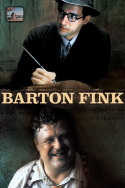
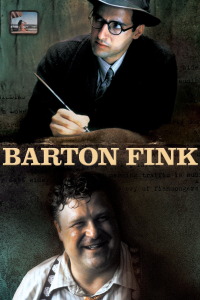
And so, Joel and Ethan Coen take on their most harrowing challenge yet: ...putting John Turturro in a lead role. I'm kidding, John Turturro is awesome, apparently as more than just a character actor, but I'm not entirely kidding when I say that we are dealing with a harrowing endeavor with this, "The Fly III: The Rise of the Mosquito"! I can't help but think a surrealist horror film of that nature when I see this film's poster, because the titular Barton Fink seems to be really freaked out by that mosquito, and looks so much like some kind of a combination between Jeff Goldbum as Seth Brundle, and Eraserhead, and... Woody Allen. I guess all New York Jew screenwriters look alike, and yes, I'm very, very well aware that Turturro is Italian, and therefore Catholic, but then again, New York Italians don't look that much different from New York Jews. Hey, he must have had the Coen brothers fooled, because Fink is by no means an Italian name, although it is pretty popular with - you guessed it - the Jews. Boy, when the Coens said that they "didn't do any research, actually, at all" for this film, they weren't kidding, yet here they are, deconstructing Broadway and Hollywood, just as they deconstructed Texas in "Blood Simple", and Arizona in "Raising Arizona"... probably because they even realize that their films are bland enough when they're not set in their hometown of Minnesota. Well, make no mistake, this film, as the Coens' first rewarding drama, by one heck of a long-shot, is a whole lot more exciting than Minnesota, to a certain extent, at least.
Something that I really appreciate about this film is its extensiveness as a character study, even in concept, and yet, I don't know if a narrative this intimate is layered enough to warrant a runtime of nearly two hours, dragged towards with overdrawn meditations on certain material and filler that all but stiffen pace, while leaving what layers there are to this drama to outstay their welcome. The film is driven by the titular Barton Fink's interactions with eccentric peers, and the more time it spends with one peer is time lost on another, thus, when focus shifts, it jars, resulting in some glaring focal inconsistencies that are almost, maybe even about as detrimental to a smooth sense of momentum as tonal inconsistencies. Now, there are more inconsistencies in focus than in tone, because it's not until more consequential conflicts come into play, a little past the hour mark, when tone takes a serious shift, but make no bones about it, when the humor chills down a bit for the sake of tension, the twist, no matter how gripping, is a touch too sharp, shaking dramatic momentum a bit, or at least reflecting an ambition for dramatic momentum. Although they had never been so inspired by this point, Joel and Ethan Coen, with this film, had not yet fully cleansed an almost awkward sense of ambition, and there are times in which they get too carried away with such ambition to get a comfortable grip on structure, which isn't to say that the generally tightly fulfilled ambition is the most relatively distancing aspect of this drama. The Coens' trademark directorial thoughtfulness, being backed by particularly intriguing subject matter, a particularly razor-sharp script, and particularly well-portrayed characters, is particularly effective, but considering the steadiness of this narrative, material lapses often, and when it does, I'm not going to lie, the film occasionally falls into dullness, and when it doesn't do that, it at least descends to a certain bland coldness which shakes the bite of the film's subjective value. Of course, it's not only the cold spells that shake substance, as it seems as though the drama tries a little too hard at times with its wit and subtle style, and when you combine these reflections of ambition with such reflections as hiccups in a movement to meet ambition with inspiration, the final product finds itself held back, but only shy of excellent. I don't know how far this somewhat minimalist film could have gone, but through the flaws of a project of only so much consequence are the strengths of an outstanding effort, the glimpses of which are plentiful enough to make a strong picture whose inspiration even touches art direction.
Exploring the high cultures of New York and Hollywood, in addition to some of the grime of the Los Angeles low culture, during 1941, this period piece has a potential for diversity to its settings that Robert C. Goldstein and Leslie McDonald go above and beyond with when it comes to fulfilling through art direction that distinguishes each set and costume with an immersive handsomeness that is augmented by the Coen brothers' first of many collaborations with the great Roger Deakins. Deakins' cinematography might not be stunning, but it is consistently sharp with its subtle lighting and coloration, with a visual style that is made all the more immersive by impeccable framing and sweeping camerawork, and defines the final product as, if nothing else, stylistically upstanding, which isn't to say that style solely defines the drama. While the story concept doesn't match the sharpness of its interpretation enough to craft an altogether excellent effort, this film's subject matter is not simply intriguing, but genuinely original, in its approach to intriguing themes on the artistic distinctions between stage and film, and the social and intellectual distinctions and pain between big-shots and simple men, while studying on the personal conflicts of a man in strange land that grow heavier and heavier as the land grows stranger and stranger, thus making for an interesting film idea that is done justice by plenty, but only truly brought to life by the Coen brothers' writers. As with any of the Coens' best films, this effort thrives on its being so incredibly well-written, and even if the interpretation of the script is not of equal quality, there's no seeing this film as good as it is without the biting satire that is distinctly colorful, yet not too over-the-top, thanks to a cleverness that is anchored by sparklingly snappy dialogue that needs to be heard in order to be believed, and helps in tightly defining colorful characters who are still best-defined by their portrayals. One might expect a drama this minimal to seriously limit acting material, but most everyone has his or her time to shine, whether it be the delightfully over-the-top Michael Lerner and John Mahoney as flawed Hollywood sensations, or the effective Judy Davis as a woman in love with a troubled artist, or the show-stealing John Goodman, whose chillingly intense dramatic twists break which reflect a certain instability to the Charlie Meadows character punctuate Goodman's classic charm at its most dynamite, especially when applied to equally dynamite chemistry with leading man John Turturro, who is the real treat of this picture, with a subdued charisma that makes the titular Barton Fink character effective as an avatar audience who is distinguished by his own right by remarkable layering that never lose passion, but gradually mold Fink as a man of vision and fear, both for his art and his life. As much as everyone justly praises Goodman, Turturro is a revelation, and if you see the film for no other reason, see it for him, but stay for the Coens' performance as directors, who admittedly make sticking around a bit of a challenge with their pacing issues, overstylization and overambition, but whose more subtle stylistic touches go a long way in coloring up the film, and whose more thoughtful touches are often given enough to work with to bite, whether it be with dramatic intrigue or tension that compel, often thoroughly. In a lot of ways, the film is so good, even excellent, and it's frustrating that natural and consequential shortcomings are recurring enough to hold the final product back from excellence, yet inspiration is never lost, entertaining and intriguing enough to make a strong drama.
When the job is done, some questionable structuring that drags and finds inconsistencies in focus and tone, joined by some dull, or at least coldly distancing dry spells in direction, betray a potential for excellence, but just barely, for there is enough inspiration to immersive art direction which captures the era impeccably, handsome cinematography which captures style dynamically, and original and intriguing subject matter which is brought to life by sparklingly clever writing, great acting - especially by show-stealer John Goodman and revelatory leading man John Turturro - and effective direction to make "Barton Fink" a generally biting satire, intriguing drama and overall engrossing first triumph for Joel and Ethan Coen.
3.25/5 - Strong.
This review of Barton Fink (1991) was written by Cameron J on 02 Jun 2014.
Barton Fink has generally received very positive reviews.
Was this review helpful?