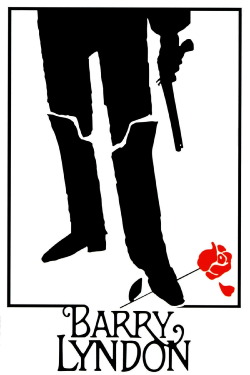
Review of Barry Lyndon (1975) by Brett C — 25 Dec 2014
Review In A Nutshell:
With every master filmmaker, there will be films that would instantly grab you, a perfect specimen that would define one's perspective of the filmmaker and cinema in general, and there are films that are great but slightly pale when compared to the favourites. I may be one of the rare few who find Barry Lyndon to be a slightly lesser product than Kubrick's other works, but I am also not blind to the rationales of those who see this film as pure perfection.
Barry Lyndon utilises the rise and fall storytelling that Kubrick has achieved wonderfully in films like Spartacus, Lolita, and A Clockwork Orange. In this style of storytelling it is most important for a film to contain a protagonist worthy of great attention; and Barry Lyndon, initially titled as Redmond Barry, is no exception. Kubrick has a fascination for individuals who are likeable but at the same time flawed, the only time his film has swerved from the norm is his conveyance of Spartacus, but even then he had very limited control and forced to tell its story and protagonist only through a positive light, becoming more symbolic than realistic. Barry Lyndon's story begins with the character full of innocence and hope, but at the same time also flawed, viewed as a child who is selfish and showing very little empathy for others aside for his mother. It is through this balance that the character rarely ever feels frustrating to follow, and prevents the problems that he carries to be over-dramatic. The situations he goes through during the first half of the film were sympathetic and interesting to watch, with each one allowing us to become closer to the character. It is also during this half of the film where most of the film's comedic tone lurks, but executed so in a manner that still retains the film's seriousness.
The second half of the film depicts Barry Lyndon's fall from his position of higher society, it details the many tragedies that he had to endure and act as a contrast of his once humble and innocent beginnings. It was during this aspect of the film that I started to find myself less and less interested in following his journey, it seemed to concern more the members that have been affected by his change rather than Barry Lyndon himself; he is the reason why I wanted to embark on this journey in the first place, and Kubrick's decision to distant the audience and view him from the perspective of the sympathised made me become aware of non-story related aspects of the film that I disliked, an example would be the film's slower pacing becoming much emphasised during this act of the film. Though emotionally distant from the character, there were a couple of moments that caught my attention, prime examples would be the final duel or the death that occurs within the Lyndon family; I wish they were abundant enough to keep the whole hour and a half fascinating.
Barry Lyndon can be seen as a film that depicts the destructive nature of reality, breaking the innocence of youth and having to rely on deceitfulness in order to succeed. It was his virtuous actions early in the film that made him such a wonderful individual, but through those actions has further placed him in deeper to a situation he never wanted to be in the first place. It was only during the growing relationship of him and a professional gambler, eventually also his mentor, that he was able to escape. His mentor's influence on him begins to grow, executed subtly, introducing Lyndon to the life of the higher society, enticing him in wanting to climb the social ladder. He inserts himself to royalty with a cunning mindset and through opportunistic methods. From there, we start to see the titular figure fall, becoming consumed by the world that he desperately wanted to belong to, becoming entirely opposite of what he once was; a believer of true love and high morals. It was definitely interesting, but if only the process in the latter stages wasn't so tedious at times.
Kubrick's masterful strokes do not only lie in his characters but also in the settings and environment that surrounds them. Take a look at all of his films after Dr. Strangelove; they all convey their worlds with such distinctive beauty that it could easily become a character of its own, a subject on which one could dissect and find meaning of. Barry Lyndon achieves so greatly because of its distinctive beauty, recreating a previous world that we have once settled and admired. Kubrick maintains a sense of authenticity through the use of particular locations that geographically and visually connect with the film's story, shooting interiors with the use of candle lights and natural light passing through the windows, using only electrical methods of lighting as minimally as possible and only done so to capture that naturalism that Kubrick desired. What Kubrick ended up creating is a gracefully moving painting, capturing the glowing softness and beauty that many would recall of that time, mimicking the gorgeous paintings and art that capture the particular period. It is not only in the photography and lighting that captures this overall feeling, as elements from set design, costumes and props coming together to immerse its viewers of a long forgotten period.
Barry Lyndon's grounded tone primarily comes from Kubrick's classical musical choices, intended to accurately capture the film's setting. Paired with other elements of the film's production, it immerses us into its world and story. The film's acting performances can at times come off as cartoonish, especially during the first hour of the film, but this was intended by Kubrick, to keep the film from coming off as too overbearing from its heavy drama, therefore the presence of the classical tracks kept the film from being too satirical.
Barry Lyndon is a wonderful film that is only held back due to story and pacing elements during the second half of the film. It achieves brilliantly in capturing a particular time and place, immersing the audience in the process; Barry Lyndon may not seem much of a technological or visual achievement as his other films, The Shining, A Clockwork Orange, and 2001: A Space Odyssey are notable examples, but it is no doubt innovative through brilliant methods of illumination and pairing them with slow but mesmerising zooms. It seems with every viewing, the film's visual beauty becomes more and more stunning, leaving a mark on my mind that stands along with the most beautiful films in all of cinema.
This review of Barry Lyndon (1975) was written by Brett C on 25 Dec 2014.
Barry Lyndon has generally received very positive reviews.
Was this review helpful?