Review of Bad Times at the El Royale (2018) by Bertaut1 — 21 Oct 2018
Derivative, predictable, and dull.
Following the genre-bending and extremely funny The Cabin in the Woods (2011), Bad Times at the El Royale is the second feature from writer/director Drew Goddard, and is a similarly stylised cine-literate genre mash-up. However, whereas in Cabin, the twist upon twist upon twist had a cumulative effect, with the story getting better the longer it went on, in Bad Times it's a case of ever diminishing returns. By the time we reach the end of the lengthy 141-minute runtime, with everything and everyone shoehorned into neatly explained niches, the film has been shorn of its vitality, leaving one with an overriding impression of "meh". If Cabin was a genuinely new spin on a clichéd old story, playing with and subverting genre at every turn, Bad Times is singularly unable to free itself from the most oppressively derivative of its generic constraints.
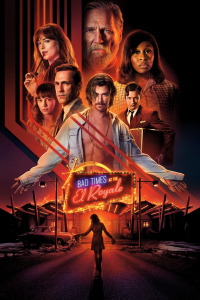
Set in 1969, the film takes place almost entirely in the titular El Royale Hotel (obviously inspired by the Cal Neva Lodge & Casino). Over the course of one night, seven people will encounter one another but not all seven will leave. There's Fr. Daniel Flynn (Jeff Bridges), a Catholic priest; Darlene Sweet (Cynthia Erivo), a singer travelling to a job she doesn't want; Emily (Dakota Johnson), an intensely private woman; Laramie Seymour Sullivan (Jon Hamm), a vacuum cleaner salesman; Rose (Cailee Spaeny), who appears to be Emily's kidnap victim; Billy Lee (Chris Hemsworth), a cult leader; and Miles Miller (Lewis Pullman), the motel's receptionist/bellhop. As the night wears on, it becomes apparent that not only are few of these people who they claim to be, but the motel itself is hiding its own dark secrets.
If that set-up reminds you a little of Identity (2003), you're not completely off course. Bad Times shares very similar DNA, at least up to the point where Identity goes totally nuts; both are set in an out-of-the-way motel where a group of strangers are trapped overnight, and all, or some of them aren't who they appear, with the audience slowly filled in on their backstories via flashbacks. However, whereas Identity failed because the last half-hour is patently ridiculous, Bad Times has the exact opposite problem - the conclusion is decidedly underwhelming, with the last twenty minutes or so lapsing into utter mundanity, and, most unforgivably for a mystery film, twists for twist's sake.
To start on a positive note though, it looks terrific - Seamus McGarvey's cinematography is faultless, whilst Martin Whist's production design is superb, with the ultra-tacky period detail dripping off the screen. Directorally, Goddard also has his moments with some eye-catching compositions, locked-off cameras, POV shots, and lengthy single-take Steadicam sequences, with the long single-shot opening scene, in particular, a masterclass in slow-burning tension. The problem is that the scene is so good, it spoils the audience, establishing a tone to which the rest of the film mostly fails to live up.
In direct contrast to the opening, the ending is both narratively and directorally formulaic, predicable, and trite, with the least compelling and well fleshed out character taking centre stage, mano-a-mano good guy/bad guy dialogue aplenty, and even a ludicrous shoot-out. The whole thing smacks of "been there, seen that a million times." Another problem is that the characters all feel like archetypes ripped from other films, with none giving the impression of having any degree of interiority. They are, in essence, walking plot-points.
A final problem which must be discussed is length. Padded, and massively self-indulgent, there is enough narrative content to barely fill 90 minutes. With this runtime and so little content, needless to say, the bottom falls out entirely during the middle section, as things become unrelentingly slow and contrived. Goddard seems to equate curiosity about who the characters are with suspense, meaning things take a decided turn for the mundane long before the underwhelming dénouement. And when he finally does get around to wrapping things up, the last few twists are nowhere near enough of a reward, with the mysteries more interesting than the explanations.
The film flirts with a few themes (redemption, forgiveness, karma, political corruption, the seductive nature of power), but none get off the starting grid, and ultimately, Bad Times isn't really about anything. Attempting to both subvert and celebrate generic conventions, Goddard seems to think he has a bonafide epic on his hands, a portent piece of celluloid mastery which imparts valuable lessons in the process. He doesn't. It's more self-indulgent folly than paean of universal truth.
This review of Bad Times at the El Royale (2018) was written by Bertaut1 on 21 Oct 2018.
Bad Times at the El Royale has generally received positive reviews.
Was this review helpful?