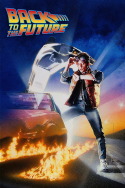
Review of Back to the Future (1985) by Cinemasins — 08 May 2015
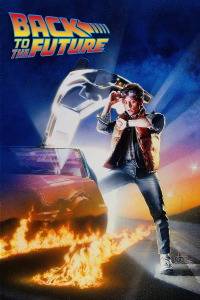
Had Back to the Future come to life as originally envisioned by the purse string-holders at Universal Pictures (which owned the rights to Bob Gale's screenplay), it might have been a very different project, with Eric Stoltz in the lead role. Stoltz, however, bowed out early during filming due to that ever-popular reason: "creative differences," opening the door for Michael J. Fox (or, as nearly everyone knew him at the time, Alex P. Keaton). Would Back to the Future have become a modern classic with a different lead actor? That's as much of an unknown as what Casablanca would have been like with Ronald Reagan asking Sam to play "As Time Goes By." What is known, however, is that the version of Back to the Future produced by Robert Zemeckis remains one of the mid-'80s most enduring and enjoyable confections: an infectious mix of comedy, fantasy, satire, excitement, and nostalgia.
Back to the Future is played neither entirely seriously nor entirely for laughs, and therein lies the nature of its success. It's funny and breezy but doesn't descend to a level where the characters are little more than props for jokes. We believe in Marty, like him, and root for him to succeed. Part of the reason for that is Michael J. Fox, whose unforced screen charisma had already made him a huge television success. (He was the #1 reason Family Ties was a Sunday night staple.) Fox brought a lion's share of that "aw shucks" affability to Marty, and Back to the Future launched Fox's big-screen career. In order to appear in Back to the Future (once he had agreed to replace Stoltz), Fox had to go virtually without sleep. During the day on weekdays, he would film Family Ties episodes. At nights and on weekends, he made Back to the Future.
Like Crocodile Dundee one year later, Back to the Future is at its heart a "fish out of water" story, about an '80s boy being trapped in a 1950s small town. His mother is smitten with him, the local bully doesn't like him, his dad is a wimp, and he doesn't fully understand the customs and lingo of the period in which he has become stranded. Plus, there are the twin difficulties of repairing a state-of-the-art 1980s time machine using 1950s technology and patching the damage his presence has caused to the time continuum. Zemeckis plays much of this with a light touch, but when there are opportunities for some excitement (as when Marty has a deadline to get to the "finish line" or risk not getting to 1986 until he's middle-aged), he milks it for all it's worth. Back to the Future leaves viewers a little breathless, but not drained - exhilarated and smiling.
Nostalgia plays a role in Back to the Future's success. For kids in the '80s, it suggested the '50s of Leave it to Beaver and other black-and-white sit-coms that were in UHF re-runs around the time Back to the Future opened. For 40-somethings, the movie provided a glimpse of their past through rose-colored glasses (always the best way to remember high school). When the film is watched today, some 25 years after its release, the nostalgia is double-barreled. Now, the '80s scenes are as evocative as the '50s material.
F there's a problem with Back to the Future, it's the film's ending, which left open the expectation that there would be more chapters to come. In fact, the movie was originally designed as a one-off project, with the final scene being a quirky way to wrap up things rather than a teaser for another installment. However, when Back to the Future topped the 1985 box office and public sentiment was high in wanting to know what the problem was with Marty and Jennifer's kids, Zemeckis went to work on Back to the Future Part II and III, which were filmed back-to-back and took four years to reach the screen.
The '80s were a dark and cynical decade, remembered by most for excesses of consumption and greed. Back to the Future is unapologetically lighthearted and upbeat - a tonic for a weary movie-going society. Even its theme song (Huey Lewis' "The Power of Love") brought a smile to the face on its way up the charts to the #1 position. For Zemeckis, this represented an opportunity to join his buddy Steven Spielberg on the A-list - his next film would be Who Framed Roger Rabbit?, and Forrest Gump was less than a decade away. Like Spielberg, Zemeckis has a keen understanding of how to blend diverse elements of comedy, action, adventure, and drama into concoctions that win over audiences.
It's the kind of alchemy that, on those rare occasions when it materializes, cannot be replicated - as the filmmakers discovered when they re-assembled for Back to the Future Part II. The magic lasted for one film, and that's the one to re-visit.
This review of Back to the Future (1985) was written by Cinemasins on 08 May 2015.
Back to the Future has generally received very positive reviews.
Was this review helpful?