Review of Baby Driver (2017) by Matt M — 25 Aug 2017
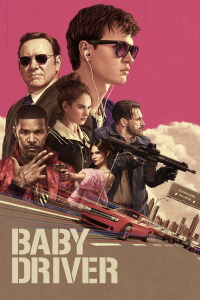
"Baby Driver" is a masterful tour de force driving genuine originality and blistering narrative.
In a film period where edginess is often lacking and the few ones that come to light are squandered by unreasonably bombastic pieces of cinema entertainment, filmmaker Edgar Wright breaks into this parched audiovisual panorama with a film oasis that is reaching, at full speed, the summit just after the first two minutes.
Can you imagine an uninterrupted hissing rale in the ear 24 hours a day, eight days a week, hoarse, insufferable? These perceptual phenomena are known as under the name of tinnitus, an irrevocable symptom caused by hearing impairments. 90% of the world's population has experienced or will experience the annoying buzzing at least once in their lifetime, however, no one will eradicate them with both atticism and rebellion as Baby (Ansel Elgort), a crime apprentice. Finding in the art of the Muses, of mature preference, a spiritual escape from the stressful chant dragging him into a horrific childhood spoiled by the veil of death; this young man is immersed in the dirty business of Doc (Kevin Spacey), a devilish kleptomaniac and crime boss, devoid of scruples, who has adopted him as a good luck charm in every one of his exhaustive robberies, giving him the chance to remedy certain monetary inconveniences through a labor pact as a form of payment, however, fate won't allow Baby to turn on the stationary lights of his life, demanding him to accelerate to the peak of madness by overtaking, sensibly, a combination of mild sounds and violent silences.
Written and directed by the same subject, this English moonlighter overwhelms with his most recent and first incursion into the action thriller field, after having assembled a subliminal comic trilogy with the help of the acting duo composed by Simon Pegg and Nick Frost. Concurring by the highest standards of today's entertainment cinema, the film makes maximum use of its tools proposing a quality product that is supported by pillars that allows it to spurns restrictions and embraces ambitions.
As a heist cinema veneration, Jon Spencer Blues Explosion welcomes, with a fiery punk blues, the circumstantial maelstrom experienced by the main role, placing the spectator in the middle of the core since the opening, putting us alternatively inside and outside a lavish red car, which symbolizes the fierce, intriguing and frantic path the main character must drive. Undoubtedly, the film encompasses and handles, with an impressive care, a set of juicy components that enable it to do and be tremendous deed: a frenetic and spellbinder stylistic journey (of no return) to a severe personal maturation, an awakening greatly empowered by music, rather by good music. Steven Price, Academy Award winner for his hair-raising compositions for Alfonso Cuarón's "Gravity" film, orchestrates and gears, alongside the large sound department, both the created scores and the ultra- popular songs (which monopolize more than 80% of the footage) with the most accurate expertise throughout the story, they're the tires of the film, they take the plot hand-in-hand, a homologous thing to Gunn's work with "Guardians of the Galaxy", only in an atmosphere a little more worldly. Tossing around icons such as James Brown, Boga, Ennio Morricone or T-REX, the explosive, nostalgic and functional soundtrack effectively slides among more than forty hits from the last centuries that make the wonders of any inveterate musical nerd and assistant who gets involved in the events, an illustrious repertoire pressing the trigger in order to activate the film.
The visual section is simply masterful, glorifying frames that synthesize the most beautiful attributes of the scene. Bill Pope's camera emanates magic from the opening sequence; unsuspected angles, smart focus and avant-garde photographic games lead the preconception of the typical and theatrical American crime to another level, one that is hard to reach. Justin O'Neal Miller, Marcus Rowland and Nigel Churcher decorate settings with (on the surface) a limited view of artistic potential: a conservative cafe, a grayish control center, an urban parking plot or depressing banking entities. Leaning on nuances, colors, contrasts and bright visual tricks that, together with Pope's cinematography and Courtney Hoffman's costume design work, conceive a high-octane motion picture in general and specific terms. To finish the flattery, the soul of the footage could not miss, magnified by the task of Jonathan Amos and Paul Machliss in the editing room, a fundamental work for the technical and creative results, which must be considered as one of the best incursions within the genre so far this century. Each of the features, mentioned above, are dependent, thus they work such as an intricate Swiss timepiece, an Edgar Wright watch.
Actors and storytelling merge into one. Without the excellence of one, there is no excellence of the other. Teaming up with a cast of real talent, the plot doesn't miss the focus and presents what it desires; Here the action scenes don't have mere ends of entertainment, here these are chess chips that jointly address the future of Baby, the leading role. The way in which it brings together the circumstances can be counterproductive, since assembling an interactive puzzle that doesn't demand a high degree of attention by the audience, because of some permissions are taken to sort out some key mysteries in the movie, one of the near non- existent drawbacks. "The Fast & the Furious" carries the banner for the car film universe, the high demand action films are led by DC Comics and Marvel Studios titans, thriller genre feeds on periodic indie strangeness and comedies are governed by laughable ideas of major studios, so how does "Baby Driver" get to encompass and execute perfectly each of these genres without falling into the classic homage or the shameful copy? Well, the answer is in the successful narrative management. It's practically impossible that a current film doesn't present reminiscences to previous ones, and even this one cannot be saved, however, the way to intersperse surprises, sadness, and twists is sharp and sudden, distributing them naturally thanks to the excellent sketch of the narrative script, an authentic fear of the 21st century. Beauty, masculinity, panache, and energy possesses the acting team that has as head the DJ and actor Ansel Elgort. The performances are unbeatable, something that was predictable in advance by having a first-grade diverse cast, they all have a chance to catch and reach at least a few seconds of glory, however, the main actor, Hamm, James and Spacey are those who freeze the screen with their amazing interpretations, which drive this crazy carriage, which take the greatest praises.
"Thank you very much, ladies and gentlemen, right now I got to tell you about the fabulous, most groovy" action, crime and thriller motion picture of the year. Wright leads on firmly with one of the most original, potential and coolest proposals within the thriller/crime so far this century. With a remarkable third act, the margins of error are iotas in respect of the sublime work, a contemporary movie with nostalgic and old references by a Hollywood that is claimed step by step; A must-see that needs to be experienced by any cinema fan thirsty for speed, comedy, drama and many, many great twists. Complexly striking, perhaps the best crime is the one made by Edgar Wright, a master of huge magnitudes.
This review of Baby Driver (2017) was written by Matt M on 25 Aug 2017.
Baby Driver has generally received very positive reviews.
Was this review helpful?