Review of Away from Her (2007) by Tero H — 03 Mar 2010
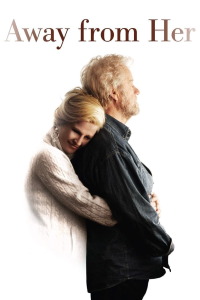
"AWAY FROM HER" 2006)..... A- ... This film is a stunning and heartbreaking portrayal of the effect that Alzheimer's Disease can have on family relationships. It is a gift to us from our northern neighbor, Ontario, Canada, where the bleak but beautiful winter landscapes provide a rich but colorless backdrop to the study of a beautiful older woman as her own mental landscape turns similarly bleak and wintry. Everything in this movie is mood, and it is one of great sorrow and loss.
The story has been adapted from "The Bear Came Over the Mountain," by Alice Munro, but it is not for those who expect a light night out at the movies. Almost every scene in this film has been chosen with great care and then beautifully edited to add to the texture of the story. Director and screenwriter Sarah Polley evidences amazing depth and perception in this movie, which marks her stunning directorial debut.
The high-powered acting talent present in this film is phenomenal. More about Julie Christie shortly, but Gordon Pinsent more than holds his own as her husband, while the always interesting Olympia Dukakis offers her own special complexity to the role of a wife who shares his pain with the loss of the company of her own beloved spouse.
My complaints about this movie are few, but they are substantial. There is a feel good scene added to the end of the film that is not only not necessary, but it is at cross purposes with the structure of the story. Furthermore, my above compliments about this film's editing notwithstanding, the editing at the very end of the movie looks as though it were patched together in a rush job, since critical threads of the story were left either unresolved or unexplained.
A shower of critical praise has rained down on this film for all of the above reasons, but also for the return to the screen of Julie Christie in this full-fledged and very demanding starring role. She is just overwhelming in her portrayal of Fiona, a still lively woman, as she sinks into the abyss of her mind.
Christie has remained an iconic actress for many of us. She has symbolized, perhaps more than any other, the ethereal actress of the Sixties. Approachable, earthy and certainly very sexy, yet there was always something deep in the core of her being that remained untouched by the world around her. A woman who represented the here and now, but also an otherworldly vision of feminine beauty.
Christie has appeared in a few small roles in recent blockbuster films such as "Troy" and "Harry Potter and the Prisoner of Azkaban," but her heyday was back in the Sixties and the early Seventies when she shone forth on the cinema screen like a goddess. I do not believe that there is another actress of that era, or any era since then, who has appeared in as many landmark films as she has. She is truly a remarkable woman and an actress of legendary proportions.
She appeared in five or six films in a few short years, and most of them have became seminal works of that era. In 1965 she quickly followed a breakout role in "Darling" with her stunning and unforgettable portrayal of Lara in "Dr. Zhivago," the classic David Lean film of the same year. The popularity of the music, "Lara's Theme," only added to her allure and mystique.
Her string of home run hits continued with "Fahrenheit 451" in 1966, "Far From the Madding Crowd" in 1967 and "Petula" in 1968. Actresses today should only be so good, but she gave us more. Her role in the lushly filmed, "The Go-Between," followed in 1970.
Thereafter the pace of her career, at least in American films, slowed down somewhat until she costarred with Warren Beatty, then a breakout star, in three very fine movies, the first a western, "McCabe and Mrs. Miller" in 1971, and then two comedies, the risqué "Shampoo" in 1975 and the bittersweet "Heaven Can Wait" in 1978.
In this film Christie plays Fiona, a wife who is living in quiet retirement on a lake in Ontario with Grant (Gordon Pinsent), her husband of 44 years. She had been former flower child of the Sixties who decided on a lark to propose to Grant, who was her college professor at the time. He accepted because he was so captivated by her that he could never imagine living "away from her.".
Their marriage has not been without its sorrows. For the first twenty years of their marriage, Grant was an inveterate womanizer who kept having affairs with the female students in his classes. He always loved Fiona, but this was just the way he was. Finally, the worst of all imaginable situations occurred when a young girl with whom he was involved committed suicide. Always the free spirit, Fiona gave Grant credit for never wanting to leave her, so she has remained by his side.
To protect himself and what was left of their marriage, he resigned from his professorship and retired to a lakeside lodge that he had inherited from his grandparents. Here he and Fiona have lived for the last two decades in natural splendor and quiet solitude. Since those tumultuous early years, Grant has become deeply devoted and even emotionally dependent upon his wife. Now more than ever before, he cannot imagine living "away from her.".
Their quiet happiness and their contentment with their present life spent together suddenly turns into a challenging vortex of emotions as Grant begins to notice lapses of mental acuity in Fiona. He puts his concerns aside until Fiona wanders off on two occasions and forgets where she is, how she got there, or even who she is.
In her alternating moments of lucidity, Fiona pushes for her confinement much more than Grant, who is deeply fearful of losing her. They finally agree that this is the only course of action, but then the deeply buried icebergs in the back of Fiona's mind come to the surface with flashes of anger at his many infidelities. With her recognition of her deteriorating mental state, she worries if they will ever be able to discuss what happened when that poor girl committed suicide.
Grant's fears of the loss of Fiona's company and their continuing conjugal pleasures prove to be all too true when he is informed during the admittance process to a long term care facility that he will have to leave her alone for the next 30 days so that she can adjust to her new life.
The rather frosty and distant Dr. Fischer (Alberta Watson) provides her professionalism but little emotional support during this process. That is left to Madeleine (Wendy Crewson), the head nurse on duty, who becomes Grant's inside confidante.
The 30 days finally slowly trickle by and then Grant rushes back to the facility. He is horrified by what he finds. Fiona hardly recognizes him, and, worse yet, she has already formed a deep attachment with Aubrey (Michael Murphy), a fellow patient. Grant is shocked to observe his wife smothering Aubrey with maternal attention and perhaps even more deeply expressed emotions. He has been replaced by this interloper, and now the husband has become the other man and an unwelcome intruder. The suspicious thought tortures him that this may be her pay back for his many infidelities.
Aubrey's wife, Marian (Olympia Dukakis), is equally disturbed by this turn of events. After great initial distrust on her side, the two lonely spouses join together for mutual support. 110 minutes and unrated.
This review of Away from Her (2007) was written by Tero H on 03 Mar 2010.
Away from Her has generally received very positive reviews.
Was this review helpful?